
Rudraksha mala in gold plated caps
गोल्ड प्लेटेड कैप वाली रुद्राक्ष माला
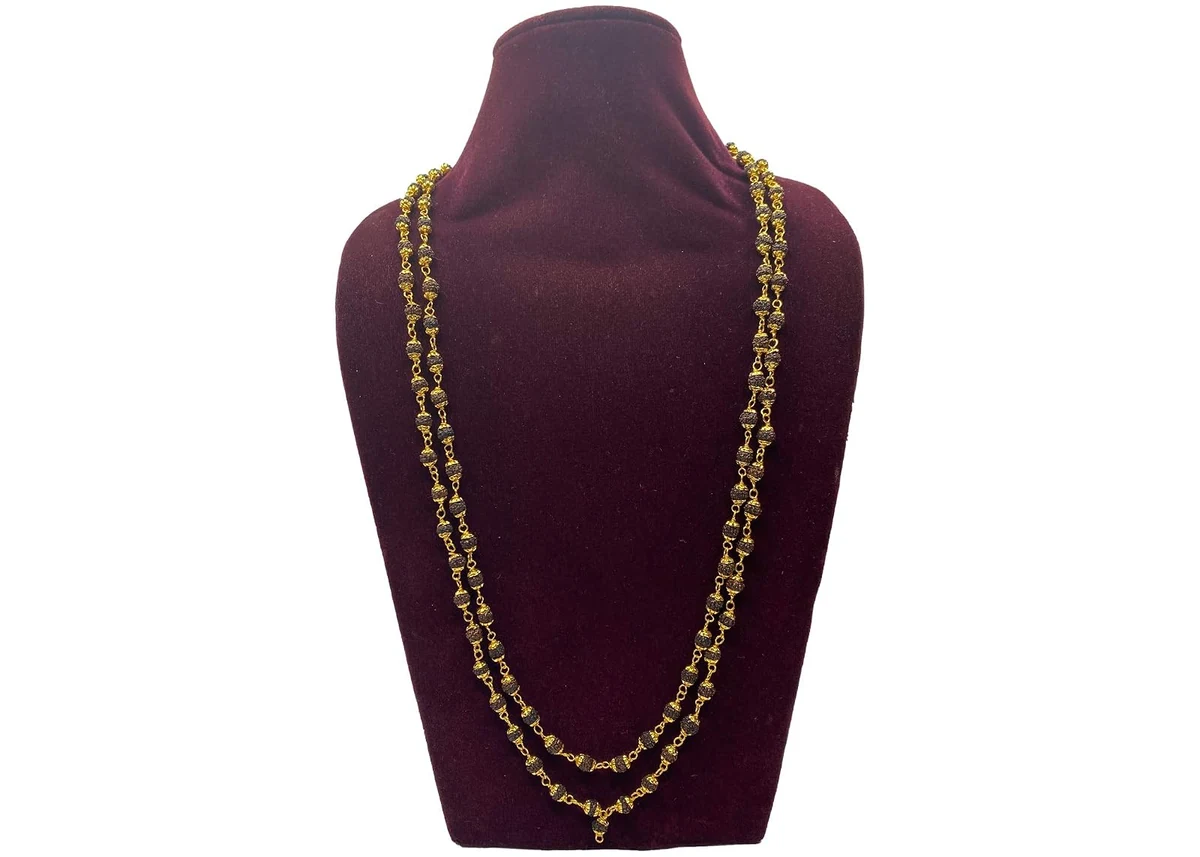
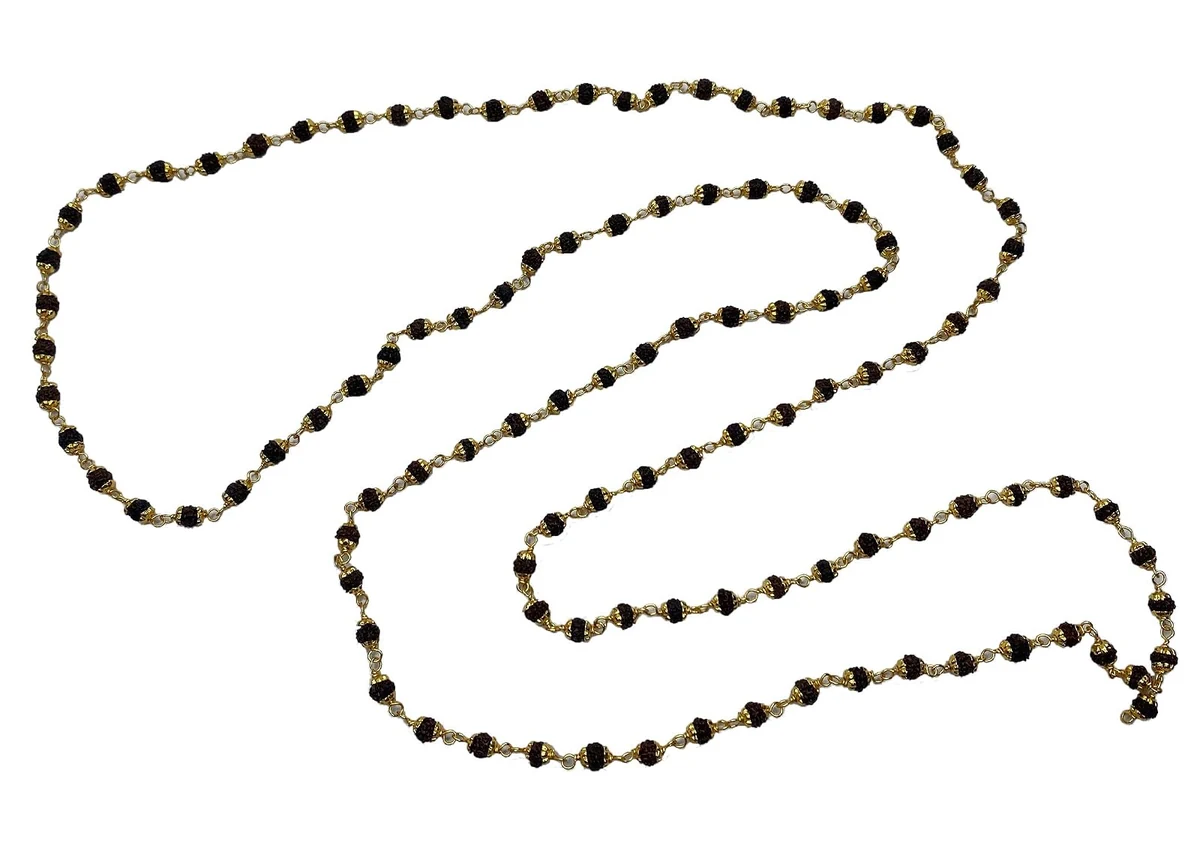
Every bead on this strand sits inside a gold plated cap and links to the next one, so it hangs as a chain rather than on thread. The beads themselves are small, 4 to 7 mm, and the whole thing weighs under about thirty grams.
- Bead size
- 4 to 7 mm
- Beads
- 108 plus sumeru
- Setting
- Gold plated caps, linked
- Weight
- About 23 to 32 g
About this rudraksha mala
Capping is a piece of jewellery work rather than a devotional one. Each bead is held between two small metal cups, the cups are joined by a link to the next pair, and the finished strand hangs as a chain with no thread running through it at all. Traditionally this was done in silver or gold by families who wanted a mala to survive being worn daily for a generation. What is sold now at this price is base metal with a thin gold coloured plating over it, which looks the same on the day it arrives and does not behave the same over years.
The practical case for capping is real. A thread is the part of any mala that fails, and capped beads have no thread to fail: links wear far more slowly, a broken link loses one bead instead of scattering a hundred, and the metal takes the friction at the drill hole instead of the seed taking it. For a mala that is worn all day rather than kept for counting, that is a genuine advantage.
The practical case against is the plating. Gold plating over brass is measured in microns, and the places it goes first are the places that rub: the outside of each cap, the links, and wherever the strand sits against a collar. Expect it to dull within months of daily wear and to show base metal at the high points within a year or two. That is not a defect, it is what plating does, and anyone buying this should buy it knowing that rather than being disappointed later.
The beads inside the caps are small, four to seven millimetres, and the whole mala comes in at around twenty five to thirty grams. Capped, they sit further apart than bare beads on thread, so the strand is longer than a bare mala of the same bead count and hangs lower. It counts adequately but not beautifully; the metal makes each step click rather than slide, and people who count fast generally prefer bare beads on cotton.
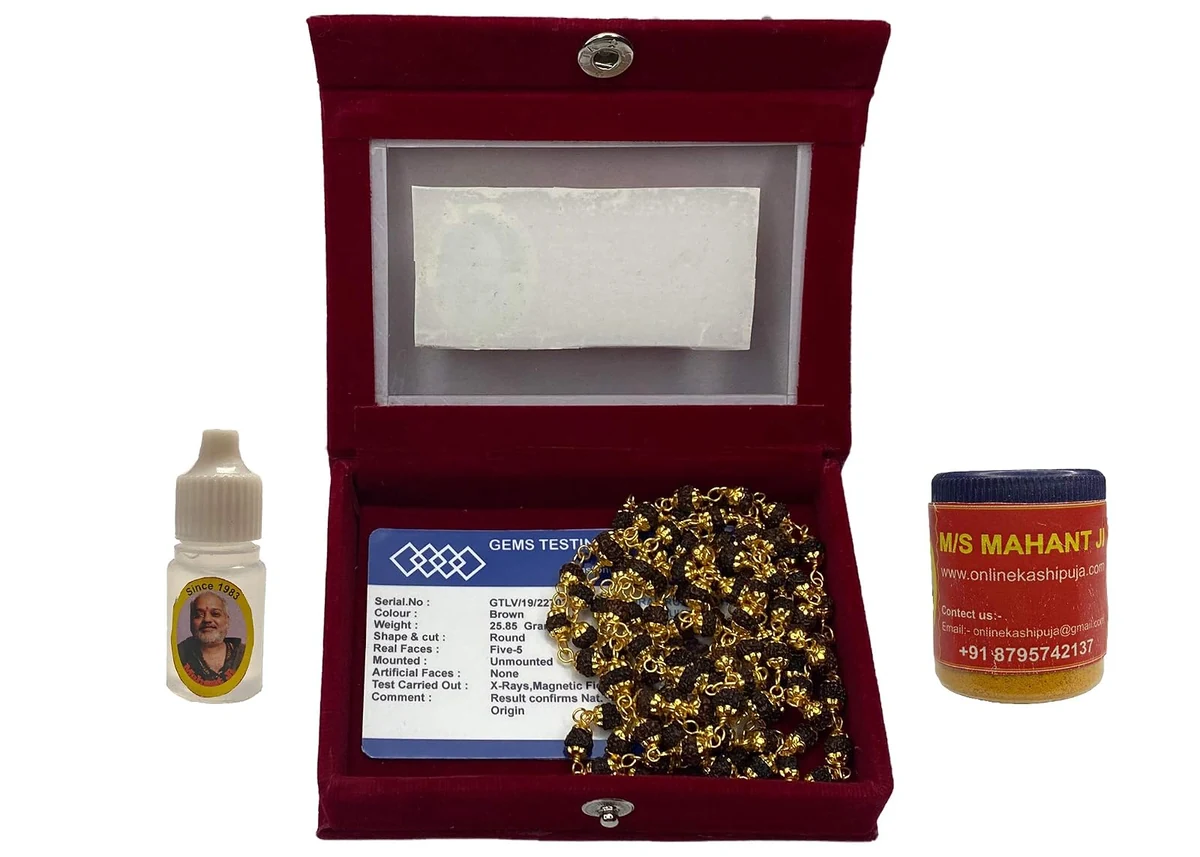
The listing includes gangajal and chandan from Kashi for an initial cleansing before use. Whether you use them is entirely your own business. What is worth knowing is that no ritual is required to make a counting mala usable, and no absence of one makes it unusable, whatever a seller packs in the box.
So it is worth separating two things that this listing runs together. A capped mala is a well engineered object: no thread to fail, less friction at the drill hole, a strand that survives daily wear for years. That is a real and defensible reason to spend more. The gangajal, the chandan and the language about initial cleansing are something else, and nothing about a counting mala’s usefulness depends on them. Buy the engineering if you want it. Treat the ceremony as optional, because in this tradition it genuinely is.
What to look for before buying
Ask what is under the plating. Gold plated means a coating over another metal, usually brass or an alloy. That is fine and it is what the price reflects, but it decides how the mala ages and whether it will mark skin. If you have reacted to costume jewellery before, a plated strand worn against the neck all day is likely to do the same thing once the coating wears through at the links.
Look at how the caps grip. A well made cap holds the bead firmly at both ends with no play. Pick the strand up and look for beads that rattle or spin inside their cups: that gap will grow, and a bead that spins eventually saws its own drill hole wider until it drops out. Loose caps on a new mala are the single clearest sign of rushed assembly.
Count the beads and find the sumeru. A counting mala needs 108 beads plus the sumeru at the join. Capped strands are sometimes assembled as necklaces to a length rather than to a count, which makes them jewellery that cannot be counted on. If you intend to use it for japa rather than to wear it, confirm the count before you buy, because it is not something that can be corrected afterwards.
Keeping it, and where it sits
Keep it away from perfume, hair oil and soap. Those are what attack thin plating, far more than ordinary wear does, and a strand sprayed with scent every morning will lose its finish in a season. Put the mala on after dressing rather than before, and take it off before a bath.
Wipe it down with a dry soft cloth after wearing. Sweat carries salt, salt sits in the joins between cap and bead, and salt left there is what lifts plating from the edges. Ten seconds with a cloth at the end of the day is the whole maintenance routine and it roughly doubles how long the finish lasts.
Never polish it with metal polish or a jeweller's cloth. Those work by abrasion, which is exactly the wrong thing for a coating a few microns thick, and one enthusiastic polish will take the gold colour off the high points permanently. If the finish has gone dull, accept it or have the strand replated; do not try to bring it back by rubbing.
Store it flat in a soft pouch rather than coiled tight or thrown in with other jewellery. Linked strands tangle and kink, and a kinked link is a link that will open. If a link does open, any goldsmith can close it in a couple of minutes, which is worth doing straight away rather than after a bead has been lost.
None of this is required. What Maharaj Ji actually asks for is set out on the teachings page, the sayings he repeats most are on the quotes page, and the stotras are free to download as PDFs. If you are planning to visit Vrindavan, read how to meet Maharaj Ji first.
Also worth reading: what he says about outward marks , and how to go for darshan in Vrindavan.
Questions about buying this
What does capping a rudraksha bead do?
It holds each bead between two metal cups joined by links, so there is no thread to wear through. It makes a mala that is worn daily last much longer, and it protects the drill hole from friction.
How long does gold plating last?
On daily wear, expect dulling within months and base metal showing at the rubbing points inside a year or two. That is normal for plating at this price rather than a fault.
Can a capped mala be used for japa?
Yes, if it has the full 108 plus sumeru. It counts a little stiffly compared with beads on cotton thread, because the metal links click rather than slide.
Is the gangajal and chandan necessary before using it?
No. A counting mala needs no ritual to work and none to be valid. Use them if you want to, and nothing is missing if you do not.
Will it turn my skin green?
It can, once the plating wears through to the base metal, particularly in a humid climate or on skin that reacts to costume jewellery. Keeping it dry and wiping it after wear delays that considerably.
Is this the right mala for Radha naam japa?
No. No object is a precondition for the naam, and no ritual performed on an object makes it more effective. This is a well made thing for people who want a mala that lasts.
Is this connected with Maharaj Ji or the ashram?
No. It is not supplied by, authorised by or endorsed by Maharaj Ji or Shri Hit Radha Keli Kunj. It is an ordinary devotional item sold by other people on Amazon, listed here because a devotee might want one.
Do you sell it?
No. The button on this page takes you to Amazon. Amazon takes the payment, ships the order and handles returns and warranty. We hold no stock, never see your payment details, and cannot change or cancel an order.
Is the price on this page current?
It is the price we last saw on Amazon, with the date beside it. Amazon changes prices whenever it likes, so treat the figure here as a guide and the price on the Amazon page as the real one.
Do you make money if I buy it?
Yes. As an Amazon Associate we earn from qualifying purchases. Your price is exactly the same whether you use our link or not; Amazon pays the commission out of its own margin, and that commission is what keeps this site free to read.
Do I need this to follow the teachings?
No. Maharaj Ji asks for the Radha naam and nothing else, with no initiation, no fee and no equipment. Anything on this page is convenience, never a requirement, and he is explicit about that in satsang.
Also for daily japa
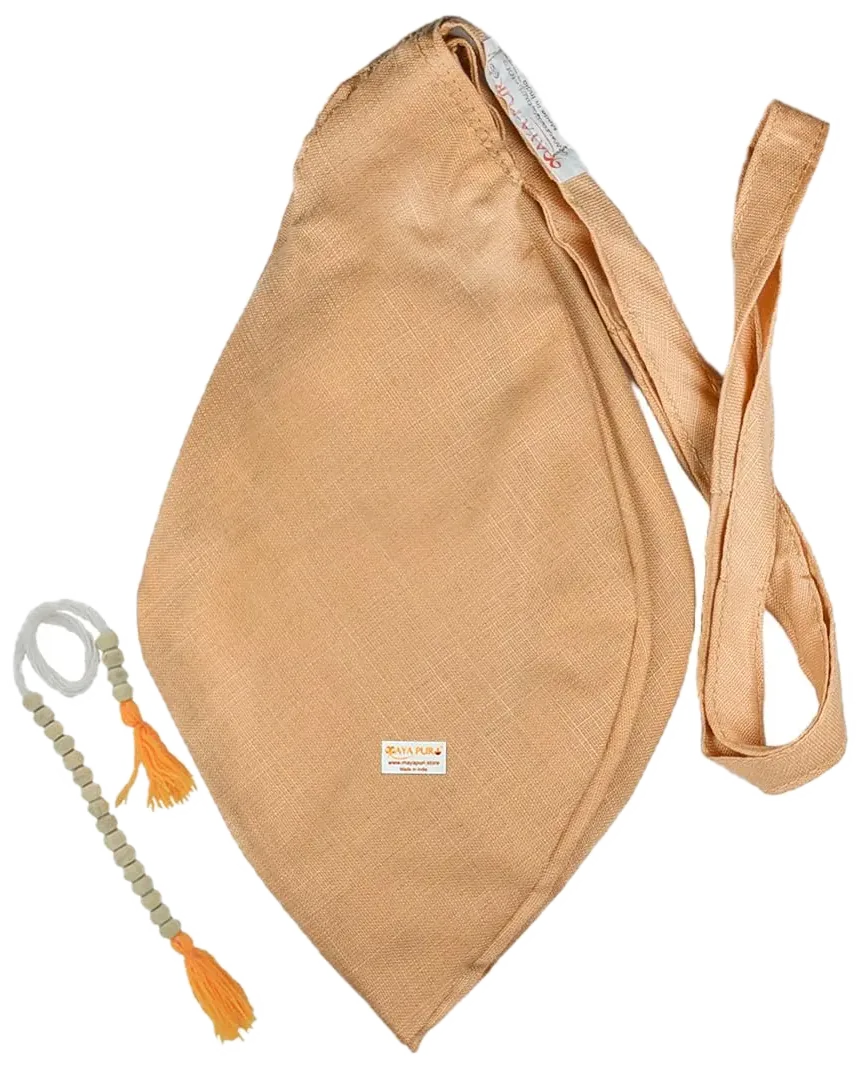
Gomukhi japa bag with counter
गोमुखी जप थैली, काउंटर सहित
₹269
A cotton bag that keeps the mala clean and lets you chant without taking it out.
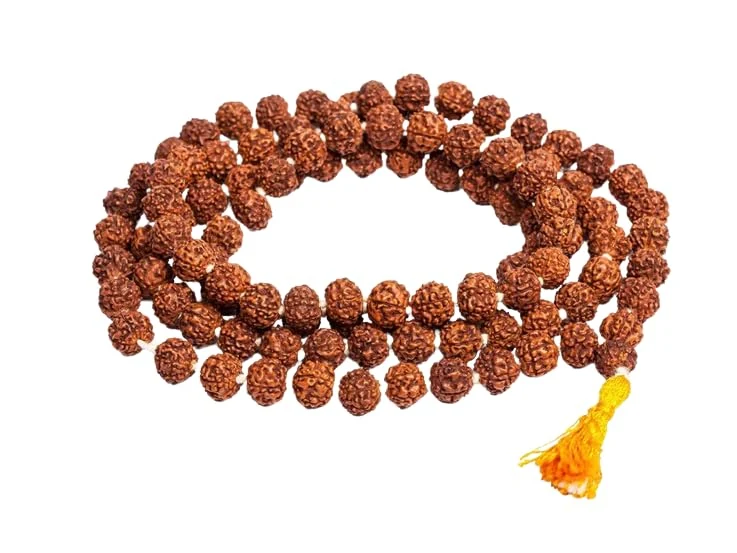
Rudraksha mala, 5 mm, 108 beads
रुद्राक्ष माला, 5 मिमी, 108 दाने
₹999
Small 5 mm panchmukhi beads on a 108 bead strand, light enough to count all day.
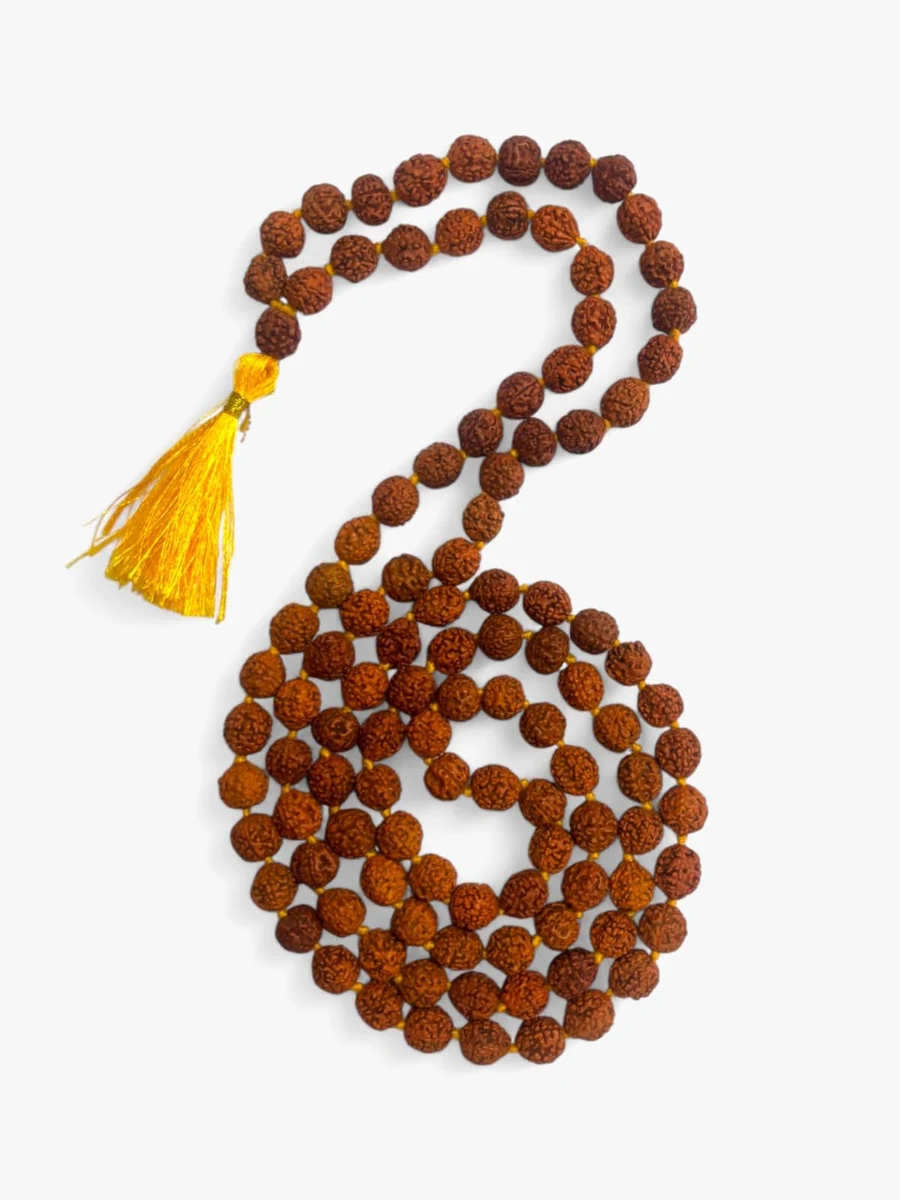
Nepali rudraksha mala, 10 mm
नेपाली रुद्राक्ष माला, 10 मिमी
₹299
Large 10 mm Nepali beads, 109 in all, at about fifty grams on the hand.