
Premanand Ji Maharaj biography
Born Anirudh Kumar Pandey in 1971 in a village near Kanpur, he walked out of home at thirteen and never went back. What followed was years of nothing: no money, no shelter arranged in advance, and a stretch on the banks of the Ganga at Varanasi that he still points to when someone tells him their sadhana is hard. This page sets out the whole record: the early life, the timeline, the guru and the lineage, a table of the facts people search for, and the parts of the story that other sites repeat wrongly. Where something is not established, it is marked as not established rather than smoothed over.
Last updated 7 September 2026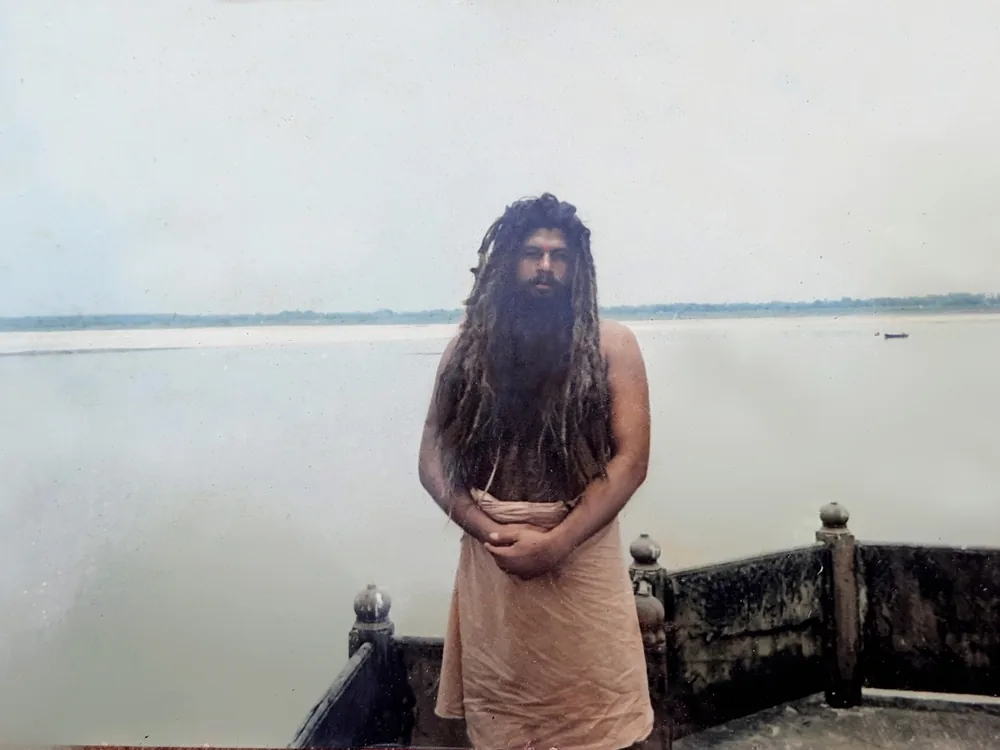
Premanand Maharaj Ji: a household where devotion was ordinary
Akhri is a village in the Sarsaul block of Kanpur district, and in 1971 a son was born there to a Brahmin family named Pandey. They called him Anirudh. His grandfather had already taken sanyas, his father was a devotee, and the Gita and the daily paath were part of the evening rather than an event.
This matters to the story. He has said in satsang that what he felt as a child was not rebellion against the family but a continuation of what the family had already placed in front of him. The direction was set at home; only the severity of it was his own.
- Born 1971 as Anirudh Kumar Pandey, Akhri village, Sarsaul block
- Brahmin family; his grandfather had taken sanyas before him
- Scripture and daily paath were household routine, not occasion
- Left home in 1985 at the age of thirteen and took sanyas
From a village near Kanpur to the lanes of Vrindavan
Four turns decide the whole story: the night he walked out, the years on the ghats, the guru who named him, and the phone cameras that carried a small Vrindavan satsang to the rest of the world.
The guru who gave him his name
Vrindavan came after Varanasi. There he met Shri Hit Gaurangi Sharan Ji Maharaj and received diksha into the Radhavallabh Sampradaya, the tradition founded in the sixteenth century by Shri Hit Harivansh Mahaprabhu. With it came the name by which lakhs now know him: Premanand Govind Sharan.
The lineage explains the emphasis you hear in every satsang. The Radhavallabh tradition places Shri Radha at the centre of worship rather than beside it, and that is why his instruction is never simply to remember God but specifically to take the Radha naam.
Read as a name, it states the whole path in four words. Prema is love and ananda is bliss, so Premanand carries the sense of one whose joy is love itself. Govind Sharan means taking refuge in Govind. Hit is the honorific carried from the founder of the sampradaya.
Premanand Ji Maharaj biography in brief
Everything people search for about him, gathered in one place. Where a fact is not firmly established, the row says so rather than filling the space with a confident guess.
| Detail | What is established |
|---|---|
| Full nameAs used at the ashram and within the sampradaya | Shri Hit Premanand Govind Sharan Ji Maharaj |
| Birth nameThe name he was given at home in Kanpur district | Anirudh Kumar Pandey |
| Name in HindiHow he is written and searched for in Devanagari | प्रेमानंद महाराज, प्रेमानंद जी महाराज |
| Year of birthNo birth certificate has ever been published | 1971. A minority of sources say 1972 |
| Age in 2026Follows from the year, since no exact date is confirmed | 55 |
| BirthplaceSarsaul block, Kanpur district, Uttar Pradesh | Akhri village |
| FamilyHis grandfather had taken sanyas before him | A Brahmin household named Pandey. Individual names are not published by the ashram and are not repeated here |
| RenunciationHe left without telling anyone at home | 1985, at the age of thirteen |
| GuruFrom whom he received diksha at Vrindavan | Shri Hit Gaurangi Sharan Ji Maharaj |
| TraditionFounded by Shri Hit Harivansh Mahaprabhu in the sixteenth century | Radhavallabh Sampradaya |
| AshramA narrow lane in Vrindavan, Mathura district | Shri Hit Radha Keli Kunj, Vrindavan |
| Core teachingChanted out of love rather than fear | Naam japa, specifically the Radha naam |
| Language of satsangHe does not teach in English at all | Hindi |
| Marital statusHe has lived as a renunciate since thirteen | Unmarried |
| Books writtenCompilations by others exist; none are his own writing | None. The recorded satsang is the primary source |
| HealthSpoken about openly from the stage for years | Long standing kidney illness. He is alive and continues to give satsang |
The tradition behind the name: Radhavallabh Sampradaya
His teaching cannot be read accurately without it. Every instruction he gives, down to which name he tells you to chant, comes out of a five hundred year old position about who stands at the centre of Vrindavan.
Who founded it
Shri Hit Harivansh Mahaprabhu, in the sixteenth century, at Vrindavan. The name of the tradition is itself the argument: Radhavallabh means the beloved of Radha, so even Krishna is named here by his relationship to her rather than the other way round.
It is one of the four principal Vaishnava sampradayas of Braj, and it has stayed comparatively small and comparatively local for five centuries.
Why Shri Radha is placed first
In most Vaishnava worship Radha stands alongside Krishna. In this tradition she is supreme, and he is approached through her rather than beside her. That is a doctrinal position with consequences, not a difference of emphasis or taste.
It is the reason Maharaj Ji never simply says remember God. He says take the Radha naam, and he means the distinction.
What "Hit" means in his name
It is the honorific carried down from the founder, Shri Hit Harivansh Mahaprabhu, and everyone in the line carries it. That is why Hit Premanand, Premanand Govind Sharan and Shri Hit Premanand Govind Sharan Ji Maharaj are all the same person written at different lengths.
People searching one form often never find the pages written under another, which is most of why the information about him online is so scattered.
What his own name says
Prema is love and ananda is bliss, so Premanand carries the sense of one whose joy is love itself. Govind Sharan means taking refuge in Govind. Read together with the Hit in front of it, the name states the entire path in four words before he has said anything.
Names in this tradition are given at diksha and are descriptive rather than decorative, which is why his is worth reading rather than only pronouncing.
Why the practice needs no machinery
A path built on the naam requires no temple, no priest, no fixed hour and no fee, because none of those is what carries it. Everything Maharaj Ji refuses to institutionalise follows from that, including the absence of a booking system, a donor list and a paid queue.
The ashram is not small because it lacks resources. It is small because the tradition it belongs to does not need the machinery.
What it asks of a householder
Structurally, nothing. There is no dress requirement presented as a gate, no initiation you must obtain first, and no expectation that you relocate to Braj. He tells householders to stay householders and treats the family and the job as where the practice is proved.
This is the point at which the tradition and his personal life diverge, and he is careful to say so rather than let his own renunciation be read as an instruction.
प्रेमानंद महाराज: the parts of the story that get repeated wrong
Most of what circulates about Maharaj Ji online is copied between sites without checking. These are the points where the copies drift furthest from what can actually be established.
The birth year
1971 is the year given consistently by the sources closest to the ashram, and it is what this site uses. A minority of pages say 1972. No birth certificate has been published, so anyone quoting an exact date is repeating a guess.
Either way the age is the same to within a year: mid fifties in 2026.
Premanand Maharaj, Pramananda Maharaj and the other spellings
He is searched for under a dozen forms and they all mean the same saint of Vrindavan: Premanand Maharaj, Premanand Maharaj Ji, Maharaj Premanand, Pramananda Maharaj, Permanand, Parmanand, Prema Nand, Swami Premanand and Hit Premanand. In Hindi he is प्रेमानंद महाराज or प्रेमानंद जी महाराज.
The spread matters for two reasons. It is why searches for the same person land on completely different pages, and it is what scam sites exploit by registering near-miss spellings to look official.
What actually happened at thirteen
He left. He did not announce it, negotiate it or come back at the weekend. What is not established, and what several sites state with false confidence, is the precise date, the precise route and the conversation that supposedly preceded it.
What he does describe himself, repeatedly, is the condition of the years after: no money, no shelter arranged in advance, and food only when it came unasked.
Why he mentions the Ganga years so often
Not as biography. He brings them up when a devotee says their sadhana feels difficult, and the point he draws is always the same: difficulty is not evidence that you have taken a wrong turn.
Almost every instruction he gives now about detachment, about the body, and about not negotiating with God for outcomes traces back to that stretch.
He does not tell you to do what he did
This is the most commonly inverted part of the story. He renounced at thirteen and he tells householders to stay householders. Family, job and duty are the field where the practice is tested, and he treats the idea of walking out as a shortcut with open suspicion.
A biography that reads as an invitation to renounce has misread him.
His health
He has long standing kidney illness and has spoken about it openly from the stage, declining treatment at various points. He is alive and continues to give satsang. Rumours of his death circulate periodically on social media and have been false every time.
What has genuinely changed since late 2025 is the reliability of the schedule, including the morning padyatra, which is the thing to check before travelling.
Where the ashram fits
Shri Hit Radha Keli Kunj is not a campus and there is no reception. It sits on a narrow lane in Vrindavan behind a yellow awning, with a board on the wall carrying the day's timings and devotees seated along the wall from well before dawn.
Every genuine darshan is arranged there and nowhere else. There is no booking, no agent and no fee, and anyone offering you one of those is not connected to him.
What he does on an ordinary day
The shape is unglamorous and repeats: rise very early, the padyatra when health allows, morning satsang, seva and rest through the middle of the day, evening satsang. Questions come from the floor and are answered on the spot rather than from a prepared talk.
He has kept roughly this routine for years, and he treats the repetition as the point rather than as a limitation.
Why the dates in his life are so thin
There was no institution recording any of it. A boy who leaves home without telling anyone, and then spends years on the ghats with nothing arranged in advance, generates no register, no admission record and no dated photograph. The gaps are not carelessness on anyone's part; there was simply nobody present whose job it was to write it down.
So a biography of him can be honest or it can be precise, and this one chooses honest. The year is 1971, the renunciation is 1985, and almost everything between Varanasi and Vrindavan is a sequence rather than a calendar.
The photograph from the 1990s
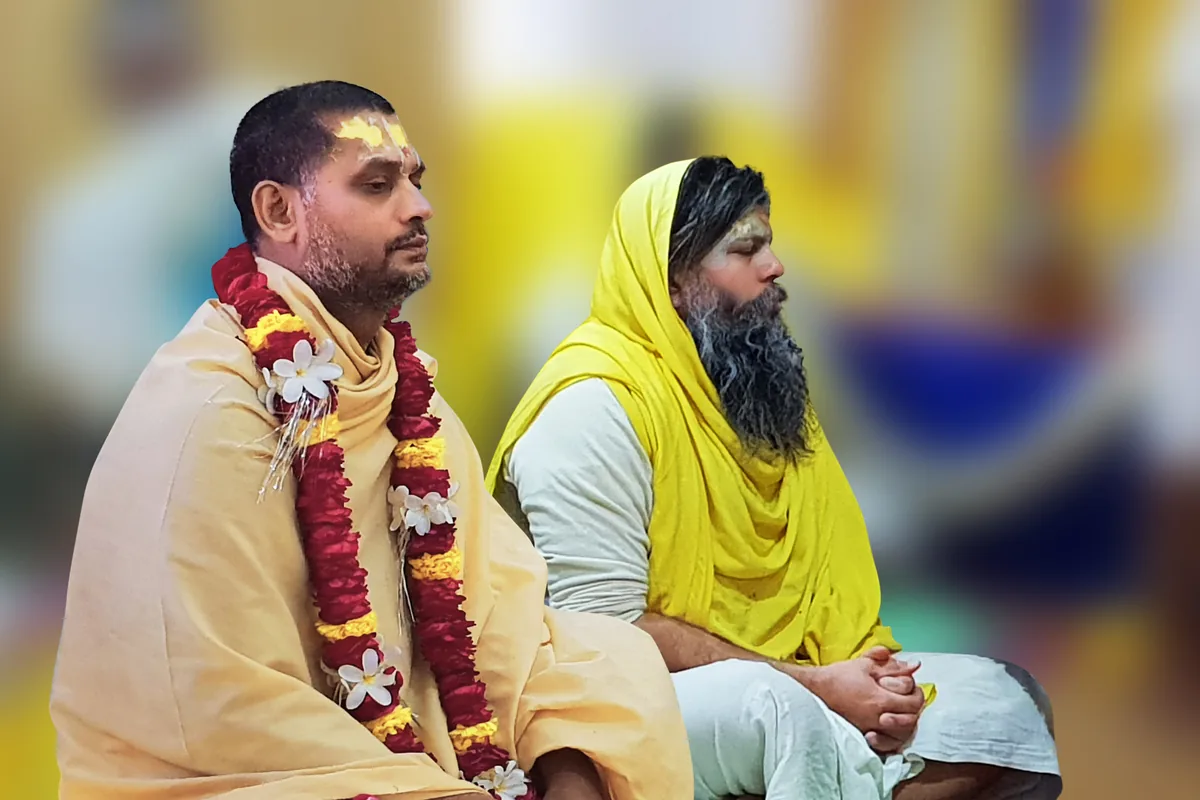
One image survives from the Varanasi period and it does more work than any paragraph. A young man with long matted hair at the water's edge, thin, in almost nothing, with none of the garlands or the decorated backdrop that frame every photograph taken of him since.
Devotees who find it are usually surprised, because the saint they know from clips is warm and often laughing. That man is the same person, roughly thirty years earlier, in the middle of the stretch he still points back to.
How a satsang actually runs
There is no prepared talk and no slides. He sits, he speaks in Hindi, and much of the session is questions taken from the people in front of him and answered on the spot. The answers are short, specific and usually unflattering to the question, and they return to the naam within a minute or two whatever the subject was.
What surprises most first-time attendees is the humour. The recordings that travel tend to be the solemn moments, and the hall is a good deal lighter than the clips suggest.
What he has never done
No book written, no course sold, no title accepted, no franchise, no branch ashram, no membership, no paid blessing and no fee of any kind for anything. He has not endorsed a product, a politician or a cause, and he has not built an organisation around himself.
The list matters because every scam using his name involves offering one of the things on it. If it can be bought, it is not connected to him.
His birth family, and what is not known
The household was Brahmin, in Akhri, and religious before he was born. His grandfather had taken sanyas and his father was a devotee. That much he has said himself in satsang.
Beyond it, names, occupations and the family's situation today are not published by the ashram, and the versions circulating online cannot be traced to a source. They are left out here rather than repeated, which is a decision about accuracy rather than privacy.
How a saint who avoided an audience ended up with one
For most of his life Maharaj Ji had no audience by design. He did not build a following, publish a book, take a title or arrange a tour. What changed was not a decision on his part but a change in the technology in other people's pockets. Phone cameras reached a small Vrindavan satsang, and short clips of him answering an ordinary question in ordinary Hindi began to travel.
Nothing about the format was designed to travel. He speaks without English, without slides, without a course to sell and without the vocabulary of self-improvement. He gives the same handful of instructions day after day and does not vary them to keep anyone interested. It turned out that was exactly what a very large number of people were looking for, and it is why he is now among the most searched spiritual figures in India, with public figures including President Droupadi Murmu visiting the ashram.
None of it has changed the arrangement. The satsang still starts in the dark. The queue still forms along a narrow lane before dawn. Nothing is charged, nothing is bookable, and the homework at the end is still the same: take the name.
The teachings page sets out what he actually says, the ashram guide covers Shri Hit Radha Keli Kunj, and how to meet Maharaj Ji explains what is and is not possible. Basic biographical facts are also recorded on Wikipedia and Wikidata.
What people ask about his life
The ten questions that bring most people to a biography page, answered in a line or two each.
What is Premanand Ji Maharaj's real name?
Anirudh Kumar Pandey. Premanand Govind Sharan is the name he received at diksha in the Radhavallabh Sampradaya, and Hit is the honorific of that tradition. The full formal address is Shri Hit Premanand Govind Sharan Ji Maharaj.
Premanand Ji Maharaj age: how old is he in 2026?
He was born in 1971, which makes him 55. A few sources give 1972 instead. The ashram has never published a birth certificate, so the year is reliable and the exact date is not confirmed.
Are Pramananda Maharaj and Premanand Maharaj Ji the same person?
Yes. Pramananda Maharaj, Premanand Maharaj Ji, Maharaj Premanand and Premanand Ji are all the same person, written differently. His full diksha name is Shri Hit Premanand Govind Sharan Ji Maharaj, and he was born Anirudh Kumar Pandey.
Where was Premanand Ji Maharaj born?
In Akhri village, Sarsaul block, Kanpur district, Uttar Pradesh, into a Brahmin family that was already religious. His grandfather had taken sanyas and daily paath was ordinary household routine rather than an occasion.
At what age did he leave home?
Thirteen, in 1985. He left without telling the family and took sanyas. He has now spent more than four decades as a renunciate, which is longer than most people reading this have been alive.
What is his family background?
A devout Brahmin household in Kanpur district. His grandfather was a sanyasi and his father a devotee. He has spoken in satsang about the pull he felt as a child being a continuation of what the family had already put in front of him rather than a rebellion against it.
Is Premanand Ji Maharaj married?
No. He took sanyas at thirteen and has lived as a renunciate since. When he speaks of family in satsang he usually means the devotees around him.
Who is his guru?
Shri Hit Gaurangi Sharan Ji Maharaj of Vrindavan, from whom he received diksha into the Radhavallabh Sampradaya, the tradition founded by Shri Hit Harivansh Mahaprabhu.
What did he do during the Varanasi years?
He lived on the ghats of the Ganga through the late 1980s and 1990s, sleeping in the open, bathing in the river and doing nothing but japa and study. He accepted food only when it was offered unasked, which was his own rule and not anyone else's.
Why did he become so widely known so quickly?
Phone cameras reached a small Vrindavan satsang and short clips began to travel. He speaks in plain Hindi, without English, slides or a technique to sell, and that turned out to be what a very large number of people were looking for.
What illness does he have?
Long standing kidney illness, which he has spoken about openly from the stage, declining treatment at various points and treating the body as something to be used rather than preserved. He is alive and continues to give satsang, though the schedule now varies.
The life is the argument for the practice
Forty years of it, and the instruction at the end is still one line long. Start where he tells everyone to start.