
Shri Hit Radha Keli Kunj, Vrindavan
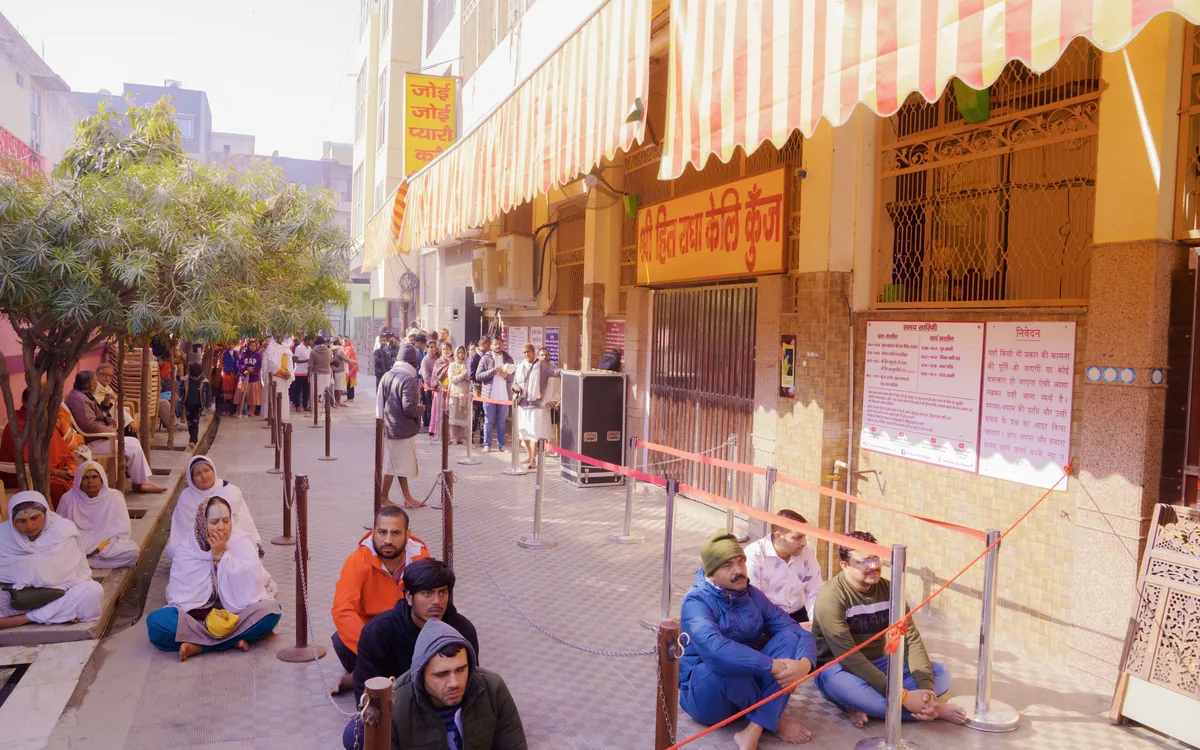
A narrow lane, a yellow awning, a board on the wall with the day's timings. There is no grand gateway, no reception desk and nothing to book. Devotees sit along the wall from well before dawn, and when the doors open the queue moves. This is where every genuine darshan of Premanand Ji Maharaj happens, and nowhere else.
Last updated 31 August 2026Smaller than you expect
People arrive expecting a campus and find a building on a residential lane. That mismatch is the single most common surprise, and it is worth knowing in advance so you do not walk past it.
There is no ticket counter, no enquiry window and no help desk. Volunteers manage the queue with a rope barrier and stanchions. Everything runs on people knowing the routine and following it, which means the fastest way to make your visit difficult is to arrive expecting to be processed.
How to reach Radha Keli Kunj
Vrindavan sits in Mathura district, between Delhi and Agra. Approximate distances and journey times are below; road times in Braj vary a great deal with festivals and traffic, so treat them as planning figures rather than promises.
| Arriving from | Approximate distance |
|---|---|
| Mathura Junction railway stationThe nearest major station, well connected to Delhi, Agra and much of north India | About 15 km, 30 to 45 minutes |
| Vrindavan town centreFrom Banke Bihari Mandir and the main bazaar area | A short auto ride, then on foot |
| Delhi (IGI airport)The usual arrival point for devotees flying in from abroad | About 160 km, 3 to 4 hours by road |
| AgraOften combined with a Taj Mahal visit on the same trip | About 70 km, 1.5 to 2 hours |
| Mathura bus standBuses run frequently from Delhi, Agra and Jaipur | About 14 km, autos throughout the day |
Agree the auto fare before you get in, and do not let a driver take you to a different ashram or shop on the way. Some drivers work on commission with places that have nothing to do with Maharaj Ji.
What to bring, and what to leave behind
There is no published list of prohibited items of the kind large temples enforce. This is simply what makes a pre-dawn wait in a narrow lane bearable, and what makes it harder for everyone else.
Worth bringing
- Warm layers between November and February; the pre-dawn wait is cold
- Modest, simple clothing you can sit on the floor in comfortably
- Water, and any medication you take on a schedule
- A shawl or thin mat, since seating is on the ground
- Patience, and the acceptance that darshan itself lasts seconds
Leave behind
- Any expectation of a reserved place, a fast track or a guaranteed meeting
- Large bags and luggage; the lane is narrow and there is no cloakroom
- The urge to film. Satsang is streamed officially; you do not need to
- Anyone offering to arrange a meeting for money, at any price
- Loud conversation in the lane; people live on it and are asleep
Planning a visit that works
Most disappointed trips fail for the same handful of reasons, and all of them are avoidable with a day of planning.
When to come
October to March is comfortable. Summer in Braj is severe, regularly above forty degrees through May and June, and a pre-dawn queue is far easier in winter than heatstroke is in June.
Festival periods such as Holi, Janmashtami and Radha Ashtami fill the whole of Vrindavan, which affects every queue in town, not only this one.
Where to stay
Dharamshalas, guest houses and hotels exist at every price across Vrindavan. Proximity beats comfort here: the queue forms long before dawn and nothing runs at that hour, so a modest room a short walk away is worth more than a good one across town.
Book well ahead during festivals, when the town fills completely and prices move accordingly.
How the queue actually works
People arrive, sit along the wall and wait. Volunteers manage the line with rope barriers, separate the queues, and direct people when the doors open. There is no numbering, no token and no list.
The queue works because everyone in it accepts that it moves. Pushing achieves nothing except making the wait worse for the people behind you.
How long darshan lasts
Seconds. That is not a failure of the arrangement, it is the arrangement. Thousands of people pass through, and the wait is measured in hours while the darshan is measured in moments.
Devotees who come expecting a conversation leave disappointed. Those who come expecting the wait itself to be part of it usually do not.
The padyatra
For years the morning walk left the ashram in the small hours and devotees lined the route in the dark for a few seconds of darshan as he passed. It became the most photographed part of the routine.
Since his health changed in late 2025 it has been irregular. Do not build a trip around it without checking that week.
What else is nearby
Vrindavan is dense with places worth the walk: Banke Bihari Mandir, Prem Mandir, ISKCON Vrindavan, Nidhivan and the Yamuna ghats among them. Mathura, Govardhan and Barsana are short trips out.
Most devotees combine satsang with the rest of Braj rather than travelling for a single darshan.
Donations and seva
Nothing is asked for and nothing is required. Maharaj Ji has repeatedly placed naam japa above money given, and quiet service above service announced.
If you wish to give, do it at the ashram itself and never through a website, an agent, or a payment link sent to you on WhatsApp. No appeal for funds in his name is genuine, whatever it claims the money is for.
The scams to know about
Three signs, any one of which is enough. It asks for money to arrange darshan or ekantik vartalap. It promises a guaranteed slot or a fast track. It wants payment to a personal UPI id or bank account.
Genuine darshan is free, unbookable and arranged only at the ashram. If you have seen one of these, report it with the link or number.
Combining it with the rest of Braj
Most devotees do not travel for a single darshan. Vrindavan, Mathura, Govardhan and Barsana sit within an hour of each other, and the parikrama routes, the ghats and the older temples are the reason the region has drawn pilgrims for centuries.
Two or three days lets you attend satsang more than once, which matters, because a single visit on a heavy day can mean a long wait and a very short darshan.
If you cannot travel at all
Satsang is recorded and streamed on the official channels, so the teaching itself reaches you wherever you are. Nothing in the core instruction requires his physical presence, an ashram or a journey.
He says this himself when devotees abroad ask. The naam is not held at one address, and travelling to Vrindavan is a wish rather than a prerequisite.
Why the ashram stays this small
Nothing about Shri Hit Radha Keli Kunj has been scaled to match the size of the audience. There is no auditorium, no ticketing system, no VIP arrangement and no app. A place drawing this many people could have built all of it, and the decision not to is not an oversight.
It follows directly from what Maharaj Ji teaches. If seva announced is a transaction and a paid queue is a contradiction, then a system that lets money buy a better position cannot exist here without undoing the thing people came for. So the lane stays narrow, the seating stays on the floor, the wait stays long, and everybody waits in the same line.
Before you travel, read how to meet Maharaj Ji for what is and is not possible, and the FAQ for timing. The teachings page covers what the satsang itself is about, and the biography explains how a saint who avoided an audience ended up with one.
What people ask before they travel
The ten questions that decide whether a trip goes smoothly or is wasted.
Where exactly is Shri Hit Radha Keli Kunj?
On a narrow lane in Vrindavan, in the Braj region of Uttar Pradesh. There is no grand gateway. Look for the yellow awning, the signboard reading श्री हित राधा केली कुँज, and the timing board on the wall beside it.
How do I reach Vrindavan?
Mathura Junction is the nearest railway station, about fifteen kilometres away and well connected to Delhi, Agra and most of north India. Delhi airport is roughly three and a half hours by road. From Mathura, autos and taxis run through the day. The final stretch into the lane is usually on foot.
What are the darshan and satsang timings?
Satsang runs early in the morning and again in the evening, with the padyatra before the morning session when health allows. The exact hours have shifted since his health changed in late 2025. Confirm at the ashram or with someone who was there that week before planning travel around a specific time.
How early should I arrive?
Devotees are seated along the wall well before dawn. If you want a place near the front for morning satsang, plan to be in the lane a long time before it starts. Arriving at the advertised hour usually means standing a long way back.
Is there any entry fee or ticket?
No. There is no fee, no ticket, no pass and no paid queue. Nothing at the ashram is sold and nothing can be booked online. Anyone charging you for entry or a better position is running a scam.
What should I wear?
Dress modestly as you would for any temple in Braj. There is no strict published dress code of the kind some Kerala and south Indian temples enforce, but simple, covered clothing is expected and appreciated.
Can I take my phone and camera?
Satsang is recorded and streamed officially, so there is no need to film it yourself. Follow whatever the volunteers direct on the day, do not photograph other devotees without asking, and never hold up a queue for a photograph.
Where should I stay?
Dharamshalas, guest houses and hotels exist across Vrindavan at every price. Staying within walking distance matters more than comfort, because the queue forms long before dawn and no transport runs at that hour. Book well ahead during festivals.
Is the ashram accessible for elderly or disabled visitors?
The lane is narrow and crowded, seating is largely on the floor, and the wait is long and often cold. Volunteers do help where they can, but plan realistically. For many elderly devotees the streamed satsang is the kinder option.
Can women and children attend?
Yes. Women attend in large numbers and there are separate queues. Children are welcome, though a pre-dawn wait in winter is hard on small children and the streamed satsang is often the better choice for them.
Going to Vrindavan?
Read what is actually possible before you book anything, and confirm timings at the ashram rather than online.