
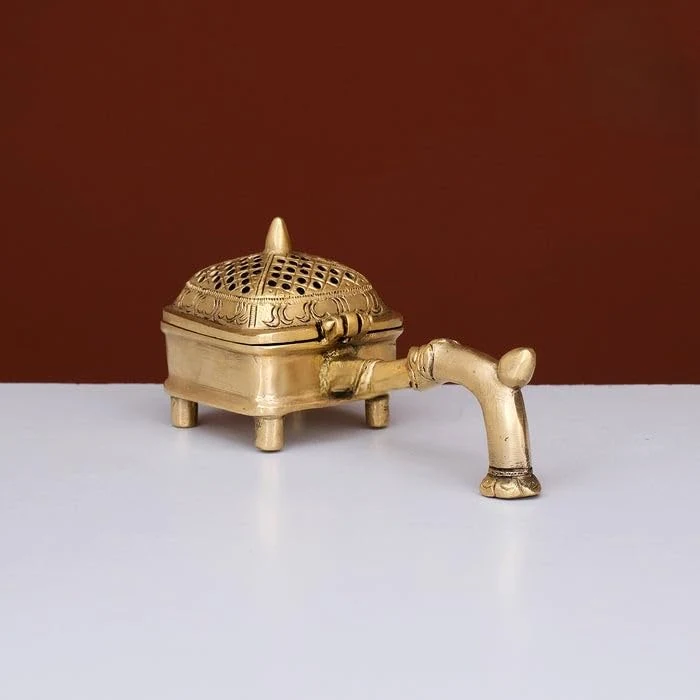
Brass square dhoop burner with handle
पीतल की चौकोर धूपदानी, हैंडल सहित
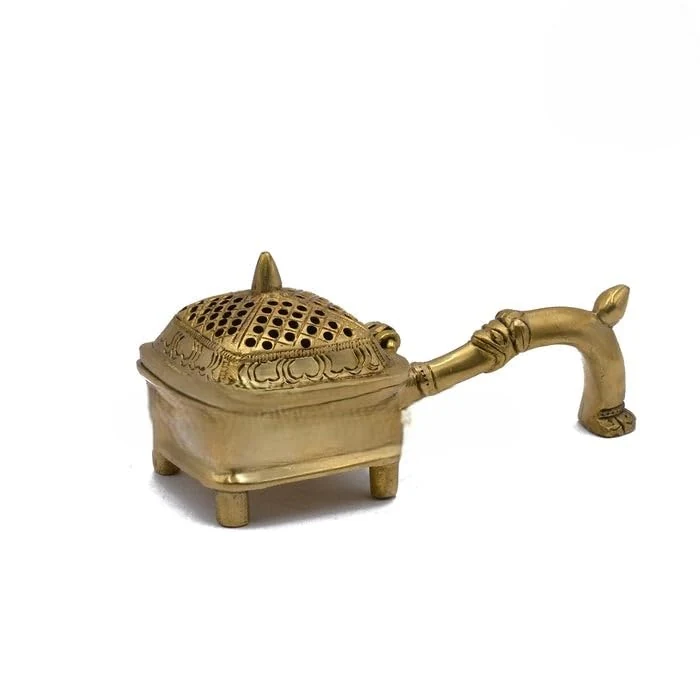
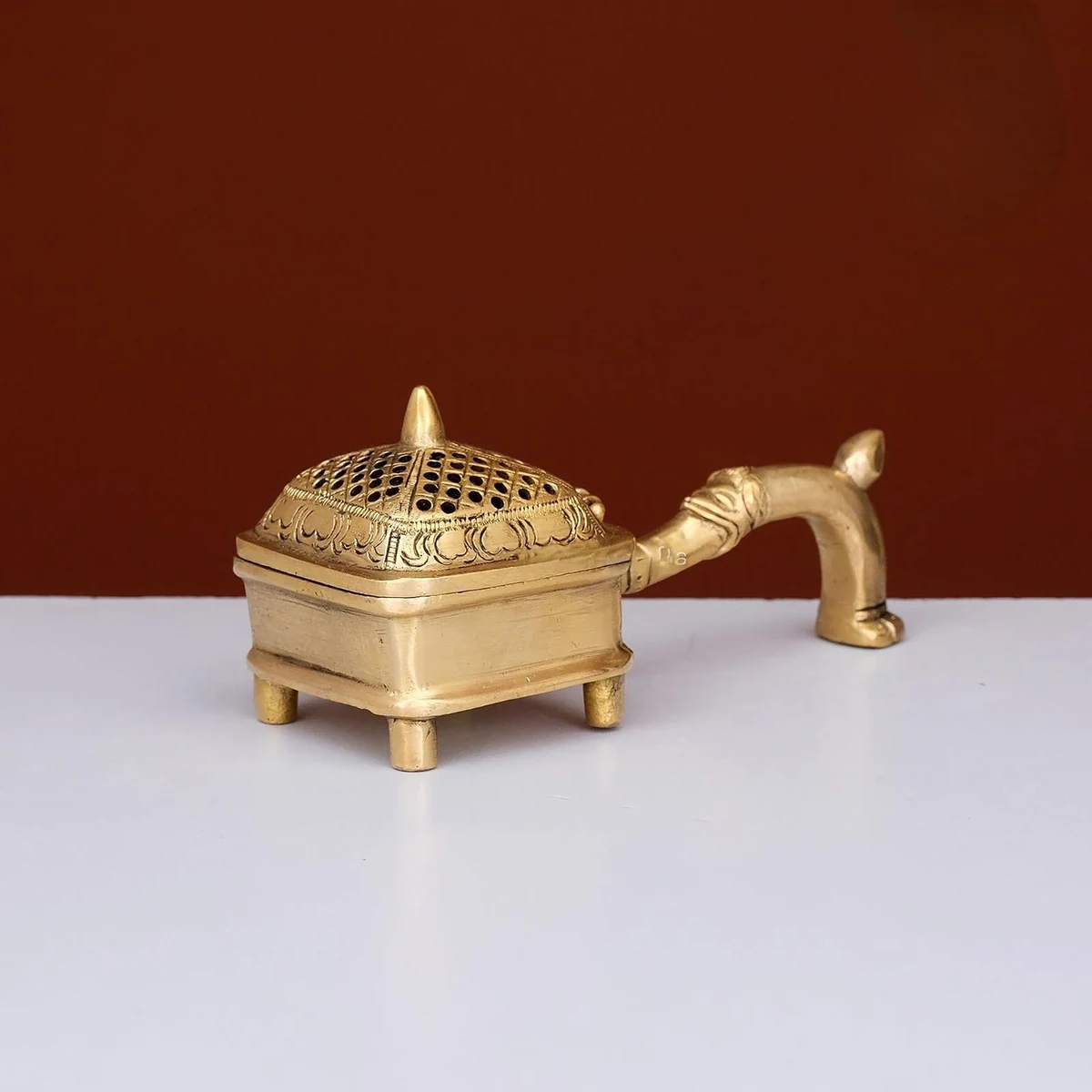
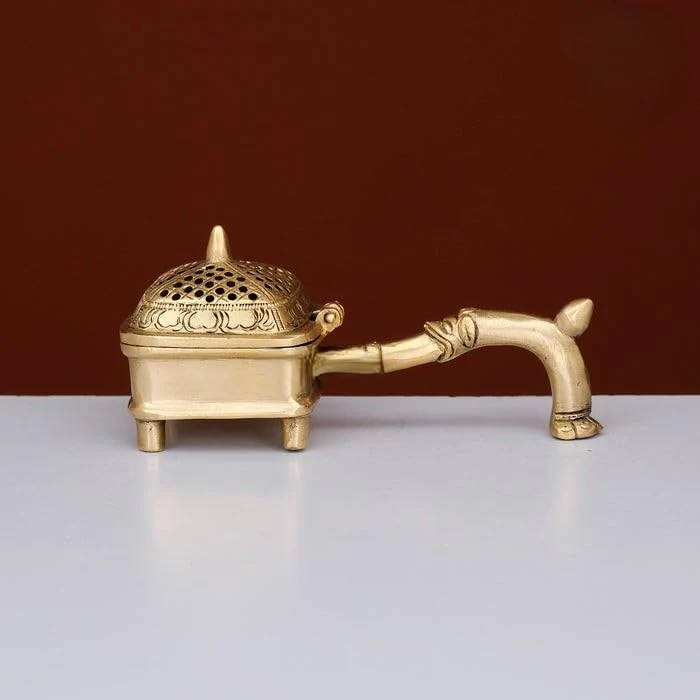
A square brass burner on four feet with a pierced lid and a long curved handle, so it can be carried around a room while it is burning. Eight centimetres tall, half a kilo.
- Height
- 8 cm
- Weight
- 500 g
- Material
- Brass
- Feature
- Long handle, pierced lid
About this dhoop burner
The handle is the entire reason to choose this over a plain footed dani, and it corresponds to an actual practice rather than being a design flourish. In a great many households the burner is carried around the house after the morning routine, through each room and often around the people present, so that the smoke reaches everywhere. A burner without a handle cannot be carried while it is hot.
For that to work the handle has to be long, and cast as one piece with the body. A short handle conducts heat to the hand within a minute; a long one stays comfortable because the distance itself does the insulating. Look at the proportion in the photographs: the handle should be roughly as long as the burner is wide, and anything much shorter is decorative.
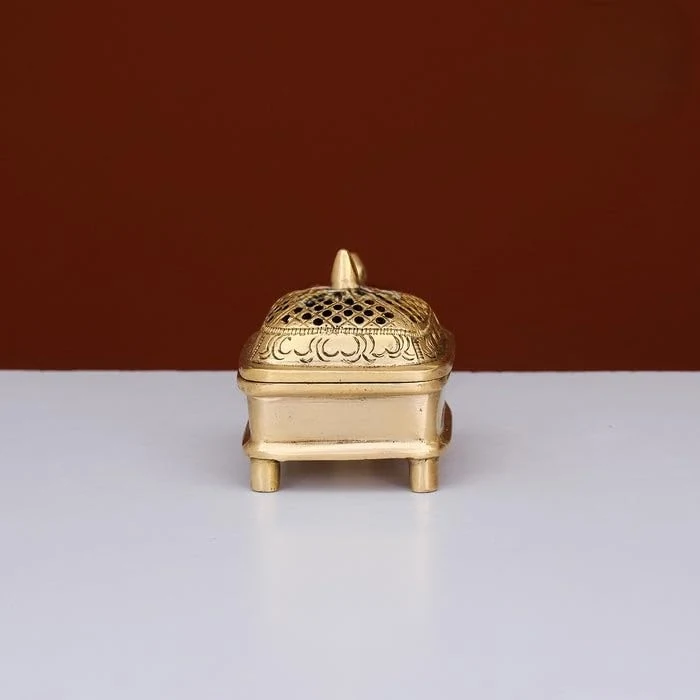
The square body is a small practical advantage over a round one. It sits without rolling if it is set down on an uneven surface, it fits against a wall or into a corner of a shelf, and the four feet at the corners give a more stable footprint than three feet on a round base. None of this is important, but all of it is faintly useful in daily use.
Like any covered dani, this is for loose material rather than sticks: charcoal with guggul, loban or sambrani placed inside, lid on, smoke through the piercing. At half a kilo it is lighter than a large fixed burner, which is what makes it carriable, and that lighter weight means it heats faster and needs the sand lining rather more than a heavy one does.
Brass is the right metal for something that is repeatedly heated, cooled, sooted and cleaned. It does not warp at these temperatures, it does not corrode from the ash, and it can be brought back to bright with lemon whenever somebody feels like it. A burner of this kind, used daily, is genuinely a thirty year object rather than a five year one.
If you are choosing between the burners on this site, the question is simply whether the thing moves. A fixed dani is heavier, holds heat better and stays where it is put. A handled one can go round the house, which is the whole reason it exists. Neither is better; one of them matches what happens in your house each morning and the other does not.
What to look for before buying
Check the handle is cast, not soldered. A handle that has been soldered or riveted onto a burner is a handle that will eventually come off, and it will do so while the burner is hot and full. Look at the join in the photographs: a cast handle flows out of the body with no visible line, while an attached one shows a seam or a plate. This is the one point on this object where failure actually matters.
Measure the handle length against the body. Heat travels along brass quickly. A handle roughly as long as the burner is wide will stay comfortable through a walk around the house; a short stub will be too hot to hold within a minute of the charcoal catching. It is the commonest fault in carriable burners and it is easy to check before ordering.
Look for four feet, cast in. The base gets hot enough to scorch wood, and the feet are what prevent it. On a square burner all four should be part of the casting and the same length, so that it sits flat. A burner that rocks will tip when it is set down in a hurry, and a burner with a soldered foot will lose it sooner or later.
Keeping it, and where it sits
Put a layer of sand or ash in the bottom before the first use and keep it there. On a lighter burner this matters more than on a heavy one: it stops the thin base from taking the full heat of the charcoal directly, which is what discolours and eventually distorts a cheap piece. It also makes emptying easy.
Carry it by the handle only, and let it cool fully before touching anything else. The lid, the finial and the whole body reach temperatures that will burn a hand. Set it down on the shelf it lives on rather than on a table, and never on cloth, even briefly.
Clean the outside occasionally with lemon and salt or tamarind, applied cold, rinsed and dried. Leave the interior black. Scrubbing the inside of a burner is effort spent for one day's appearance, since it will be black again after the next use.
Do not quench it in water while hot. Thermal shock marks brass and can crack a casting at a corner, and a square burner has four corners where stress concentrates. Letting it stand until it is fully cold before emptying is the correct routine and costs nothing but a little patience.
None of this is required. What Maharaj Ji actually asks for is set out on the teachings page, the sayings he repeats most are on the quotes page, and the stotras are free to download as PDFs. If you are planning to visit Vrindavan, read how to meet Maharaj Ji first.
Also worth reading: sayings from the asan , and printable stotras.
Questions about buying this
What is the handle for?
So the burner can be carried around the house while lit, taking the smoke through each room. A burner without a handle cannot be moved once it is hot.
How long should the handle be?
Roughly as long as the burner is wide. Brass conducts heat quickly and a short handle becomes too hot to hold within a minute.
Does this take dhoop sticks?
No. It is a covered burner for loose material: charcoal with guggul, loban or sambrani. Sticks need a flat stand with an ash plate.
Why put sand in the bottom?
It keeps burning charcoal off the metal, spreads the heat, prevents the base discolouring and makes the burner easy to empty.
Can I cool it under a tap?
No. Thermal shock marks brass and can crack a casting at a corner. Let it cool on its own before emptying.
Is any of this needed for the practice?
No. It is equipment, and optional equipment at that. What is taught has no fire, no fragrance and no cost attached to it.
Is this connected with Maharaj Ji or the ashram?
No. It is not supplied by, authorised by or endorsed by Maharaj Ji or Shri Hit Radha Keli Kunj. It is an ordinary devotional item sold by other people on Amazon, listed here because a devotee might want one.
Do you sell it?
No. The button on this page takes you to Amazon. Amazon takes the payment, ships the order and handles returns and warranty. We hold no stock, never see your payment details, and cannot change or cancel an order.
Is the price on this page current?
It is the price we last saw on Amazon, with the date beside it. Amazon changes prices whenever it likes, so treat the figure here as a guide and the price on the Amazon page as the real one.
Do you make money if I buy it?
Yes. As an Amazon Associate we earn from qualifying purchases. Your price is exactly the same whether you use our link or not; Amazon pays the commission out of its own margin, and that commission is what keeps this site free to read.
Do I need this to follow the teachings?
No. Maharaj Ji asks for the Radha naam and nothing else, with no initiation, no fee and no equipment. Anything on this page is convenience, never a requirement, and he is explicit about that in satsang.
Also for puja
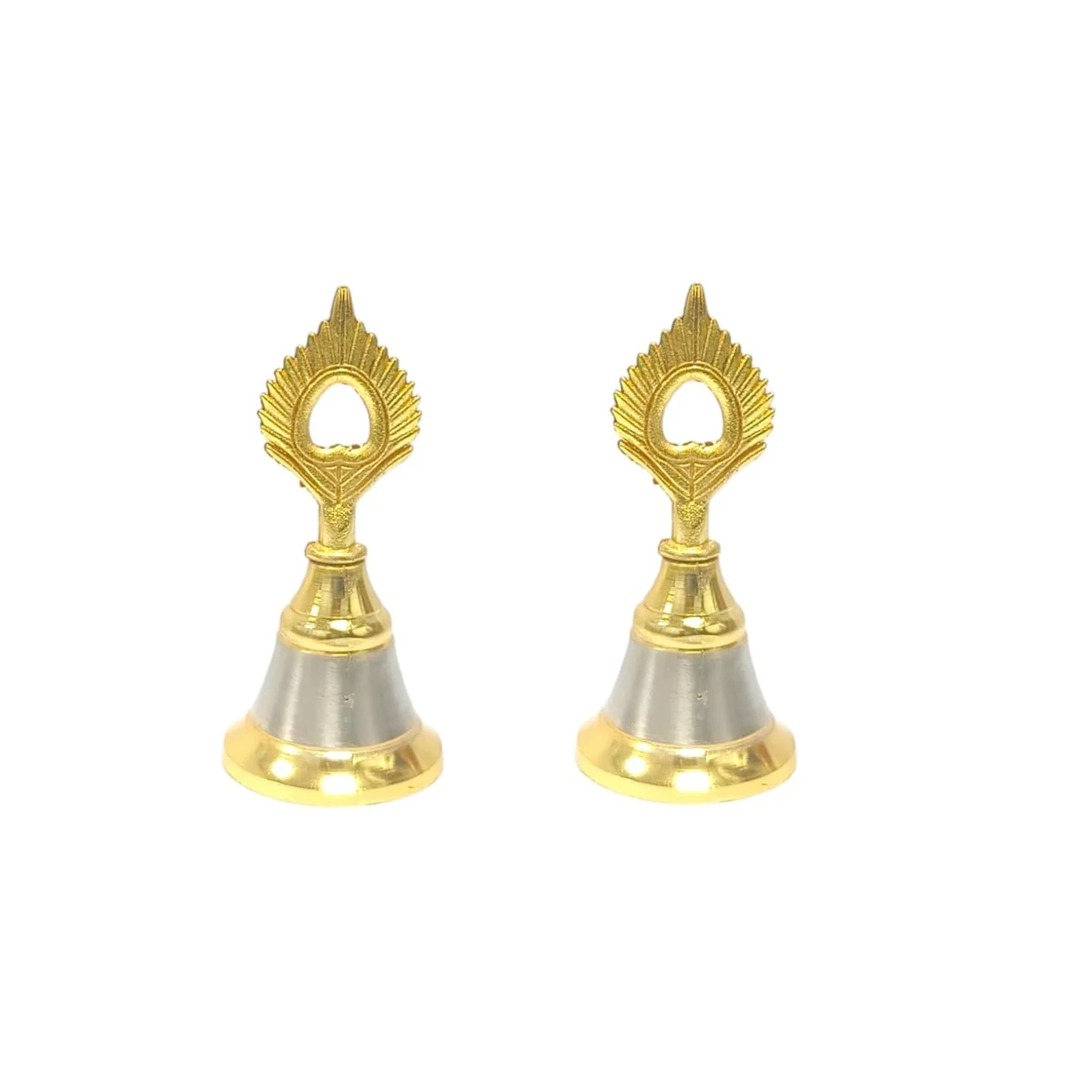
Brass puja bells, shankha chakra, set of two
पीतल की पूजा घंटी, शंख चक्र, दो का सेट
₹431
Two small brass ghanti with shankha and chakra handles, three inches each.
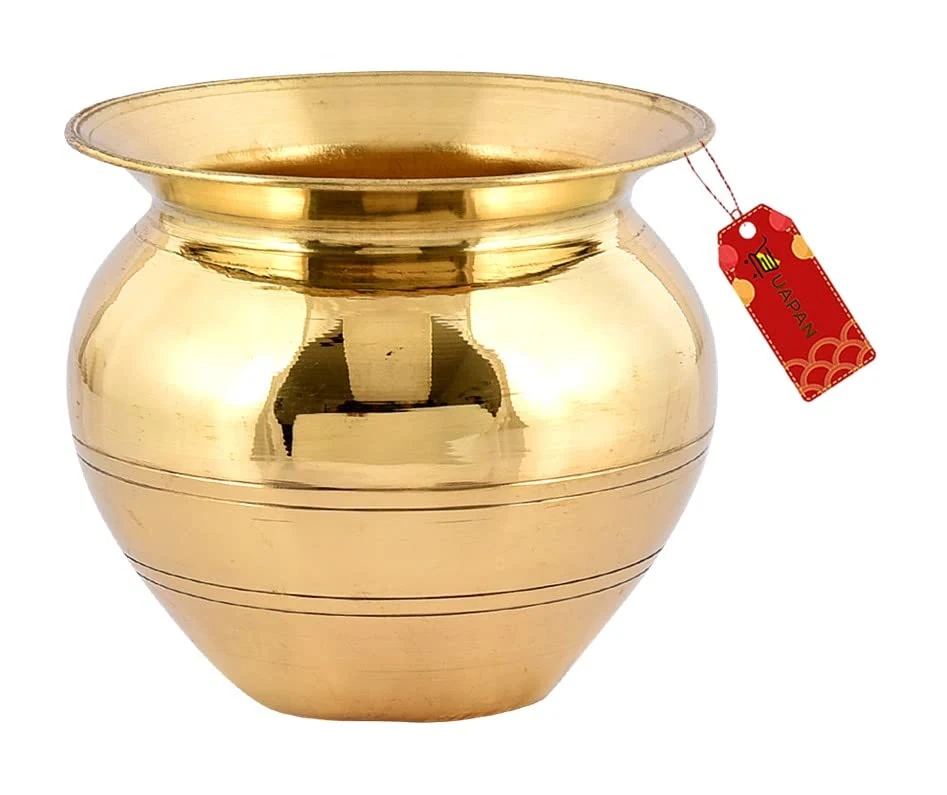
Brass puja kalash lota, 500 ml
पीतल का पूजा कलश लोटा, 500 मिली
₹322
A small brass water pot of half a litre, for abhishek and for setting a kalash.
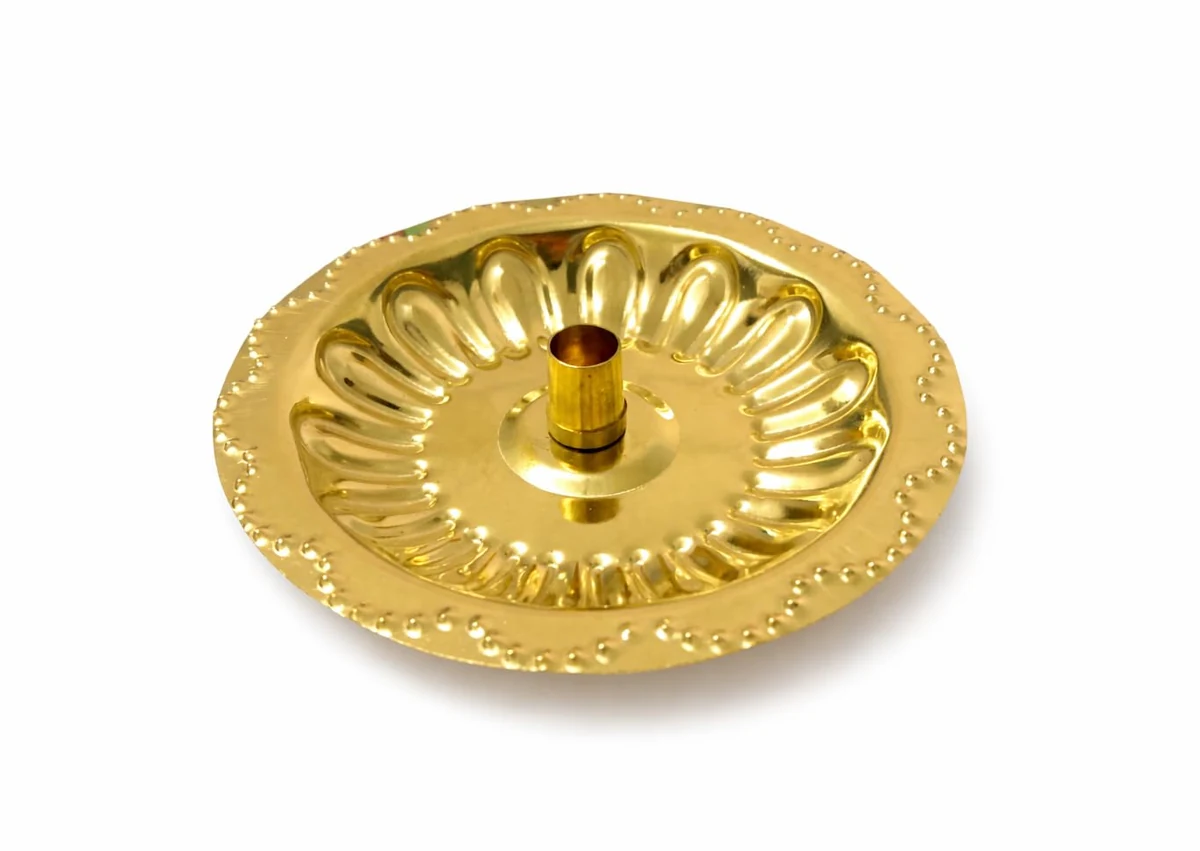
Brass dhoop stand with ash catcher
पीतल का धूप स्टैंड, राख पकड़ने वाला
₹329
A small brass plate with a central holder, eight centimetres, that catches the ash.