
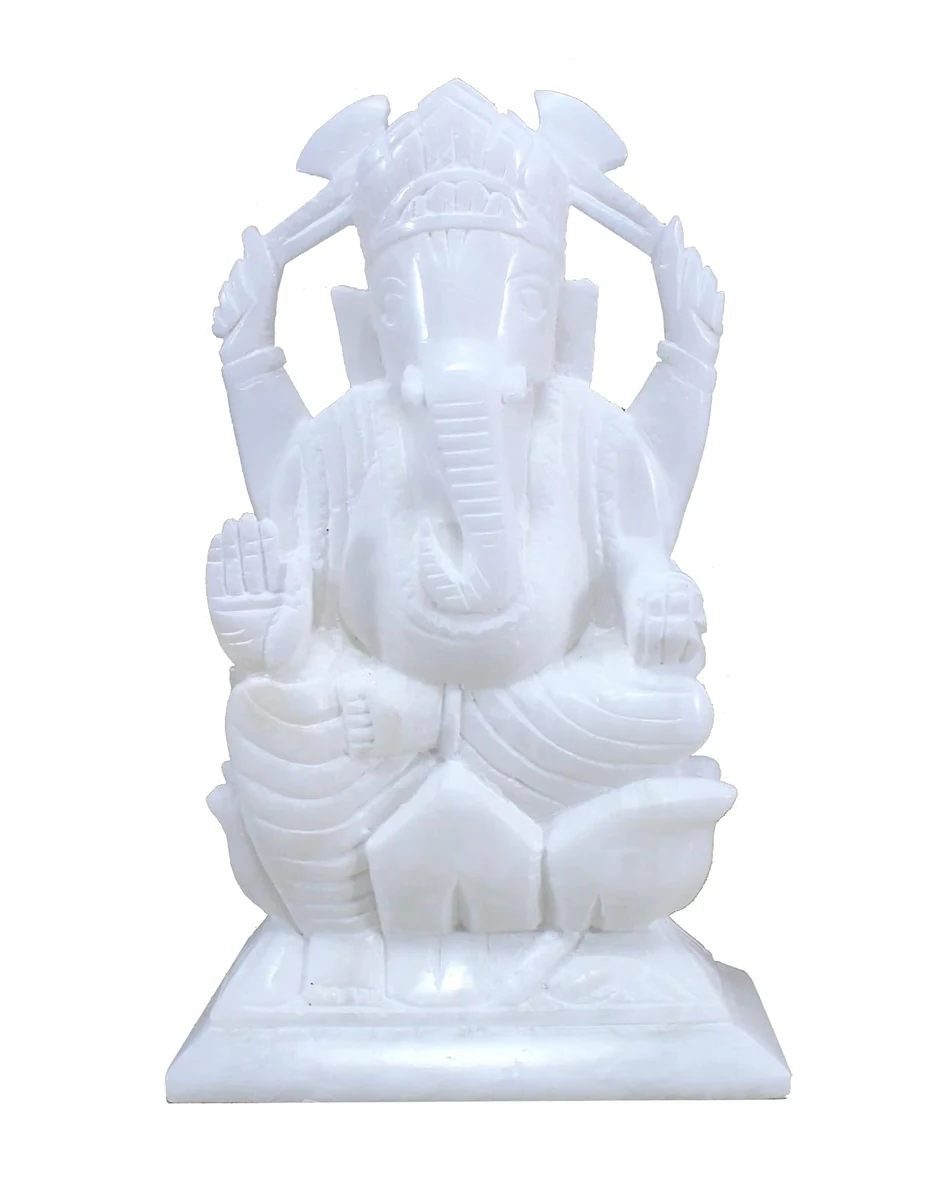
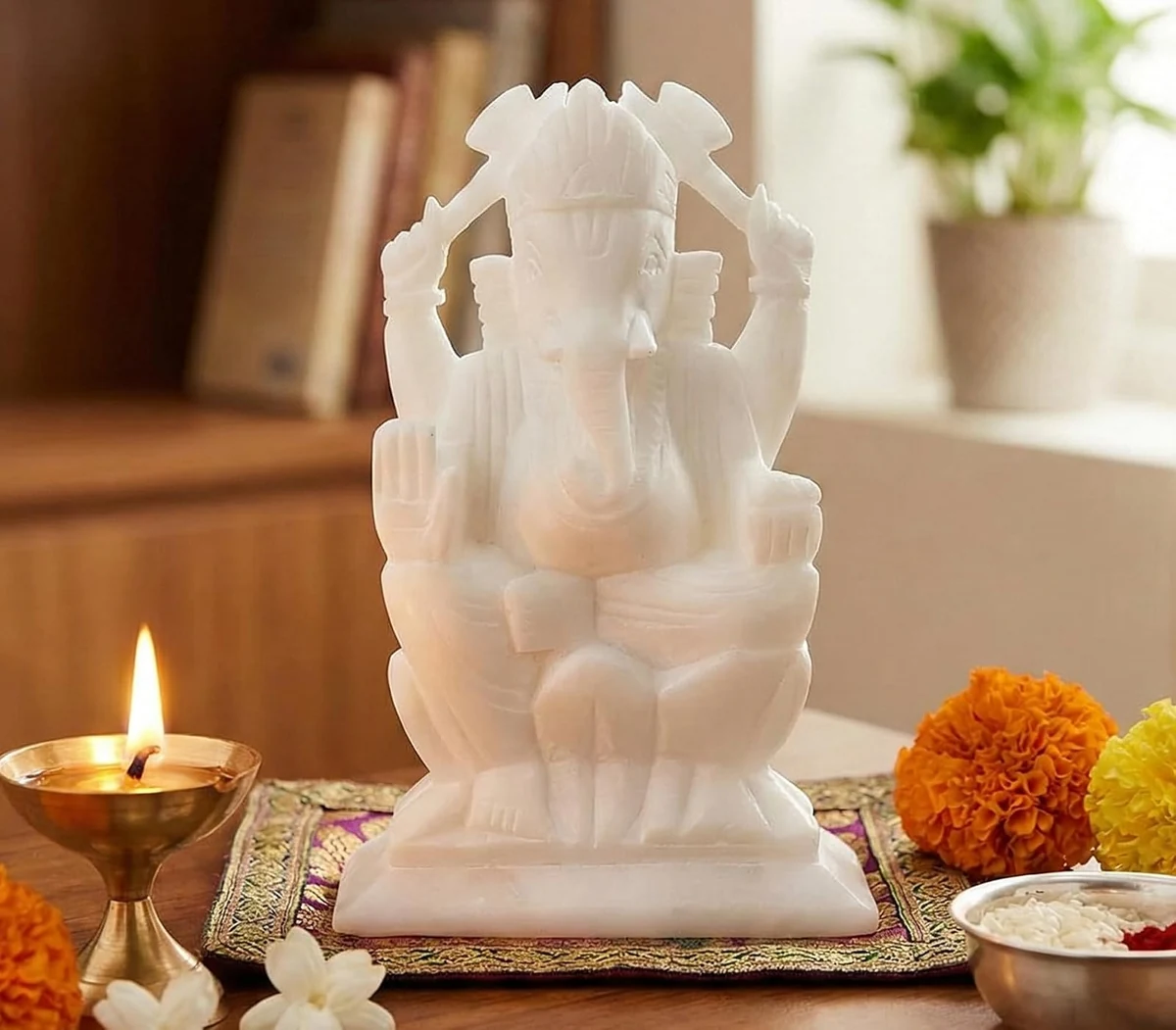
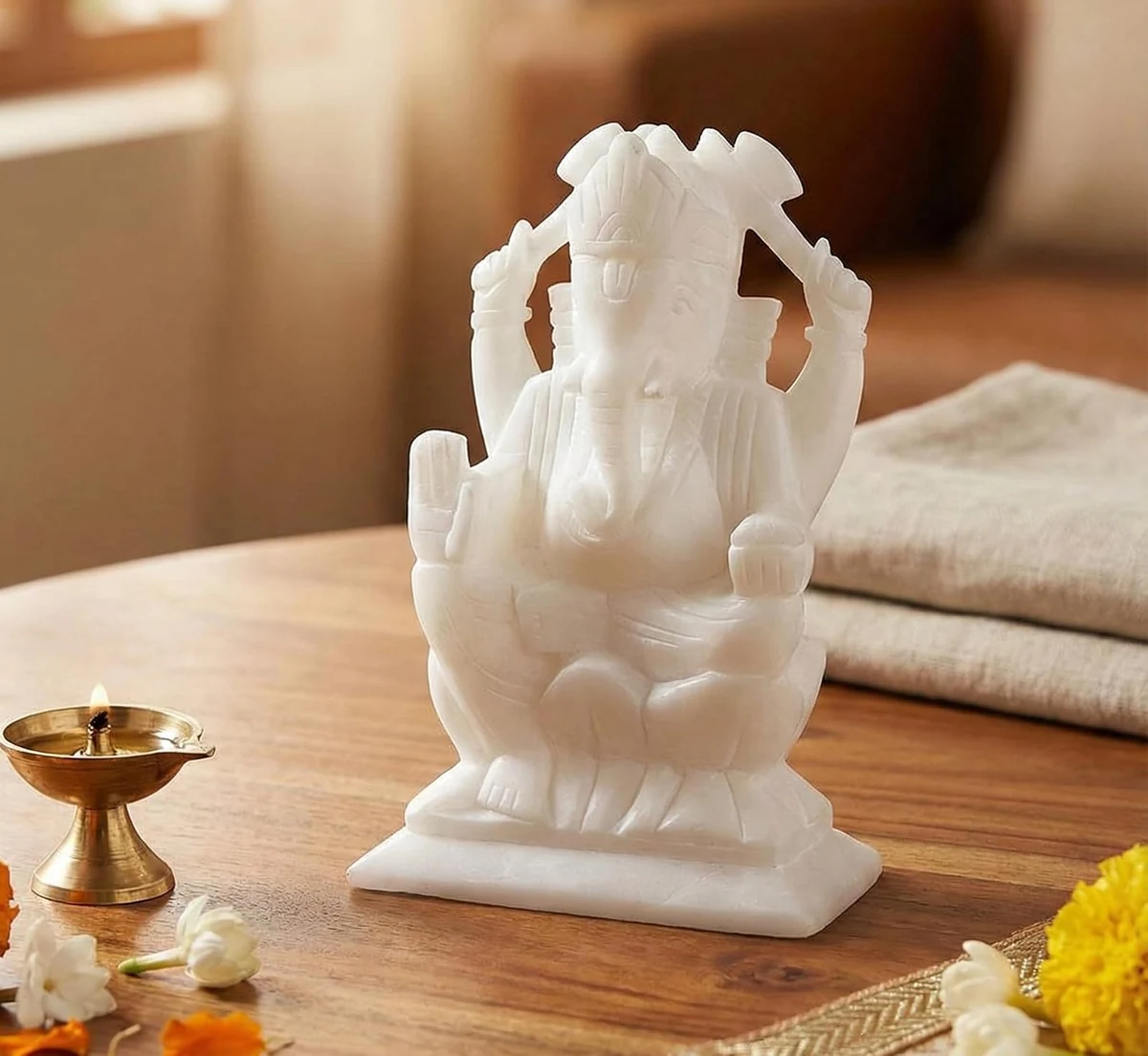
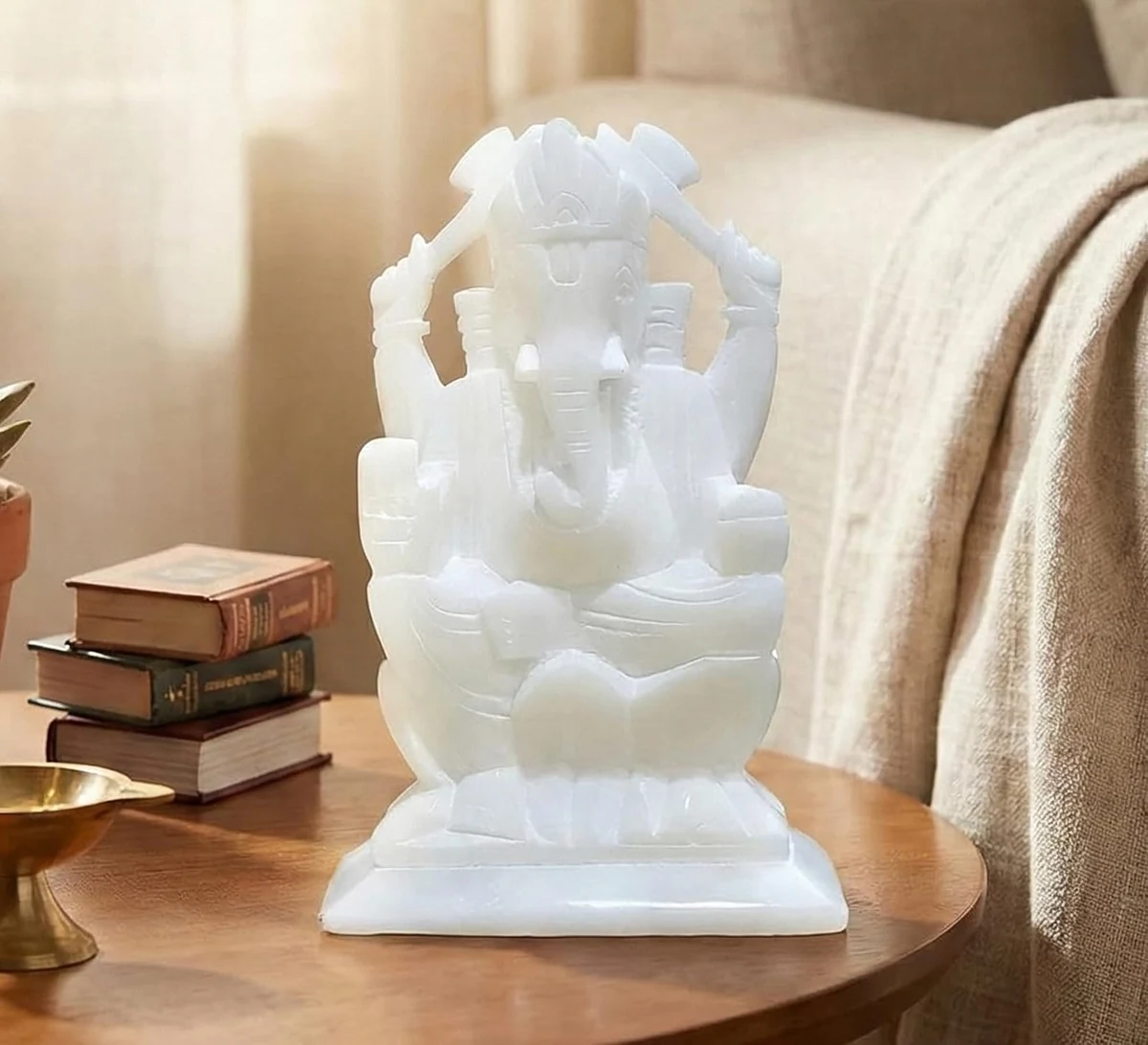
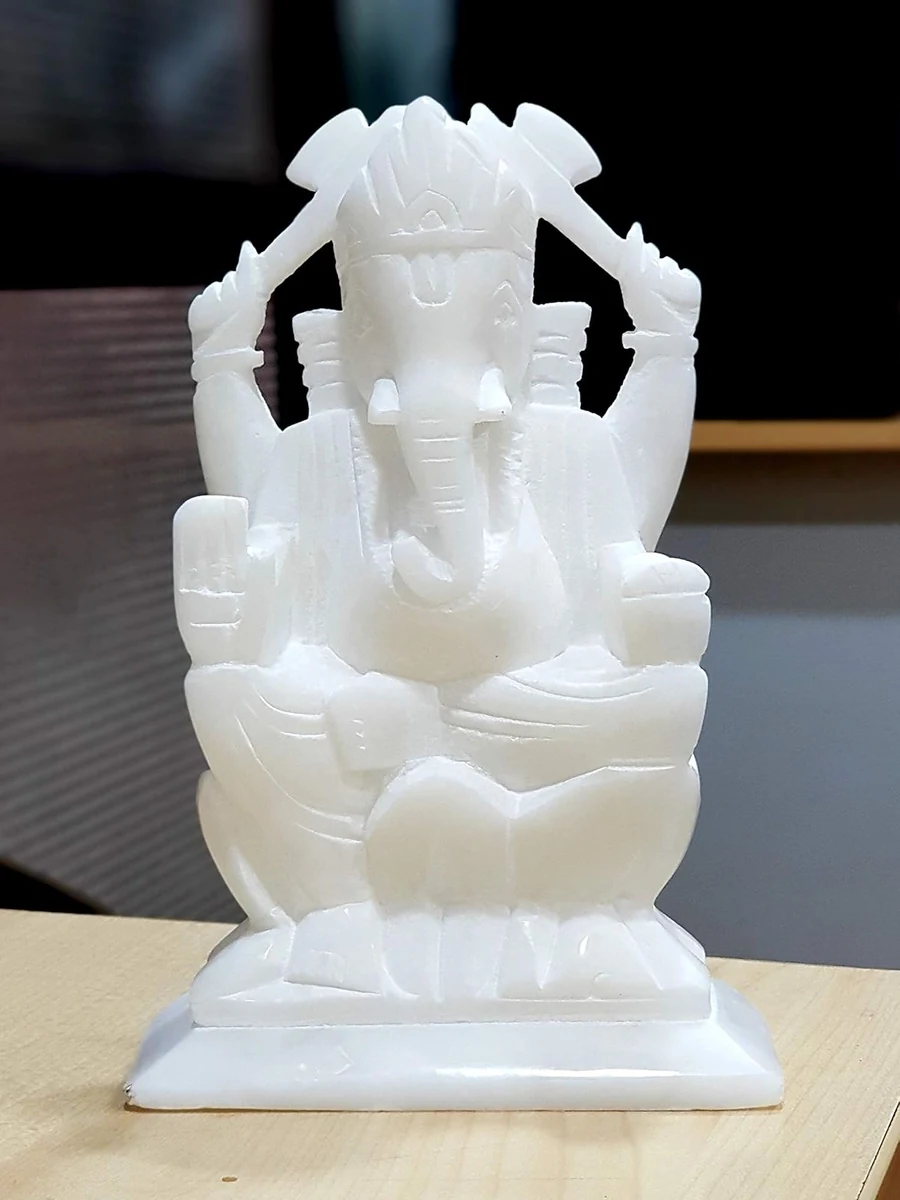
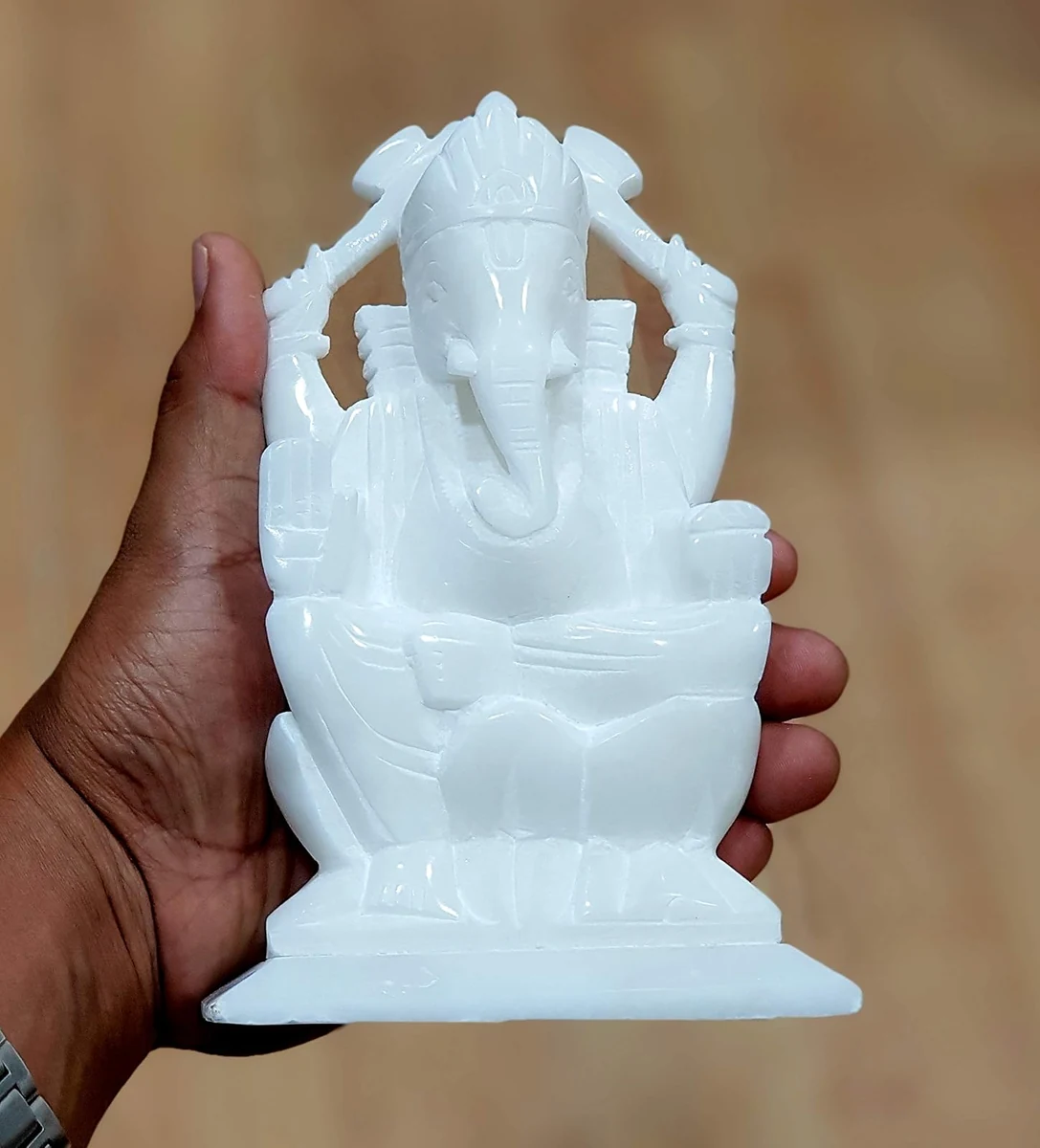
White marble Ganesh, right trunk, 5 inch
सफेद संगमरमर गणेश, दाहिनी सूंड, 5 इंच
Five inches of plain white Indian marble, unpainted, carved with the trunk turned to the right. A dakshinavarti murti, which is a deliberate choice rather than an accident of carving.
- Height
- 5 inches
- Material
- White Indian marble
- Weight
- About 500 g
- Trunk
- Turned to the right
About this ganesh murti
The trunk direction is the specification that makes this murti different from most, and it is stated in the listing because buyers look for it. In the great majority of Ganesh murtis the trunk curves to the left, towards the deity's own left hand. This one curves to the right, which is called dakshinavarti, and it is comparatively uncommon.
What is said about the difference varies by region and by who is telling you, but the common thread is consistent: the right turned trunk is regarded as more demanding. Where a left trunk murti is treated as approachable and forgiving of an irregular routine, a dakshinavarti murti is traditionally held to require a routine kept without gaps, done at a settled time and not abandoned when life gets busy. Many priests will tell a household to buy the left trunk form for exactly that reason.
It is worth being straightforward about what that is. It is custom, held with real conviction across large parts of India, and it is not something that can be demonstrated. If you find the idea useful as a way of holding yourself to a routine, it is useful. If you find it makes you anxious about getting something wrong, the left trunk form is the ordinary household choice and nobody will think anything of it.
The murti itself is plain white Indian marble, unpainted, about five inches and half a kilo. Plain stone is a different proposition from the painted murtis that fill this category. There is no paint to chip or fade, the grain of the stone is visible and slightly different in every piece, and it can be washed properly with water without anything lifting. What it does show is dirt, because white marble is unforgiving, and it does need dusting more visibly than a coloured piece.
Since Ganesh is called on at the beginning of every undertaking across the sampradayas, keeping one in a Braj household is completely usual. The unusual thing would be placing him centrally: Vrindavan mandirs are built around Shri Radha and Shri Krishna, and every other murti takes its position relative to that pair.
A word about the anxiety this particular form sometimes causes. People who buy a dakshinavarti murti and then read about stricter requirements often end up worrying that they are getting something wrong. That worry is worth setting down. Custom around trunk direction is real and widely held, and it is custom. Nobody is being watched, nothing is being tallied, and a murti kept with ordinary care and ordinary attention is being kept properly.
What to look for before buying
Confirm the trunk direction from the photograph. Listings get this wrong regularly, and mirrored product photographs make it worse. Look at the murti as you would see it on a shelf, facing you: on a dakshinavarti piece the trunk curves towards your left as you look at it, because that is the deity's right. If the images in a listing disagree with each other, ask before ordering rather than after.
Look for grain, which means real stone. Carved marble shows faint grey veining and a slight variation in tone through the body, and no two pieces are identical. A perfectly uniform white surface with no grain at all usually means cast marble dust rather than cut stone. Both are sold as marble. At five inches and five hundred grams this is in the right range for carved stone, but the grain is the visual confirmation.
Check the polish, not just the shape. Plain marble lives or dies by its surface. A properly finished murti has an even, slightly waxy polish across the whole figure including the back and the underside of the arms. Rushed pieces are polished on the front and left matte where the buyer will not see, and those matte areas hold dirt permanently once the murti is in use.
Keeping it, and where it sits
White marble can be washed properly, which is its great advantage over anything painted. Cool water, a soft cloth or a soft brush for the carved detail, and no soap. Dry it afterwards rather than leaving it to stand, because water evaporating on marble leaves faint mineral rings that build up over months into a visible dullness.
Keep turmeric, kumkum and oil lamps off the stone itself. Marble is porous and those three stain it permanently: turmeric turns white stone a yellow that no amount of washing removes, and oil soaks in and darkens a patch that stays darker forever. Use a thali or a small plate in front of the murti rather than applying anything directly to it.
Never use vinegar, lemon, or any acidic or bathroom cleaner on marble. Acid etches the polished surface and leaves a dull patch that cannot be restored without repolishing. This is the single most common way good marble murtis are ruined, and it is usually done with good intentions by somebody trying to clean a stain.
Lift it from the base with both hands and keep it off the edge of a shelf. Marble is strong in the body and weak at the trunk and fingers, and half a kilo falling even a short distance onto a hard floor will usually take a piece off. If there are children or a cat in the house, a shelf at height with some depth behind the murti is worth more than any other precaution.
None of this is required. What Maharaj Ji actually asks for is set out on the teachings page, the sayings he repeats most are on the quotes page, and the stotras are free to download as PDFs. If you are planning to visit Vrindavan, read how to meet Maharaj Ji first.
Also worth reading: the teaching itself , and Shri Hit Chaurasi.
Questions about buying this
What does a right trunk Ganesh mean?
It is called dakshinavarti and is much less common than the left turned form. It is traditionally regarded as requiring a stricter, more regular routine of worship.
Should I buy a left or right trunk murti?
The left trunk form is the ordinary household choice and is considered more forgiving of an irregular routine. Choose the right trunk form only if a settled daily routine is something you actually keep.
How do I tell which way the trunk turns?
Look at the murti facing you. On a dakshinavarti piece the trunk curves towards your left, which is the deity's right. Beware mirrored photographs in listings.
Can white marble be washed with soap?
No. Plain cool water and a soft cloth only. Soap leaves a film, and anything acidic such as vinegar or lemon will etch the polish permanently.
Why has my marble murti turned yellow?
Almost always turmeric or oil. Marble is porous and both stain it permanently. Keep kumkum, haldi and lamps on a separate plate rather than on the stone.
Is any of this required by the teaching?
No, and nor is any rule about which way its trunk turns. The practice asks for nothing material and attaches no conditions to what anybody owns.
Is this connected with Maharaj Ji or the ashram?
No. It is not supplied by, authorised by or endorsed by Maharaj Ji or Shri Hit Radha Keli Kunj. It is an ordinary devotional item sold by other people on Amazon, listed here because a devotee might want one.
Do you sell it?
No. The button on this page takes you to Amazon. Amazon takes the payment, ships the order and handles returns and warranty. We hold no stock, never see your payment details, and cannot change or cancel an order.
Is the price on this page current?
It is the price we last saw on Amazon, with the date beside it. Amazon changes prices whenever it likes, so treat the figure here as a guide and the price on the Amazon page as the real one.
Do you make money if I buy it?
Yes. As an Amazon Associate we earn from qualifying purchases. Your price is exactly the same whether you use our link or not; Amazon pays the commission out of its own margin, and that commission is what keeps this site free to read.
Do I need this to follow the teachings?
No. Maharaj Ji asks for the Radha naam and nothing else, with no initiation, no fee and no equipment. Anything on this page is convenience, never a requirement, and he is explicit about that in satsang.
Also for the home mandir
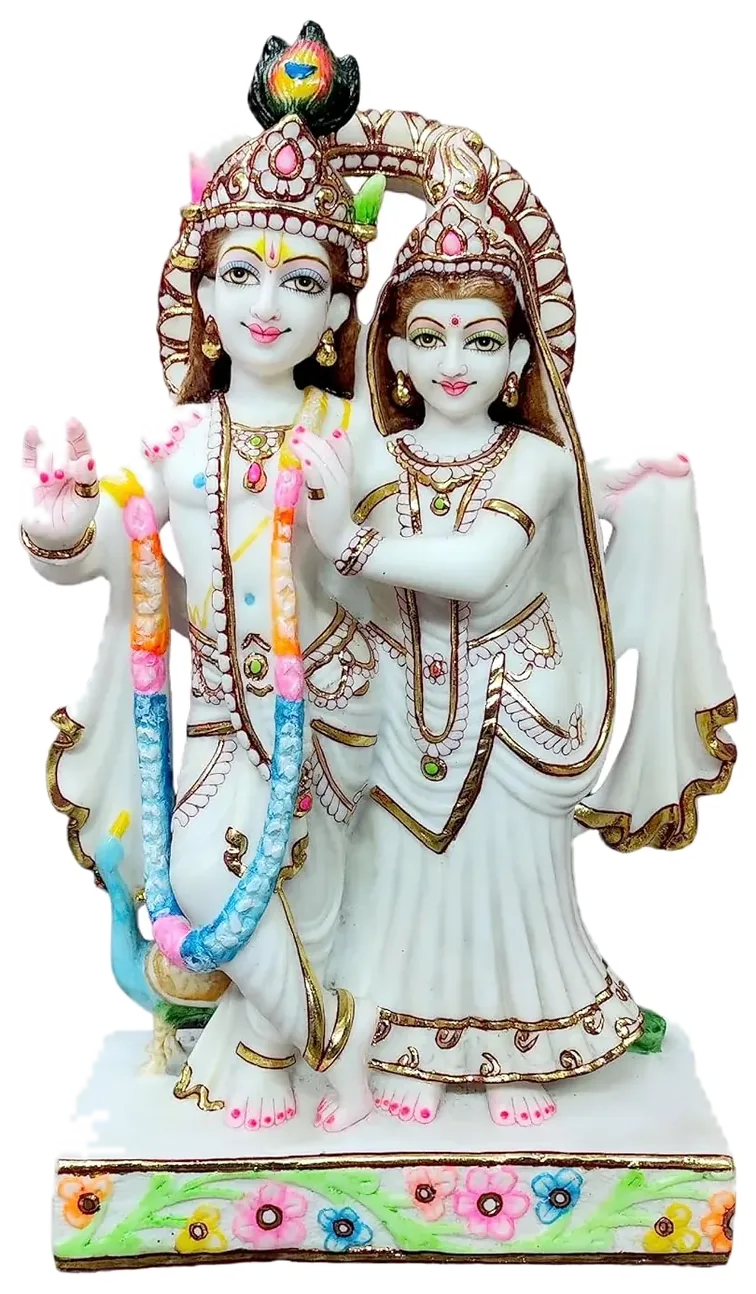
Radha Krishna marble statue, 15 inch
राधा कृष्ण संगमरमर मूर्ति, 15 इंच
₹8,000
A hand carved white marble Radha Krishna, fifteen inches, for a home shrine.
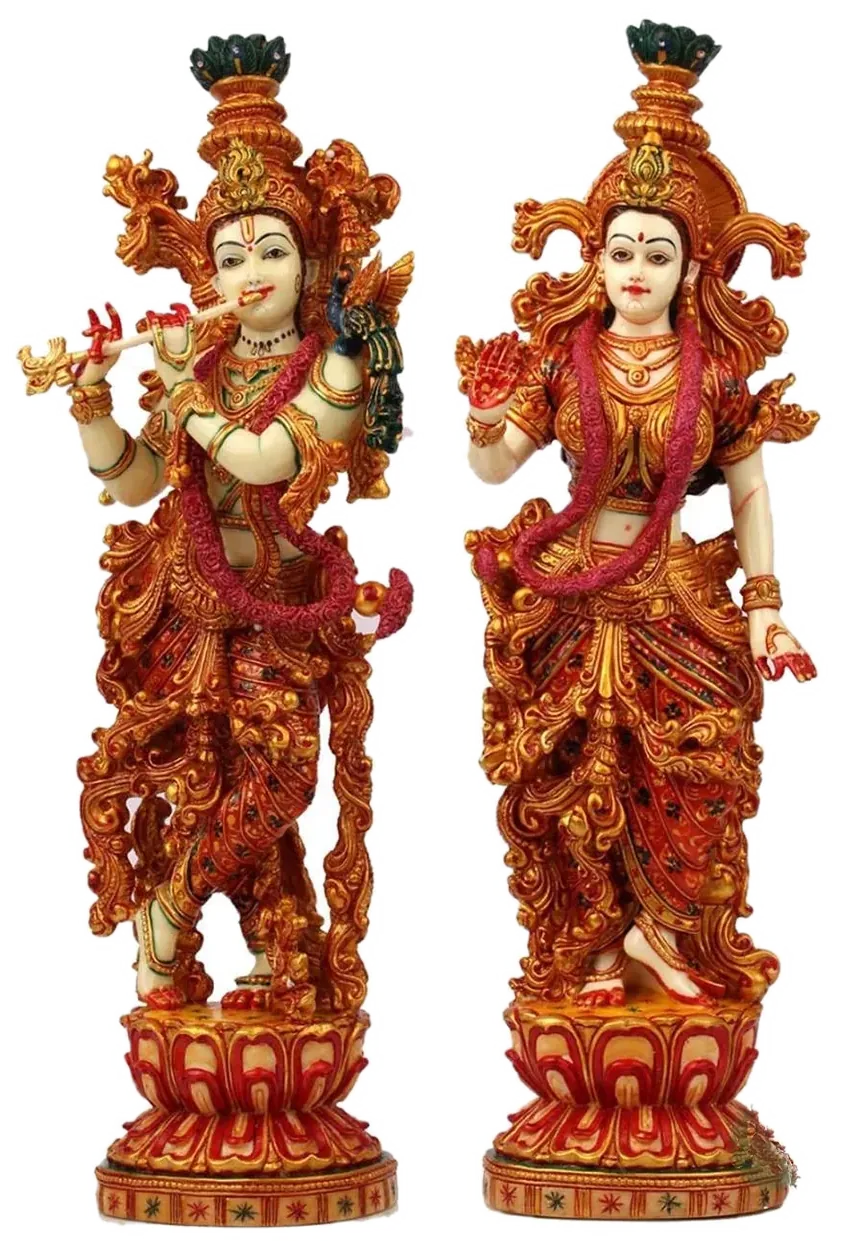
Radha Krishna statue, 15 inch
राधा कृष्ण मूर्ति, 15 इंच
₹14,999
A tall cold cast statue with marble dust and hand painted detail.
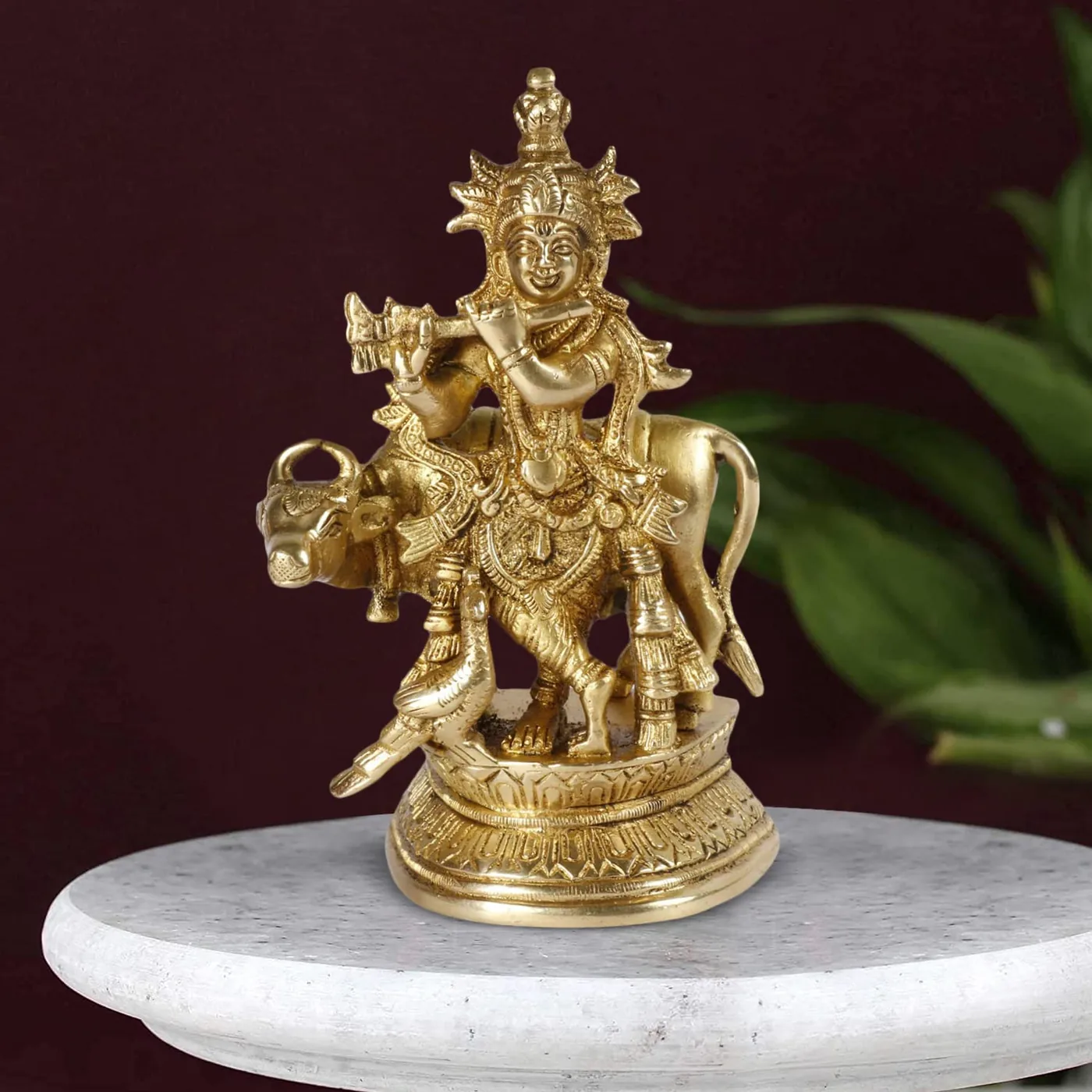
Krishna with cow, brass
गाय के साथ कृष्ण, पीतल
₹2,626
Solid brass, Krishna at the flute with a cow beside him, five and a half inches.