
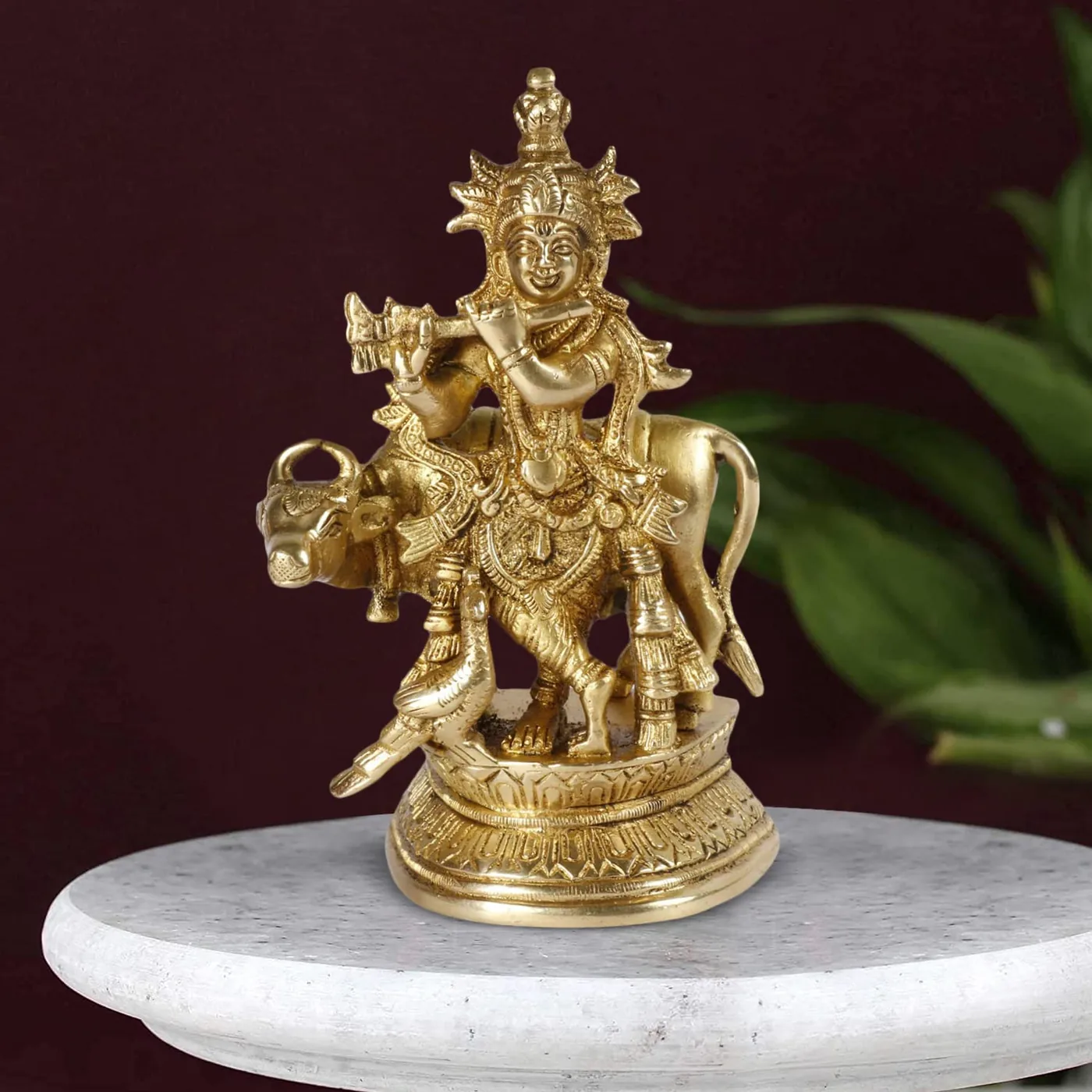
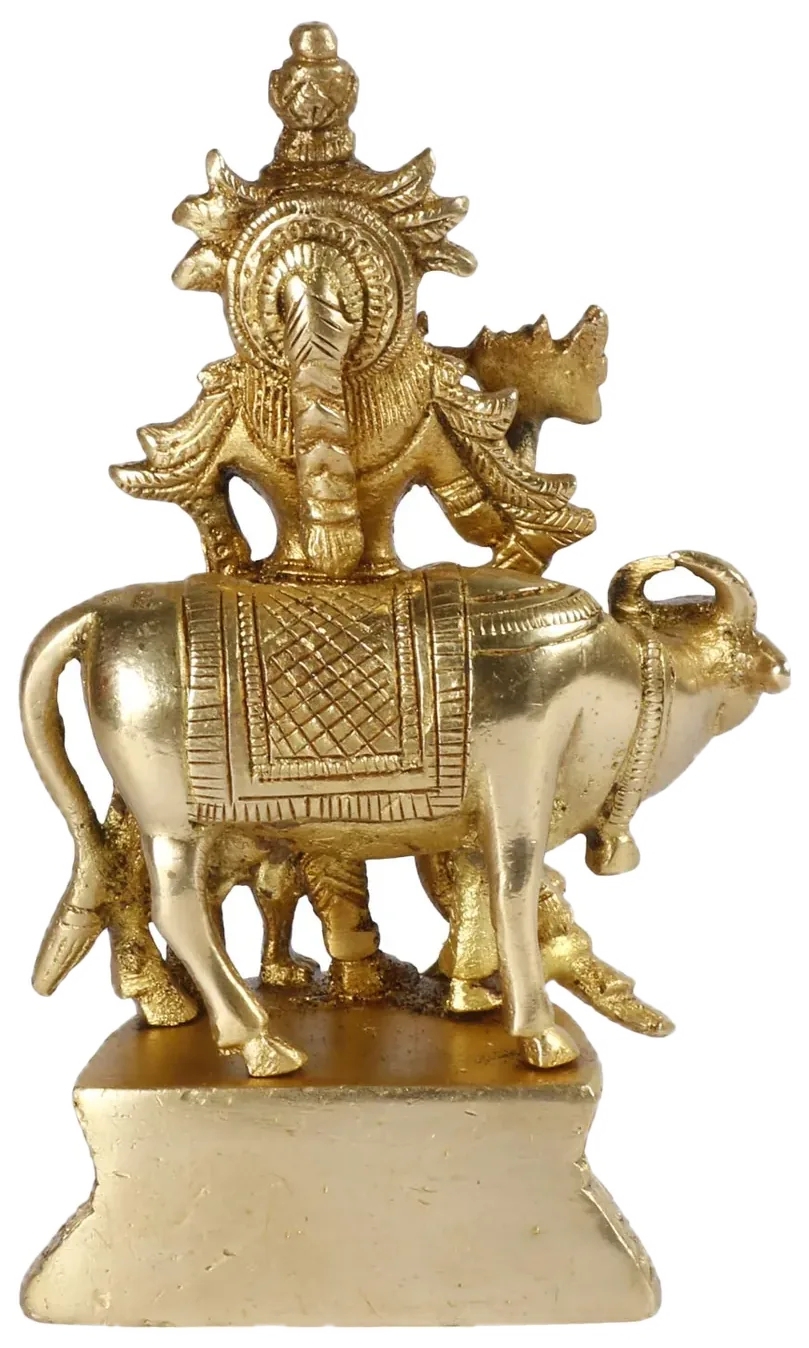
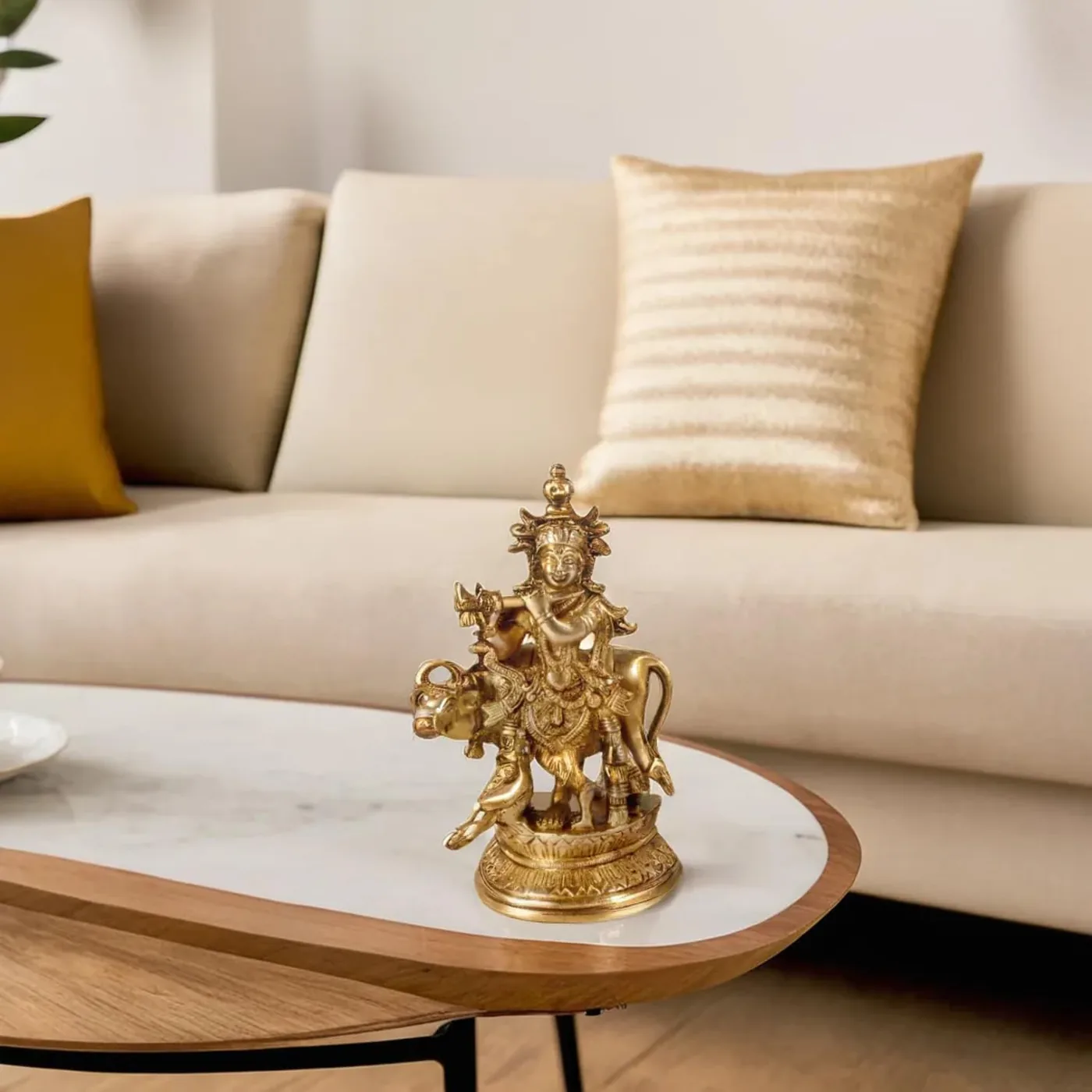
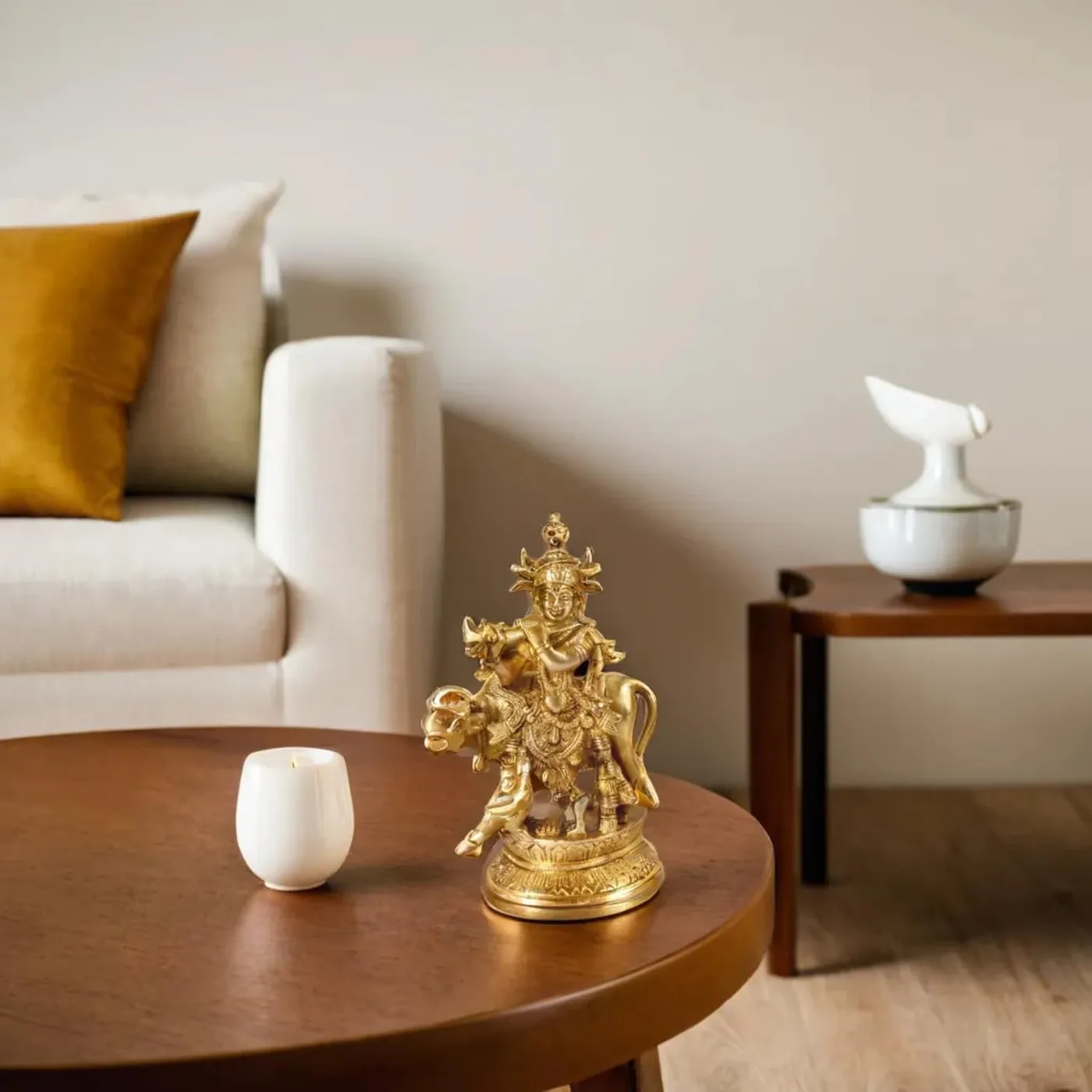
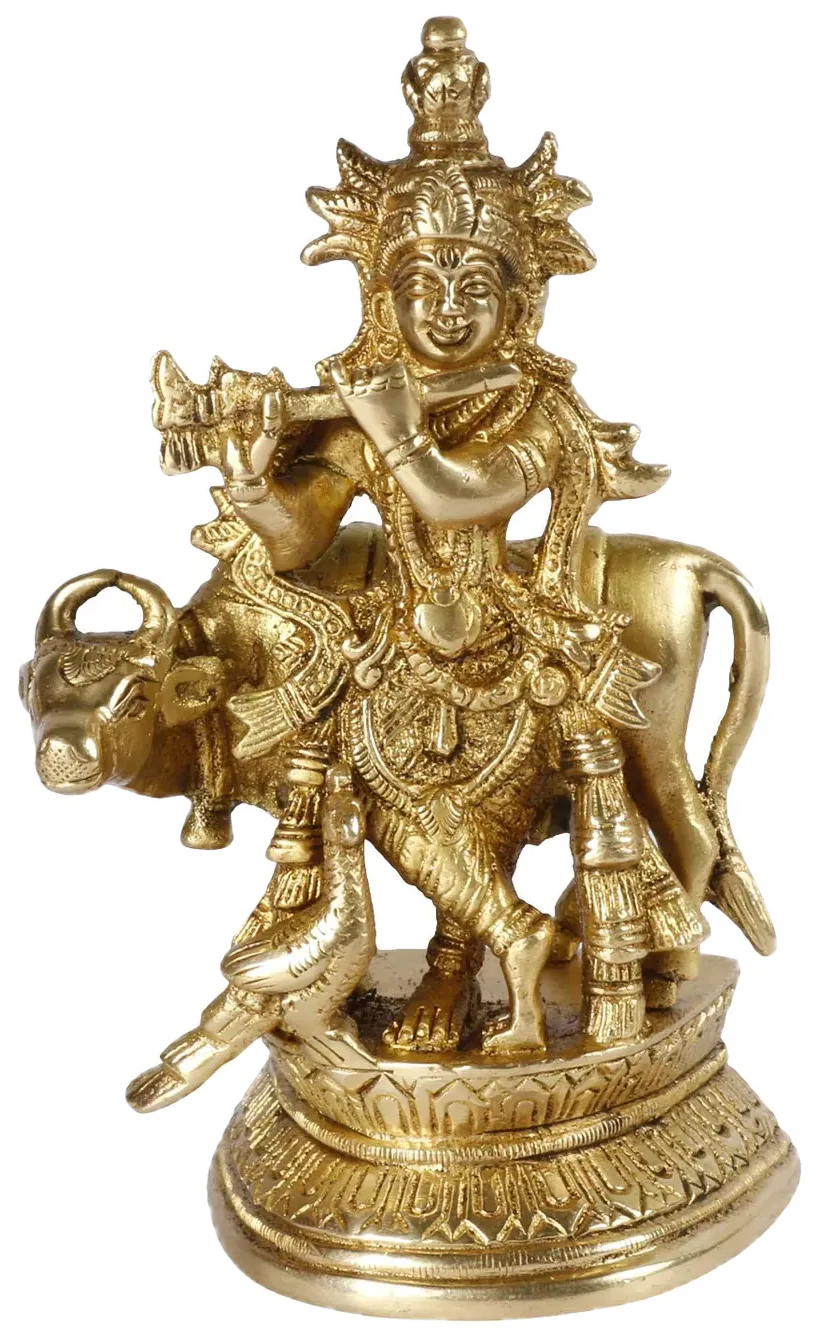
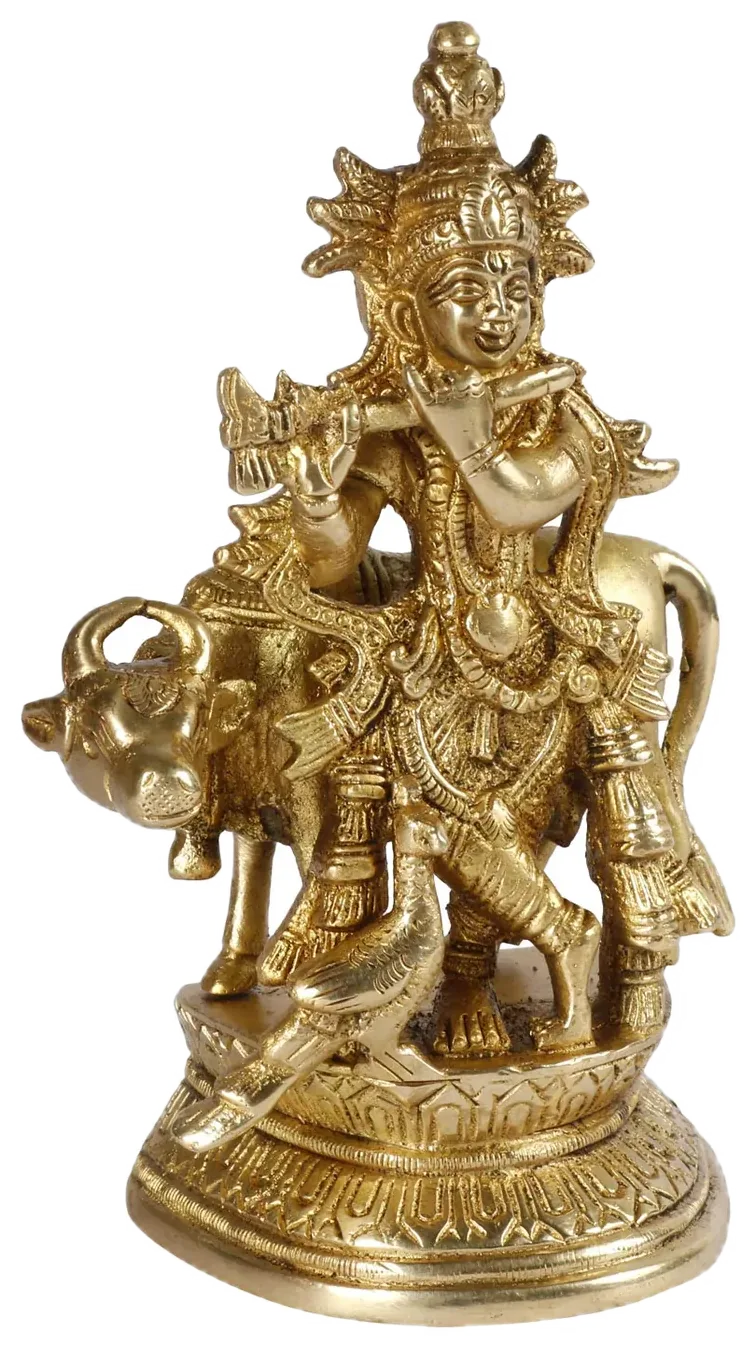
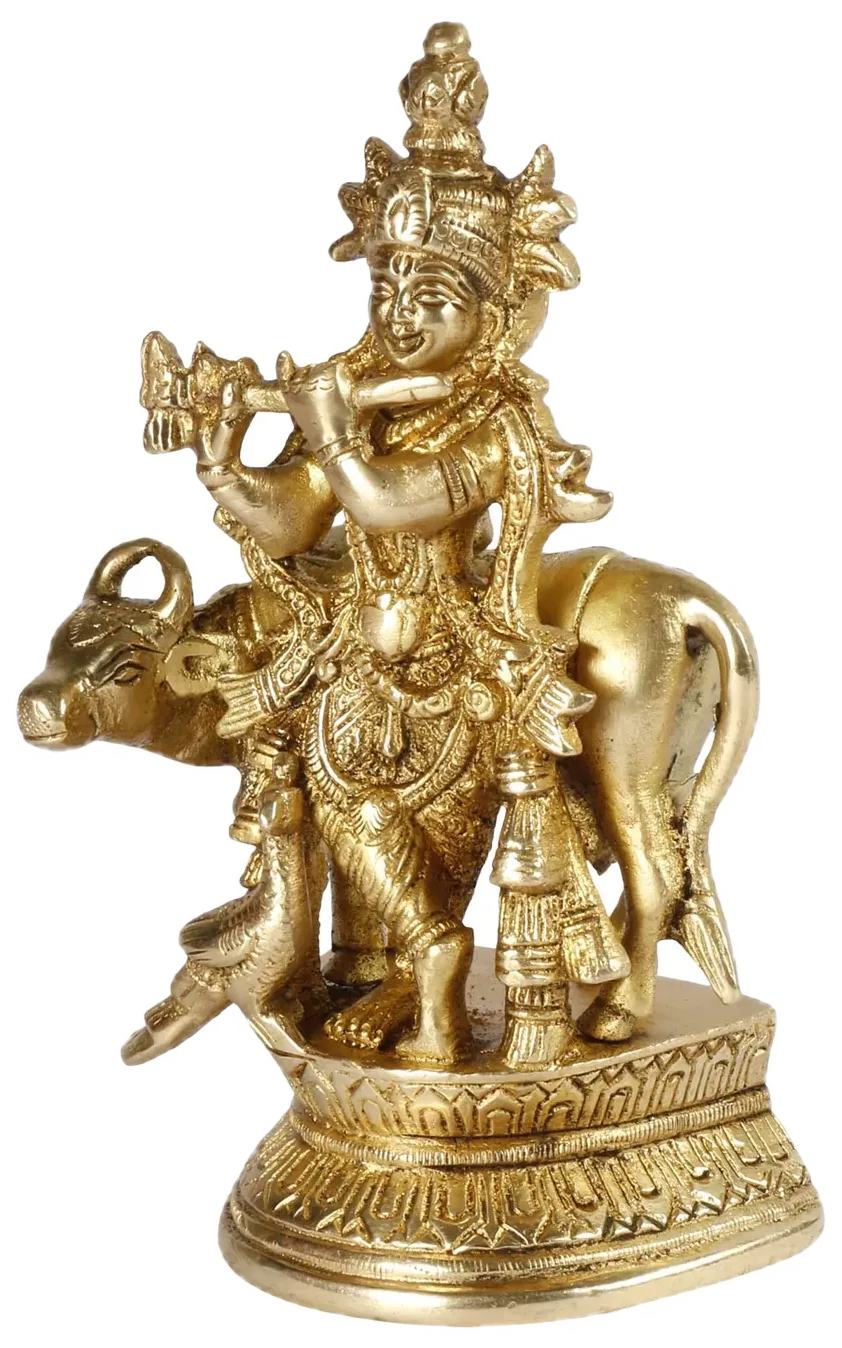
Krishna with cow, brass
गाय के साथ कृष्ण, पीतल
The Braj image rather than the palace one: Krishna standing at the flute with a cow beside him, cast in solid brass at five and a half inches.
- Height
- 5.5 inches
- Material
- Brass
- Weight
- About 800 g
- Base
- 3 × 2 inches
About this murti
Braj does not picture Krishna on a throne. It pictures him where the stories put him, which is out with the cattle, and a murti that includes the cow is showing Govinda rather than the king of Dwarka. In a house whose practice is the Radha naam that is the more fitting image of the two.
Brass at this size is solid rather than hollow, which is why it weighs close to a kilo and why the detail in the flute and the cow's harness survives. It darkens over years and most devotees leave it that way; the ones who prefer it bright use tamarind or a little lemon and salt, never a metal polish, which strips the surface and leaves it dull within months.
Five and a half inches is a working size. It fits a crowded shelf, it does not need a backdrop, and it can be picked up and washed for abhishek without two people and a plan, which is more than can be said for a marble murti of the same subject.
The Braj distinction matters more than it looks. Dwarka shows Krishna as a king, Mathura as a prince, and Braj as a cowherd, and the three are not interchangeable in a home shrine. A household following a Radha centred practice is looking at the Braj Krishna, and the cow beside him is the plainest marker of which one is which.
Small brass murtis of this kind have been made in Moradabad and around Jaipur for generations, and the process has barely changed: a wax model, a clay mould, poured brass, then hand finishing with files and a burnisher. The hand finishing is where the price sits, which is why two castings from the same mould can look quite different in the hand.
What to look for before buying
Solid, not hollow. A five and a half inch brass murti that weighs close to a kilo is solid. One that weighs a few hundred grams is a thin shell, and a shell dents if it is knocked off a shelf and cannot be straightened. Weight is the single most useful number in a brass listing and the one most often left out.
Detail in the cow, not just the figure. Anyone can cast a recognisable Krishna. The test of the mould is the cow: the harness, the fall of the dewlap, the separation between the legs. Where those are soft while the figure is sharp, the mould has been copied from another casting rather than cut fresh, which is common and worth knowing.
Base and standing. Check the murti stands square on a flat surface in the photographs. Brass castings are ground flat after casting and a hurried grind leaves a rock. It is fixable with a felt pad but you should not have to.
Keeping it, and where it sits
Brass darkens. Most devotees leave it that way and a murti that has been in a house for twenty years looks quite unlike a new one, which is generally considered the point rather than a problem. If you prefer it bright, tamarind pulp or a little lemon and salt works and is what Braj households have always used.
Never use a commercial metal polish on a murti you intend to keep. Those work by removing a layer of metal along with the tarnish, and over years they round off exactly the fine detail in the harness and the flute that you paid for. A murti polished hard every month for a decade is visibly softer than one left alone.
It takes abhishek without complaint, which is the practical advantage of brass over resin and over painted stone. Dry it afterwards rather than letting it stand wet, because standing water leaves a green mark at the base where it pools.
It is worth saying plainly that none of this is asked for. Maharaj Ji teaches the Radha naam, and from the asan he is consistent that it needs no image, no ritual and no purchase of any sort. What a brass murti gives a household is a fixed point in the room that everybody walks past in the morning, which is a domestic good and a real one, and which is a different thing from the practice itself.
Brass also suits a house where things get handled. Children pick murtis up, shelves get knocked, and a five and a half inch solid casting survives all of that in a way that painted stone and cold cast resin do not. For a household putting together a first mandir, that durability is usually worth more than the extra detail a moulded piece would give, because the murti that lasts is the one that is still there in twenty years when the detail stopped being the point.
None of this is required. What Maharaj Ji actually asks for is set out on the teachings page, the sayings he repeats most are on the quotes page, and the stotras are free to download as PDFs. If you are planning to visit Vrindavan, read how to meet Maharaj Ji first.
Questions about buying this
Why is Krishna shown with a cow?
Because Braj pictures him where the stories put him, out with the cattle, rather than on a throne. A murti with a cow is Govinda rather than the king of Dwarka, which suits a household whose practice is the Radha naam.
Is the brass solid?
At close to a kilo for five and a half inches, yes. A hollow casting of this size would weigh a few hundred grams and would dent rather than survive a knock.
Can I bathe it for abhishek?
Yes. That is the practical advantage of brass. Dry it afterwards rather than leaving it standing wet, which marks the base.
How do I clean brass without damaging it?
Tamarind pulp, or lemon and salt. Avoid commercial metal polish, which removes a layer of metal each time and rounds off the fine detail over years.
Should I let it darken?
Most households do. A darkened murti is normal and generally preferred. Brightening it is a matter of taste rather than of correctness.
Is brass a good choice for a house with children?
Yes. A solid casting survives being picked up and knocked in a way painted stone and resin do not, which matters more over twenty years than fine detail does.
Is this connected with Maharaj Ji or the ashram?
No. It is not supplied by, authorised by or endorsed by Maharaj Ji or Shri Hit Radha Keli Kunj. It is an ordinary devotional item sold by other people on Amazon, listed here because a devotee might want one.
Do you sell it?
No. The button on this page takes you to Amazon. Amazon takes the payment, ships the order and handles returns and warranty. We hold no stock, never see your payment details, and cannot change or cancel an order.
Is the price on this page current?
It is the price we last saw on Amazon, with the date beside it. Amazon changes prices whenever it likes, so treat the figure here as a guide and the price on the Amazon page as the real one.
Do you make money if I buy it?
Yes. As an Amazon Associate we earn from qualifying purchases. Your price is exactly the same whether you use our link or not; Amazon pays the commission out of its own margin, and that commission is what keeps this site free to read.
Do I need this to follow the teachings?
No. Maharaj Ji asks for the Radha naam and nothing else, with no initiation, no fee and no equipment. Anything on this page is convenience, never a requirement, and he is explicit about that in satsang.
Also for the home mandir
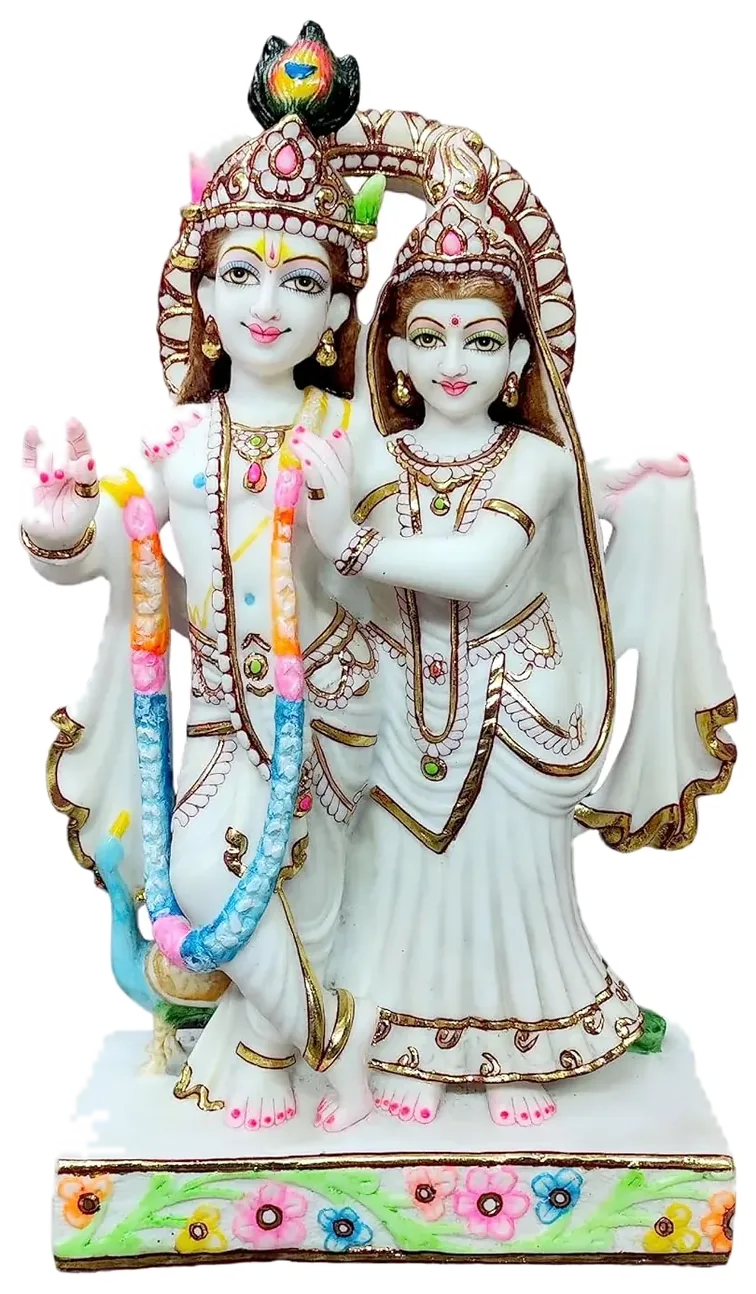
Radha Krishna marble statue, 15 inch
राधा कृष्ण संगमरमर मूर्ति, 15 इंच
₹8,000
A hand carved white marble Radha Krishna, fifteen inches, for a home shrine.
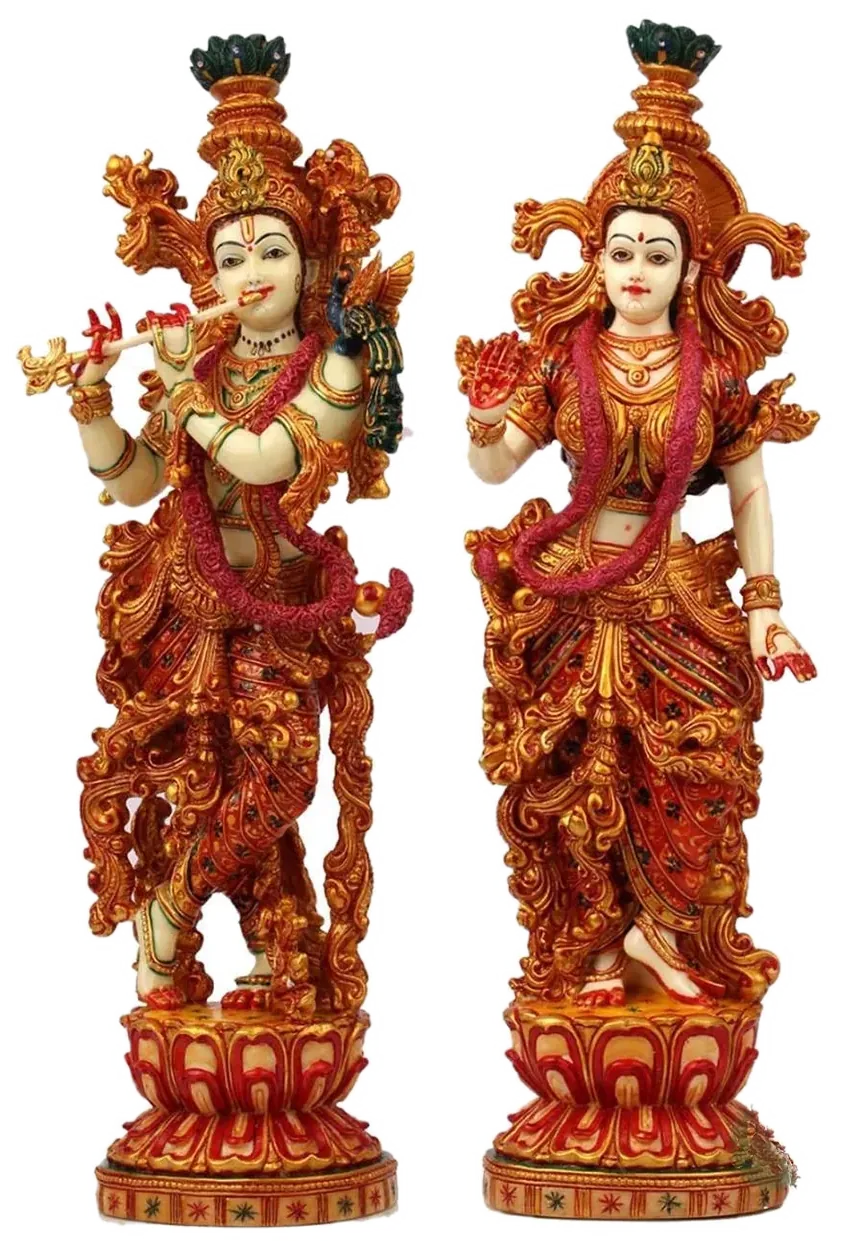
Radha Krishna statue, 15 inch
राधा कृष्ण मूर्ति, 15 इंच
₹14,999
A tall cold cast statue with marble dust and hand painted detail.
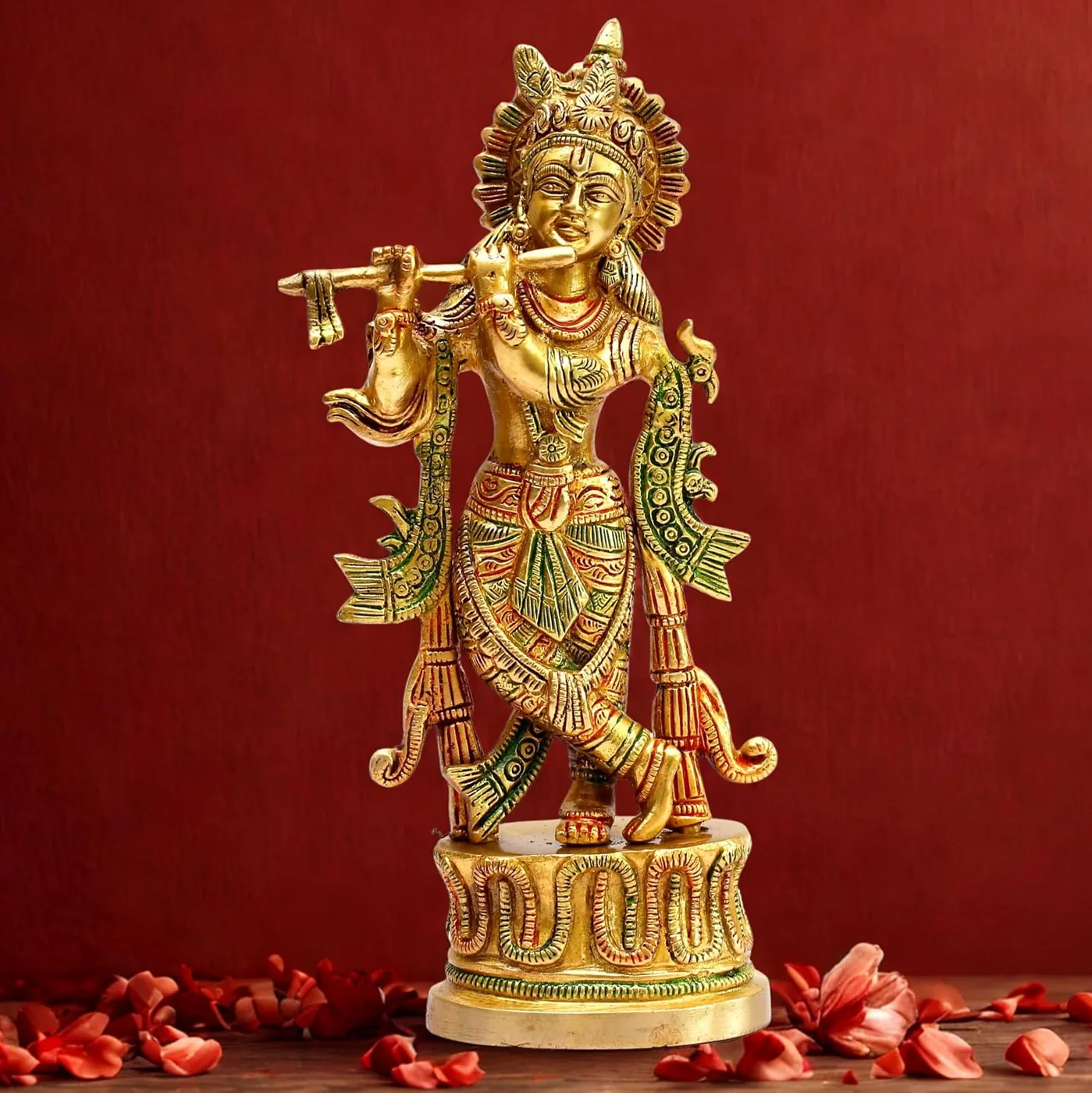
Krishna at the flute, brass
बाँसुरी बजाते कृष्ण, पीतल
₹2,299
Krishna standing at the flute in pure brass, twenty two centimetres, with enamel detail.