
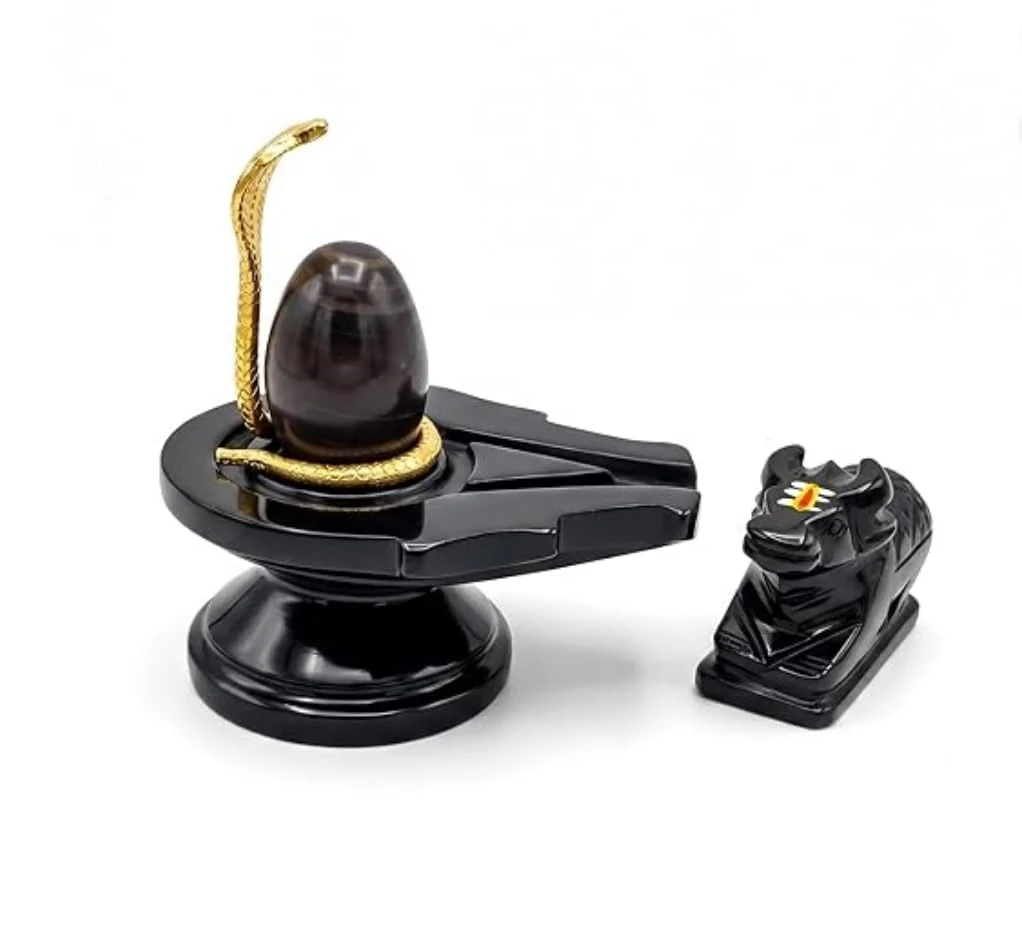
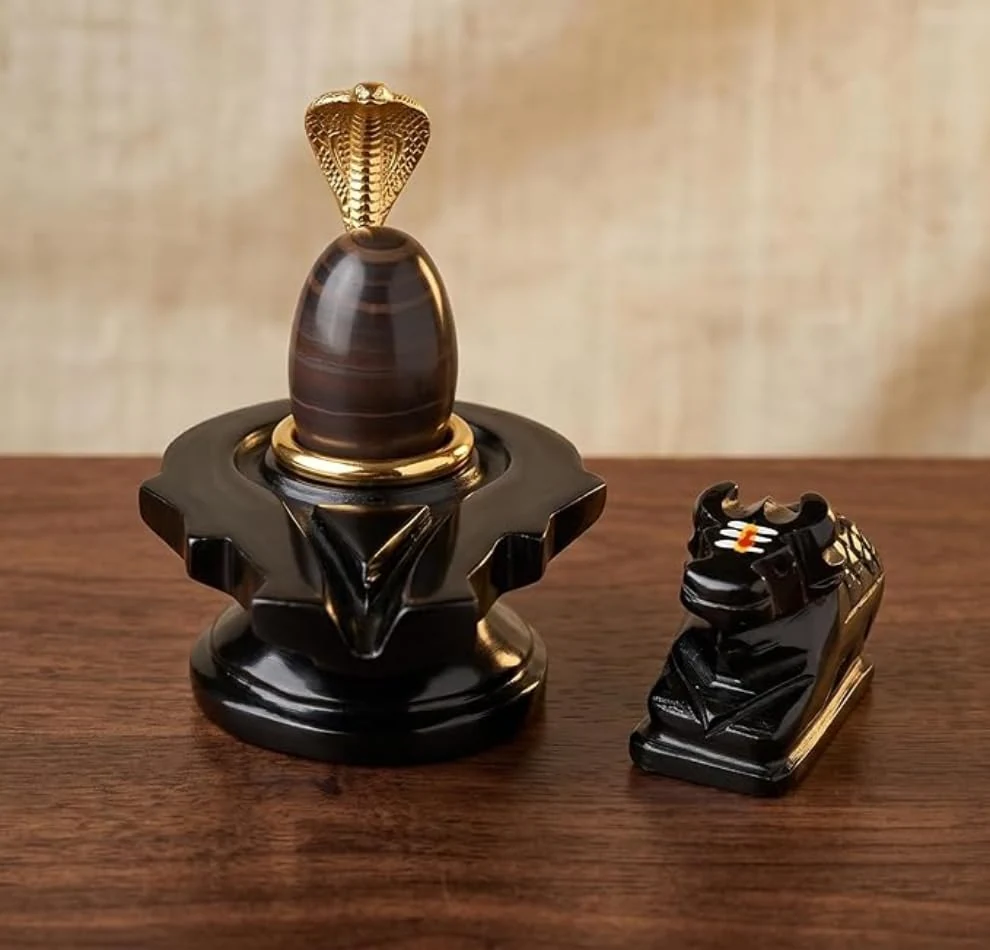
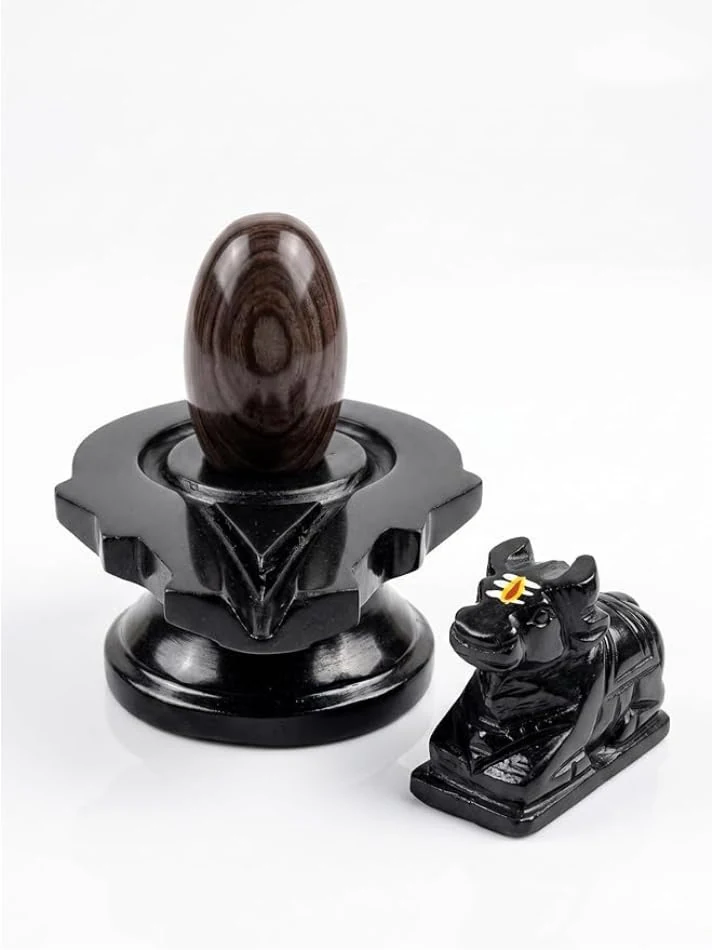
Narmadeshwar shivling with brass snake and Nandi
नर्मदेश्वर शिवलिंग, ब्रास नाग और नंदी सहित
A Narmadeshwar shivling of natural river stone, about three inches, supplied as a set with a brass snake hood and a small stone Nandi. Light at around 170 grams.
- Height
- About 3 inches
- Weight
- About 170 g
- Stone
- Narmada river stone
- Set
- Shivling, brass snake, Nandi
About this shivling
A Narmadeshwar shivling, also called a banalinga, is not carved into shape. It is a stone taken from the bed of the Narmada, worn into an oval by the river over a very long time, and then polished. That is the whole basis of its standing in practice: it is described as self formed rather than made, and traditionally such a stone requires no ceremony of installation before it is used, which is unusual.
The stone itself is a hard cryptocrystalline quartz, usually dark grey or brown with lighter banding, and no two are alike. That variation is the point rather than a flaw. Pieces that are identical in colour and marking across a batch of listing photographs are worth a second look, because moulded resin shivlings with printed banding are common and are sold under the same name.
The set includes a brass snake to sit over the stone and a small stone Nandi to place in front. Both are conventional rather than required: the snake hood is the standard iconography and the bull is the vahana placed facing the ling. Nothing is missing from a shivling that has neither, and a set simply saves buying three things separately.
What a shivling is actually for, in daily practice, is abhishek: water poured over it, continuously or at a fixed time. This is the object in the mandir most likely to be wet every day, which is why it usually sits in a dish or on a jalahari with a channel for the water to run off. If you buy a shivling, buy or arrange the drainage at the same time, because water pooling on a wooden mandir shelf will destroy the shelf before it does anything to the stone.
On where it belongs: a shivling is a Shaiva article, plainly and without qualification. The practice of Braj, and the Radhavallabh line in which Maharaj Ji stands, turns on Shri Radha, and a Vrindavan household mandir would not have a shivling in the middle of it. Many Indian homes keep both, which is ordinary, and this page would rather set that out than blur it.
The practical warning on this page is worth repeating because it is the one that actually costs people money. A shivling that is used is wet every day, and a wooden mandir shelf under a daily flow of water will be ruined long before the stone shows anything at all. Sort the drainage out on the day it arrives rather than in the month after the shelf has swollen.
What to look for before buying
Natural stone varies, resin does not. Genuine Narmadeshwar stones differ from one another in colour, banding and shape, because a river made them rather than a mould. If every photograph in a listing shows an identical pattern, or if the banding looks printed rather than running through the body of the stone, you are probably looking at cast resin. Ask whether the photograph is of the actual piece you will receive.
Weigh it in your mind. Quartz is dense. A three inch stone shivling should feel heavier than it looks, and noticeably cool to the touch for several seconds before warming. Resin is light and warms immediately in the hand. This is the same test used for sphatik beads and it is just as reliable here.
Sort out the water before it arrives. A shivling that is used is a shivling that is wet every day. Check whether the set includes a jalahari or dish, and if it does not, buy one. Water running onto a wooden or laminate shelf swells it from underneath and the damage is invisible until the shelf is permanently marked. This is the practical problem with a shivling and it is entirely preventable.
Keeping it, and where it sits
The stone needs almost nothing. Quartz does not stain, does not swell and is not harmed by water, so rinsing it is the whole routine and it can be done as often as you like. If anything dries onto it, warm water and patience will lift it; there is no need for soap and no reason to scrub.
The brass snake is the part that needs attention, not the stone. Brass that is wet every day and not dried will go green at the edges within months. Lift it off after abhishek, dry it, and put it back. If that is too much daily trouble, keep the snake beside the shivling rather than on it and it will stay bright for years.
Do not put turmeric or kumkum directly onto a stone that sits on a wooden base, and do not let coloured water run into the wood. The stone will not stain but the base will, and a marked base is what makes an otherwise perfect set look neglected after a couple of years.
Store the pieces together if the set is ever put away. The Nandi and the snake are small, they are easily separated in a drawer, and a shivling set that has lost its snake cannot be matched afterwards because every seller's casting is a slightly different size. A cloth bag for all three solves it.
None of this is required. What Maharaj Ji actually asks for is set out on the teachings page, the sayings he repeats most are on the quotes page, and the stotras are free to download as PDFs. If you are planning to visit Vrindavan, read how to meet Maharaj Ji first.
Also worth reading: sayings from satsang , and questions people ask.
Questions about buying this
What is a Narmadeshwar shivling?
A stone shaped by the Narmada river rather than carved, then polished. It is called a banalinga, and traditionally it needs no installation ceremony because it is regarded as self formed.
How do I know the stone is natural?
Natural stones vary in colour and banding and no two match. They are dense and feel cool for several seconds in the hand. Uniform identical pieces are usually cast resin.
Do I need the snake and the Nandi?
No. Both are conventional rather than necessary. A set simply saves buying them separately.
How is a shivling worshipped at home?
Principally by abhishek, water poured over it. That means it needs a dish or jalahari so the water runs off rather than onto the shelf.
Does it need to be consecrated before use?
A Narmadeshwar stone is traditionally held not to require the installation ceremony that a carved image would, on the basis that the river shaped it rather than a person.
Does a shivling belong in a Radha Krishna mandir?
No. Nothing material is asked for, and the claims made in listings about negativity and Vastu are not part of any teaching repeated on this site.
Is this connected with Maharaj Ji or the ashram?
No. It is not supplied by, authorised by or endorsed by Maharaj Ji or Shri Hit Radha Keli Kunj. It is an ordinary devotional item sold by other people on Amazon, listed here because a devotee might want one.
Do you sell it?
No. The button on this page takes you to Amazon. Amazon takes the payment, ships the order and handles returns and warranty. We hold no stock, never see your payment details, and cannot change or cancel an order.
Is the price on this page current?
It is the price we last saw on Amazon, with the date beside it. Amazon changes prices whenever it likes, so treat the figure here as a guide and the price on the Amazon page as the real one.
Do you make money if I buy it?
Yes. As an Amazon Associate we earn from qualifying purchases. Your price is exactly the same whether you use our link or not; Amazon pays the commission out of its own margin, and that commission is what keeps this site free to read.
Do I need this to follow the teachings?
No. Maharaj Ji asks for the Radha naam and nothing else, with no initiation, no fee and no equipment. Anything on this page is convenience, never a requirement, and he is explicit about that in satsang.
Also for the home mandir
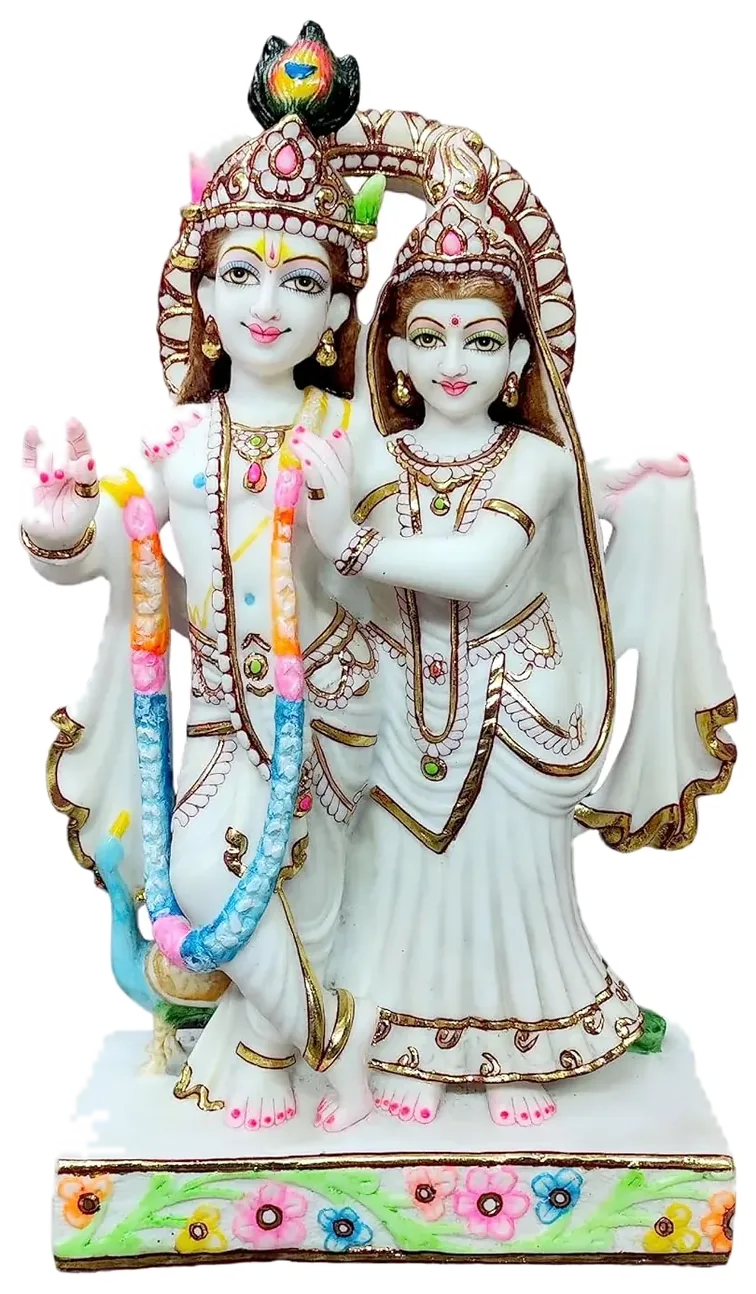
Radha Krishna marble statue, 15 inch
राधा कृष्ण संगमरमर मूर्ति, 15 इंच
₹8,000
A hand carved white marble Radha Krishna, fifteen inches, for a home shrine.
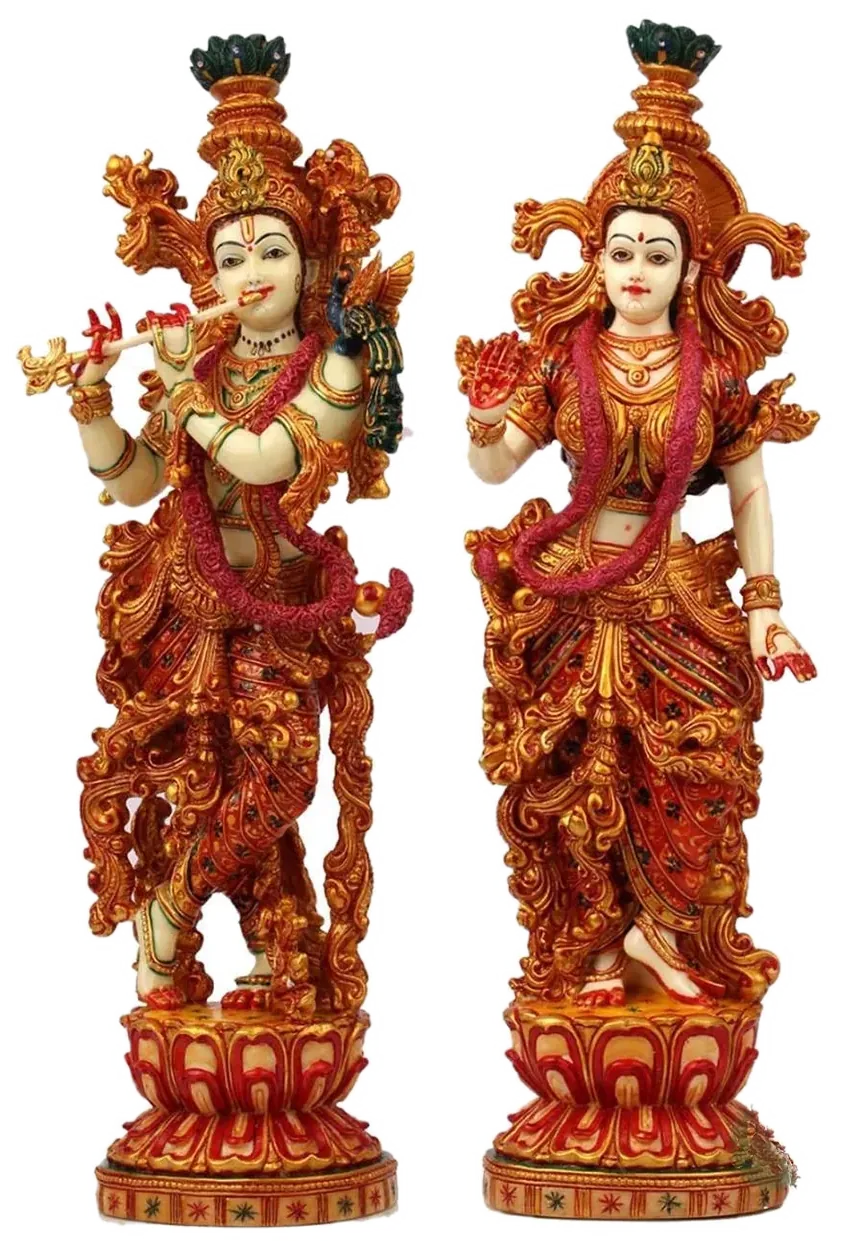
Radha Krishna statue, 15 inch
राधा कृष्ण मूर्ति, 15 इंच
₹14,999
A tall cold cast statue with marble dust and hand painted detail.
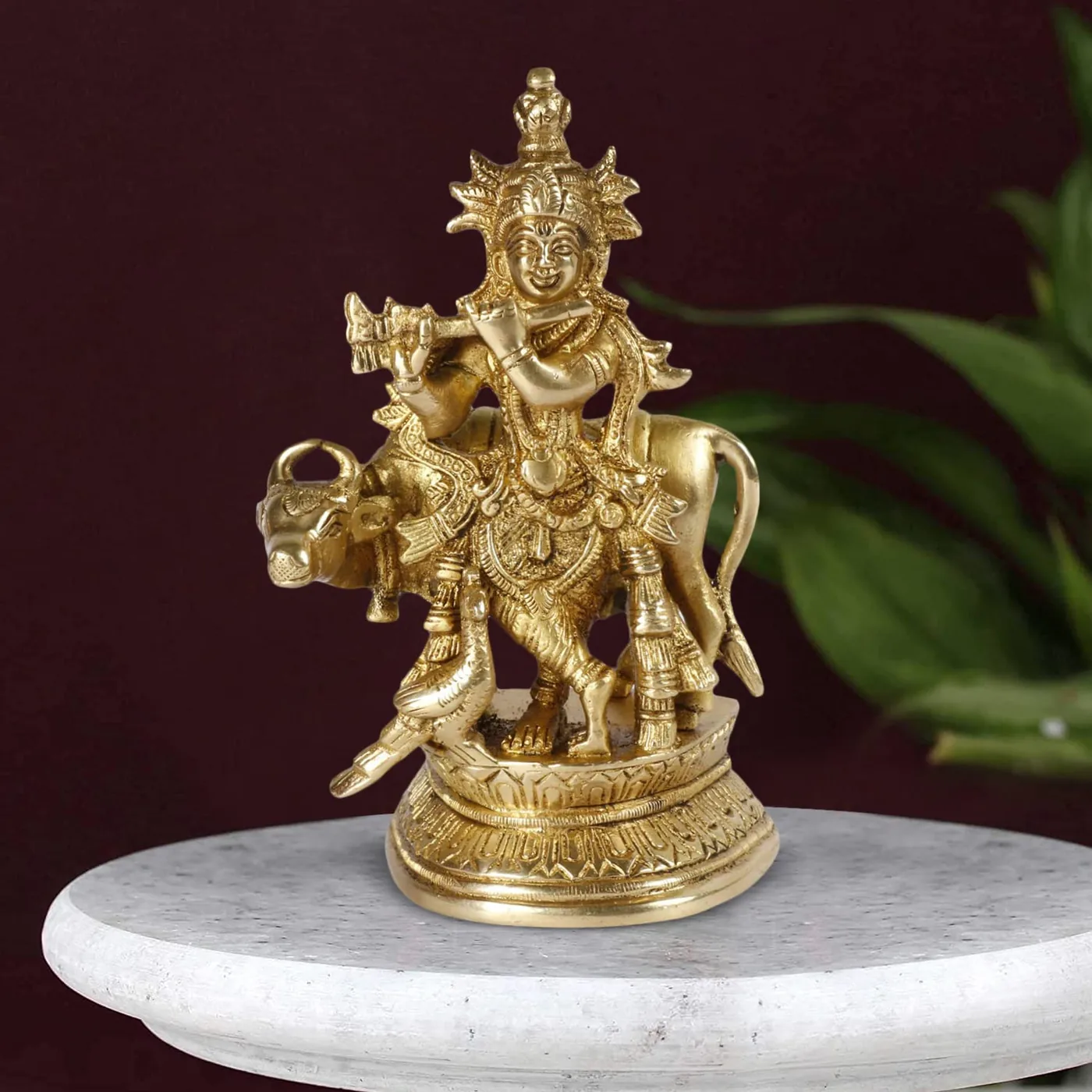
Krishna with cow, brass
गाय के साथ कृष्ण, पीतल
₹2,626
Solid brass, Krishna at the flute with a cow beside him, five and a half inches.