
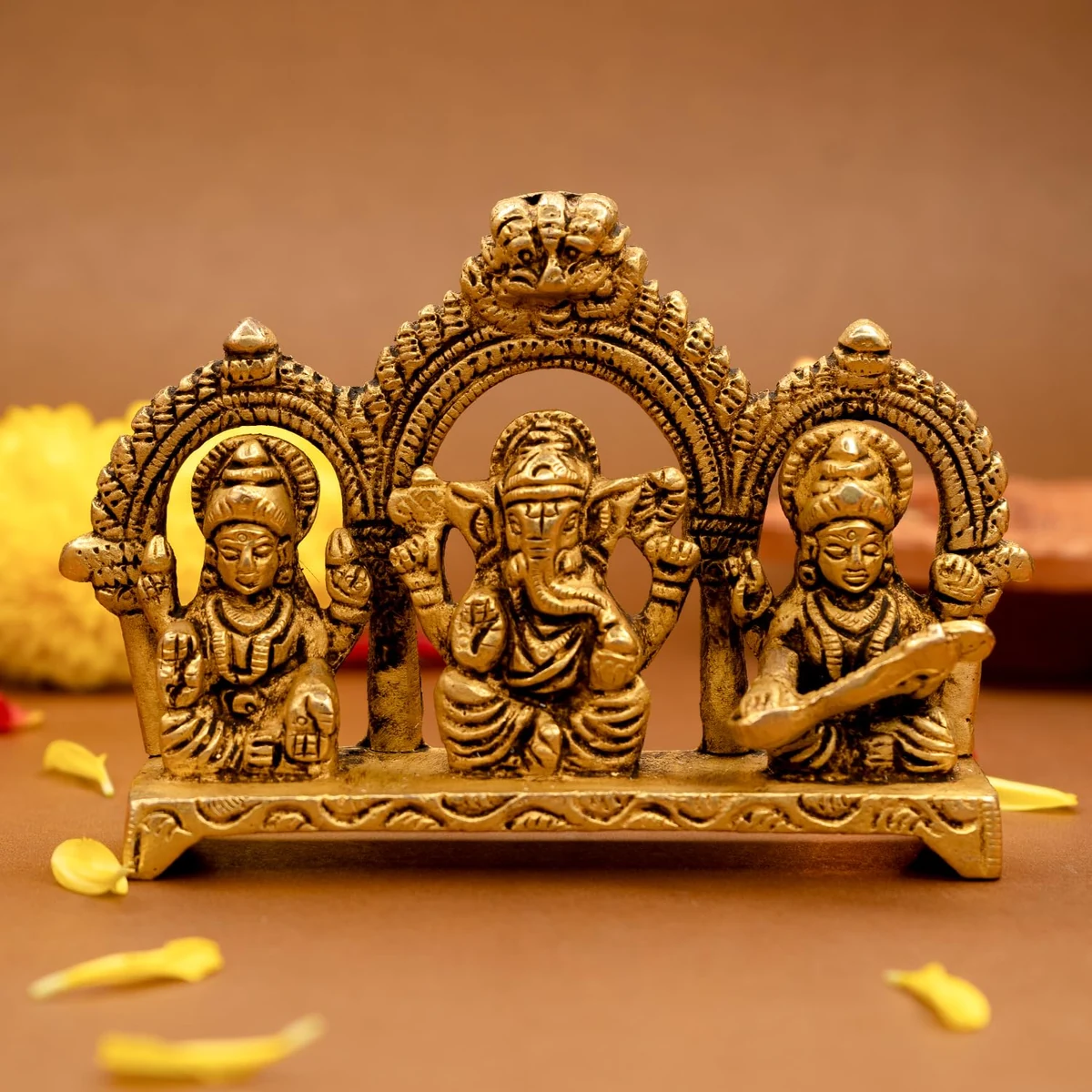
Laxmi Ganesh Saraswati brass murti
लक्ष्मी गणेश सरस्वती पीतल मूर्ति
Laxmi, Ganesh and Saraswati cast together on a single base, twelve centimetres across and eight tall. The Diwali grouping, in one piece rather than three separate murtis.
- Size
- 12 by 8 cm
- Weight
- 358 g
- Material
- Brass
- Finish
- Polished
About this murti set
The three figures are grouped for a reason that is easy to state. Ganesh is the one invoked at the start of anything, Laxmi is associated with what sustains a household and Saraswati with learning and skill. Put together, the group is the standard Diwali arrangement across much of India, particularly in businesses, where the year's books are opened in front of it.
What is unusual here is that they are cast as one piece on a shared base rather than sold as three murtis. That has real advantages: the proportions match, they cannot be arranged wrongly, they take up a fraction of the shelf space, and nothing gets separated or lost. It also means the arrangement is fixed forever, and that a chip or a bend affects the whole thing rather than one figure you could replace.
Twelve centimetres across and three hundred and fifty grams puts this firmly in the small category. It is a desk or shop counter piece, or an addition to a mandir that already has its centre. It is not going to be the main murti in a household mandir, and it is not built for a daily routine of bathing and dressing, which at this size is fiddly to the point of not being worth it.
Polished brass is bright when it arrives and does not stay bright by itself. In ordinary Indian conditions it will begin to film over within a few weeks, faster near a kitchen or in a coastal city. That is not a defect, it is what the metal does, and it is easily reversed. It does mean that if you want something that always looks as it did on day one with no attention at all, an antiqued finish is the better buy.
All three of these are worshipped widely across sampradayas and none is unusual in a Vaishnava household. Braj homes follow a settled convention about position: the pair of Shri Radha and Shri Krishna occupy the heart of the shrine, with a group like this alongside rather than at the focus. That is arrangement rather than rule, but it is what you will see in Vrindavan.
A final note on what this group is usually for. It goes on a counter at Diwali, in a shop, on a desk where work is done. That is an old and unpretentious use and it does not need dressing up as anything more. If that is why you are buying it, you are buying it for exactly the right reason and this page has nothing to add.
What to look for before buying
One casting or three pieces. A single cast group and three separate murtis are different products often photographed to look alike. A single piece is neater and cannot be misarranged; separate figures can be spaced, dressed and replaced individually. Decide which you actually want before ordering, because the photographs alone frequently do not make it obvious.
Check all three faces, not just the front one. On a small group casting the central figure usually comes out best because the mould fills there first, and the outer two can be noticeably softer. Zoom in on Laxmi and Saraswati as carefully as on Ganesh. If the outer faces are indistinct, the whole piece will look wrong on a shelf however good the middle one is.
Confirm the size against something familiar. Twelve centimetres across is about the width of a hand. Small murtis are routinely photographed to look far larger, and the commonest complaint in this category is not quality but scale. Hold your hand at the stated width before ordering and decide whether that is the object you were imagining.
Keeping it, and where it sits
Dry dusting weekly, with a soft brush for the crowns and the instruments. That is nearly all the care a small brass group needs, and doing it regularly means the metal rarely reaches the point where it needs actual cleaning, since dust holding moisture against brass is what accelerates tarnish.
When it dulls, use lemon and salt or tamarind, worked gently with the fingers, rinsed off at once and dried thoroughly. Keep the paste out of the recesses between the three figures, where residue dries to a pale crust that is harder to remove than the tarnish. A soft brush and clean water immediately afterwards deals with it.
Do not put it where cooking fumes reach it. A shop counter or a kitchen shelf will film a polished brass piece far faster than a living room, and grease combined with tarnish is much harder to clean than tarnish on its own. If it must go in a kitchen, expect to clean it several times a year.
Keep it dry, and dry it properly if it is ever washed. Water standing between the figures, where three bodies meet on one base, is the one place on this casting that green deposits will appear. It is also the hardest place to reach, so prevention here is worth more than cure.
None of this is required. What Maharaj Ji actually asks for is set out on the teachings page, the sayings he repeats most are on the quotes page, and the stotras are free to download as PDFs. If you are planning to visit Vrindavan, read how to meet Maharaj Ji first.
Also worth reading: the sayings page , and free downloads.
Questions about buying this
Why are Laxmi, Ganesh and Saraswati kept together?
Ganesh is invoked first at any beginning, Laxmi is associated with what sustains a household and Saraswati with learning. The group is the standard Diwali arrangement, especially in businesses.
Is a single casting better than three separate murtis?
It is neater, cheaper and cannot be arranged wrongly, but the arrangement is permanent and damage affects the whole piece. Separate murtis can be spaced, dressed and replaced individually.
How big is this murti?
About twelve centimetres across and eight tall, roughly the width of a hand, weighing 358 grams. It is a desk or counter piece rather than a main mandir murti.
Will polished brass stay bright?
No. It films over within weeks in ordinary conditions and needs occasional cleaning. An antiqued finish keeps its look with no attention.
Where should this be placed?
Anywhere clean and dry. Vrindavan households give the focus of the shrine to the divine pair and set groups such as this one alongside.
Is a murti needed for the practice Maharaj Ji teaches?
No. What is asked for is free, and it has never been connected to prosperity, to a shop’s accounts or to what stands on a counter.
Is this connected with Maharaj Ji or the ashram?
No. It is not supplied by, authorised by or endorsed by Maharaj Ji or Shri Hit Radha Keli Kunj. It is an ordinary devotional item sold by other people on Amazon, listed here because a devotee might want one.
Do you sell it?
No. The button on this page takes you to Amazon. Amazon takes the payment, ships the order and handles returns and warranty. We hold no stock, never see your payment details, and cannot change or cancel an order.
Is the price on this page current?
It is the price we last saw on Amazon, with the date beside it. Amazon changes prices whenever it likes, so treat the figure here as a guide and the price on the Amazon page as the real one.
Do you make money if I buy it?
Yes. As an Amazon Associate we earn from qualifying purchases. Your price is exactly the same whether you use our link or not; Amazon pays the commission out of its own margin, and that commission is what keeps this site free to read.
Do I need this to follow the teachings?
No. Maharaj Ji asks for the Radha naam and nothing else, with no initiation, no fee and no equipment. Anything on this page is convenience, never a requirement, and he is explicit about that in satsang.
Also for the home mandir
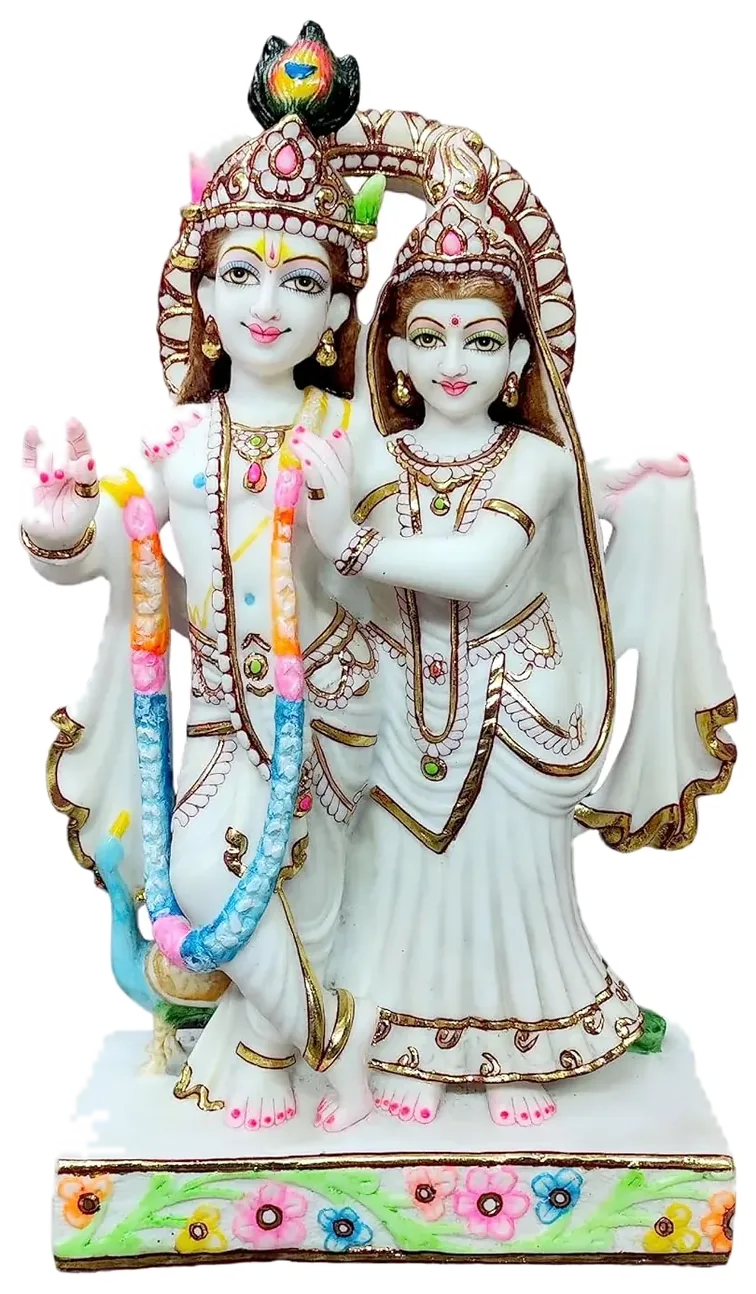
Radha Krishna marble statue, 15 inch
राधा कृष्ण संगमरमर मूर्ति, 15 इंच
₹8,000
A hand carved white marble Radha Krishna, fifteen inches, for a home shrine.
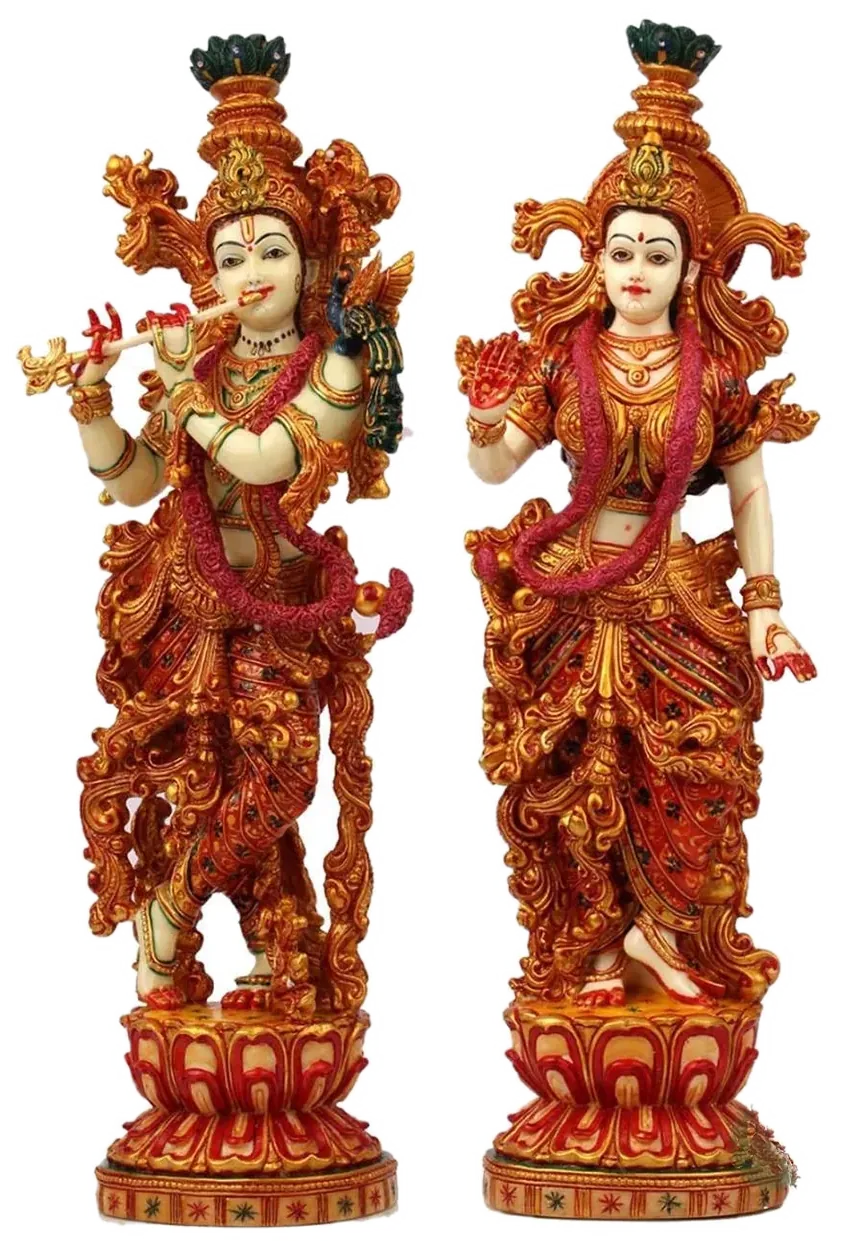
Radha Krishna statue, 15 inch
राधा कृष्ण मूर्ति, 15 इंच
₹14,999
A tall cold cast statue with marble dust and hand painted detail.
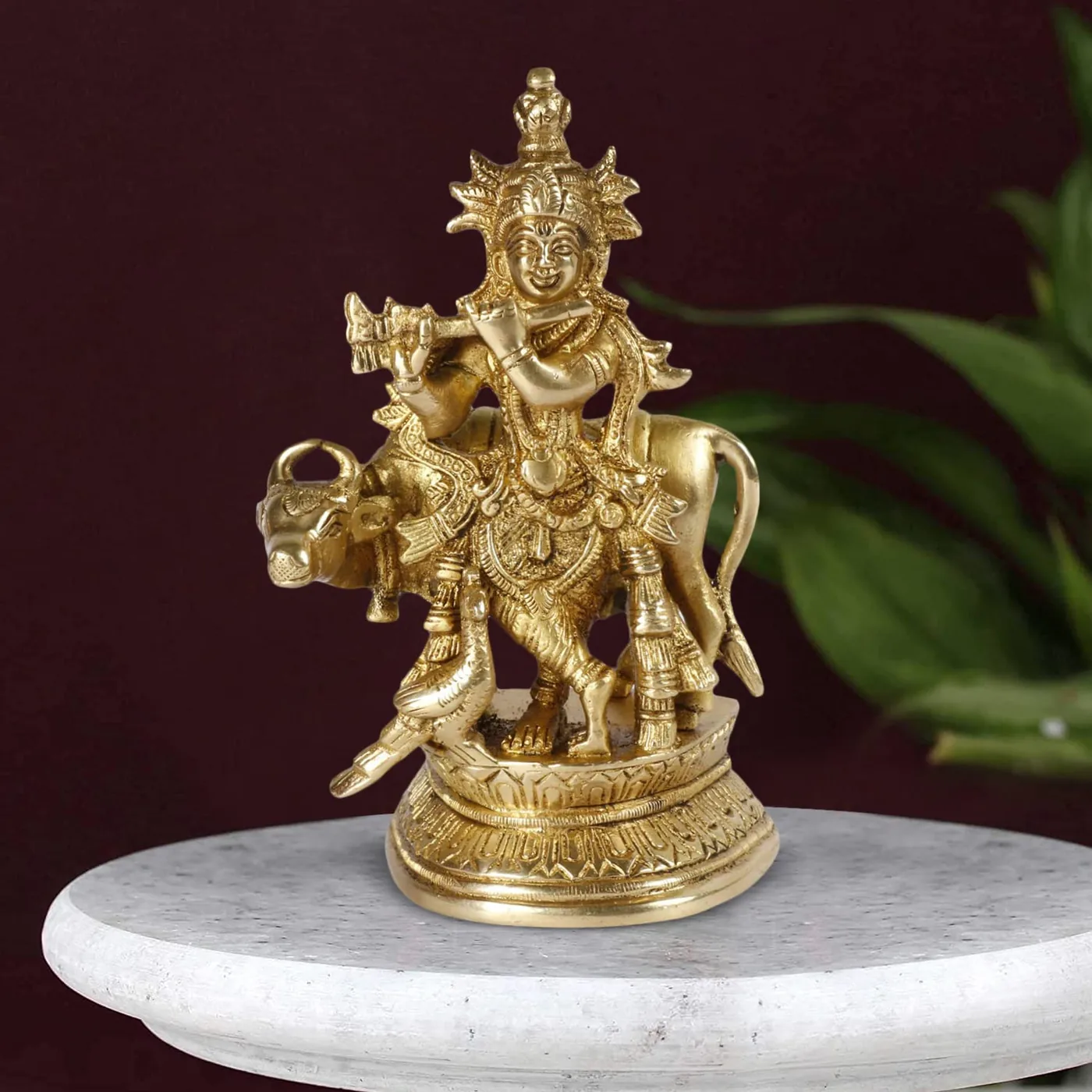
Krishna with cow, brass
गाय के साथ कृष्ण, पीतल
₹2,626
Solid brass, Krishna at the flute with a cow beside him, five and a half inches.