
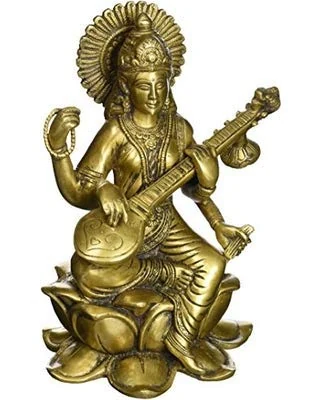
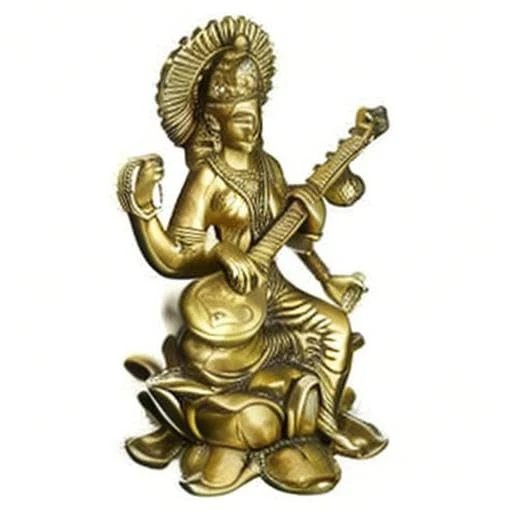
Brass Saraswati idol, 300 g
पीतल सरस्वती मूर्ति, 300 ग्राम
Saraswati seated on a lotus with the veena across her body, cast in brass with an antique finish. About three inches each way and three hundred grams.
- Size
- About 7.6 cm each way
- Weight
- 300 g
- Material
- Brass
- Finish
- Antique
About this saraswati murti
Saraswati is depicted with a small set of attributes that are consistent almost everywhere, and they are worth knowing when looking at a casting. The veena is the one always present, held across the body, standing for music and for the ordering of sound. A book in one hand is learning held rather than performed. A mala in another is practice. The swan at her feet is the discriminating faculty, from the old idea that a swan can separate milk from water.
The lotus she sits on is the standard seat for a deity across Indian iconography and carries the same meaning wherever it appears: something rooted in mud that opens above it. On a small casting the lotus is usually where the sculptor puts the visible work, because the petals give the piece its base and its silhouette, and a flattened or blurred lotus makes the whole figure look cheap even when the face is good.
At around three inches each way and three hundred grams, this is a small murti with decent density. Weight relative to size is the most reliable indicator of solid casting, and three hundred grams for a compact seated figure suggests the piece is solid rather than a hollow shell. Hollow castings in this size range are typically well under half that.
The antique finish means the brass has been darkened and the high points brought back, which is the treatment that suits detailed small work best because it reads by contrast rather than by shine. It is also the finish that people most often ruin, since the natural instinct with brass is to polish it, and polish takes the darkening off in patches.
Saraswati is honoured across the traditions without belonging to one, and she is particularly present around students and musicians at Vasant Panchami. Keeping her in a Vaishnava home is entirely ordinary. Braj households follow a settled arrangement in which the divine pair hold the focus of the shrine and others are set beside them, which is worth knowing when a shelf is being planned.
Something worth saying about when people buy this particular murti. It is very often bought for a child before examinations, or for a house where somebody is learning an instrument. That is a warm and ordinary impulse. It is also worth being clear with a child that the murti is not going to do the studying, which is a small honesty that costs nothing and saves a certain kind of disappointment later.
What to look for before buying
Look at the veena along its length. The veena runs diagonally across the figure and is the longest thin element in the casting, which makes it the part most often rendered as a featureless bar. On a good piece you can see the gourd, the neck and some indication of strings; on a poor one it is a smooth stick. It is the quickest single test of casting quality on any Saraswati murti.
Check the lotus petals are separated. The base is where a rushed mould shows most. Petals should be individually defined with visible edges rather than merging into a ring. Since the lotus is a third of what you see from the front, a soft base undermines a good figure, and it cannot be improved after casting.
Weigh it against the size. Three hundred grams at roughly three inches indicates solid brass. If a listing of similar size quotes a much lower weight, or quotes none, expect a hollow shell, which dents, rings when tapped and can split at a seam over time. Neither is wrong to buy but they should not cost the same.
Keeping it, and where it sits
Dry dusting with a cloth and a soft brush is the entire routine, and on an antiqued finish it is also the only safe one. The brush matters more than usual here because the veena, the lotus edges and the swan are all detail that a cloth passes straight over.
Do not polish it. This is worth saying flatly because it is the mistake people make with brass, and on a darkened surface it is irreversible: the raised areas come up bright, the recesses stay dark, and the piece ends up looking damaged rather than either antique or new.
Keep water off it as a habit. Antique finishes can mark where droplets dry, and a small seated figure with a lotus base holds water in the petals where it is nearly impossible to dry properly. If a daily routine with water matters to you, choose plain polished brass, which is much more tolerant.
Store or stand it away from other metal objects. The finish is the vulnerable part rather than the brass beneath, and a knock against a lamp or a bell leaves a bright scratch that cannot be blended in. A little clear space on the shelf is the cheapest protection available.
None of this is required. What Maharaj Ji actually asks for is set out on the teachings page, the sayings he repeats most are on the quotes page, and the stotras are free to download as PDFs. If you are planning to visit Vrindavan, read how to meet Maharaj Ji first.
Also worth reading: Shri Hit Chaurasi , and the FAQ page.
Questions about buying this
What does Saraswati hold?
The veena always, usually with a book for learning and a mala for practice. The swan at her feet stands for discrimination, from the idea that a swan can separate milk from water.
How big is this Saraswati murti?
About 7.6 cm in each direction and 300 grams, which for that size indicates solid rather than hollow brass.
Can I polish an antique brass murti?
No. Polish strips the darkened surface unevenly and the result cannot be corrected without refinishing the whole piece.
When is Saraswati particularly worshipped?
At Vasant Panchami, and more generally around students, musicians and anyone beginning study or practice.
How can I judge the casting quality from photographs?
Look at the veena and at the lotus petals. A good casting shows the gourd and neck of the instrument and individually defined petals; a poor one blurs both.
Is a murti required by the teaching?
No. Nothing is required, nothing is purchased, and nothing about anybody’s learning or practice depends on an object on a shelf.
Is this connected with Maharaj Ji or the ashram?
No. It is not supplied by, authorised by or endorsed by Maharaj Ji or Shri Hit Radha Keli Kunj. It is an ordinary devotional item sold by other people on Amazon, listed here because a devotee might want one.
Do you sell it?
No. The button on this page takes you to Amazon. Amazon takes the payment, ships the order and handles returns and warranty. We hold no stock, never see your payment details, and cannot change or cancel an order.
Is the price on this page current?
It is the price we last saw on Amazon, with the date beside it. Amazon changes prices whenever it likes, so treat the figure here as a guide and the price on the Amazon page as the real one.
Do you make money if I buy it?
Yes. As an Amazon Associate we earn from qualifying purchases. Your price is exactly the same whether you use our link or not; Amazon pays the commission out of its own margin, and that commission is what keeps this site free to read.
Do I need this to follow the teachings?
No. Maharaj Ji asks for the Radha naam and nothing else, with no initiation, no fee and no equipment. Anything on this page is convenience, never a requirement, and he is explicit about that in satsang.
Also for the home mandir
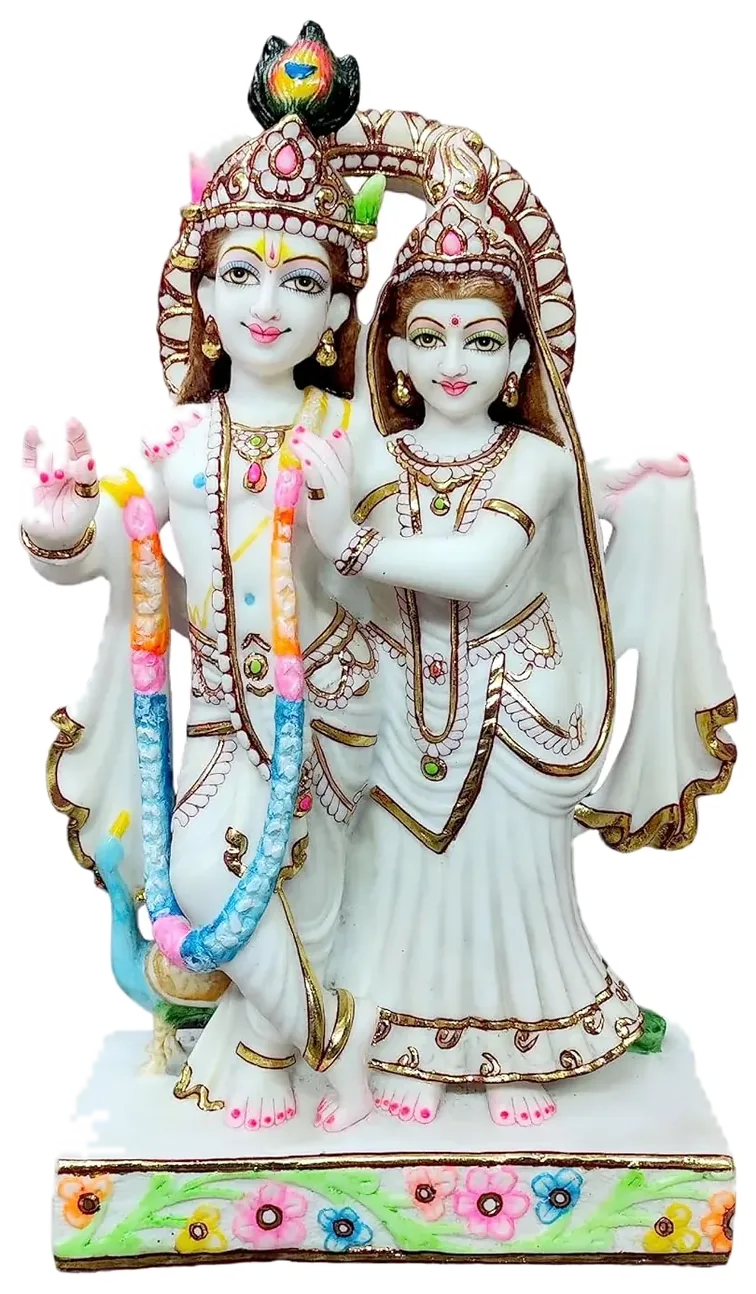
Radha Krishna marble statue, 15 inch
राधा कृष्ण संगमरमर मूर्ति, 15 इंच
₹8,000
A hand carved white marble Radha Krishna, fifteen inches, for a home shrine.
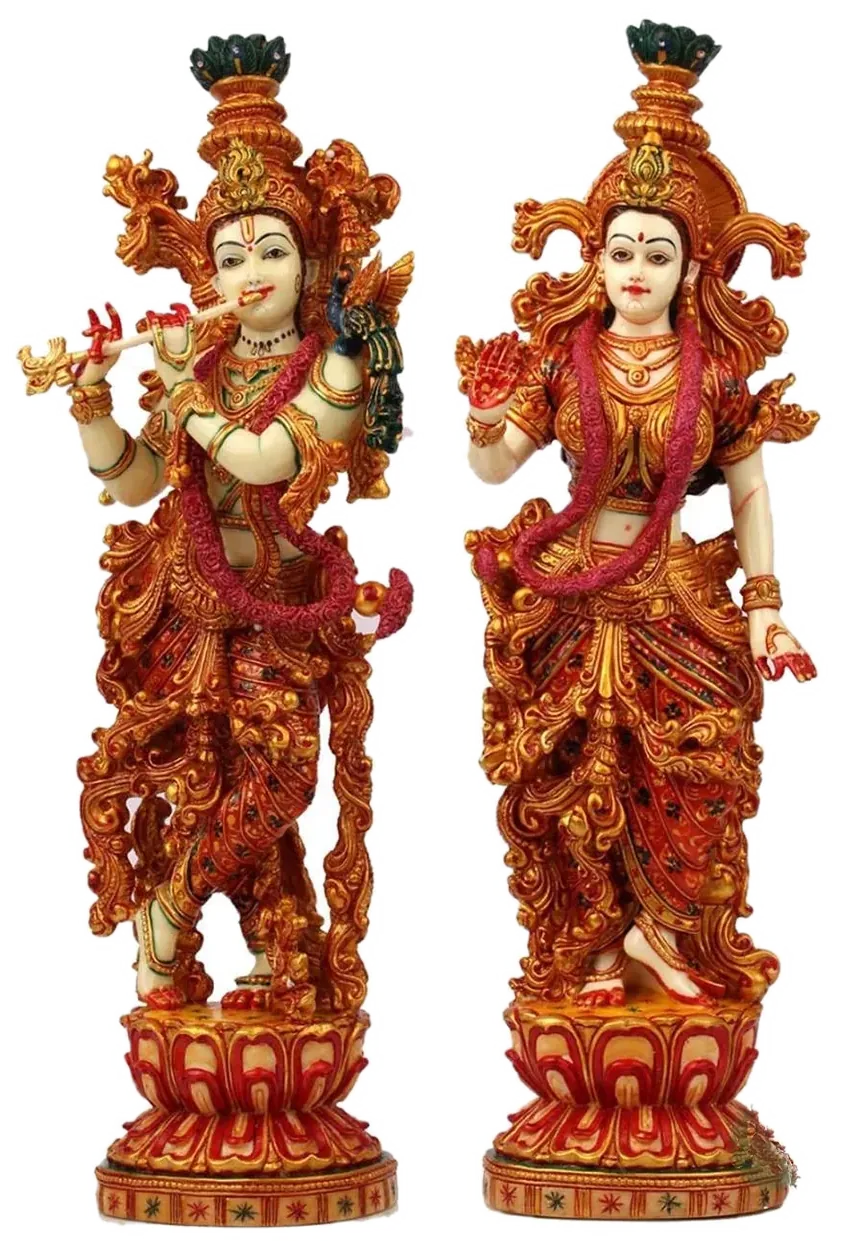
Radha Krishna statue, 15 inch
राधा कृष्ण मूर्ति, 15 इंच
₹14,999
A tall cold cast statue with marble dust and hand painted detail.
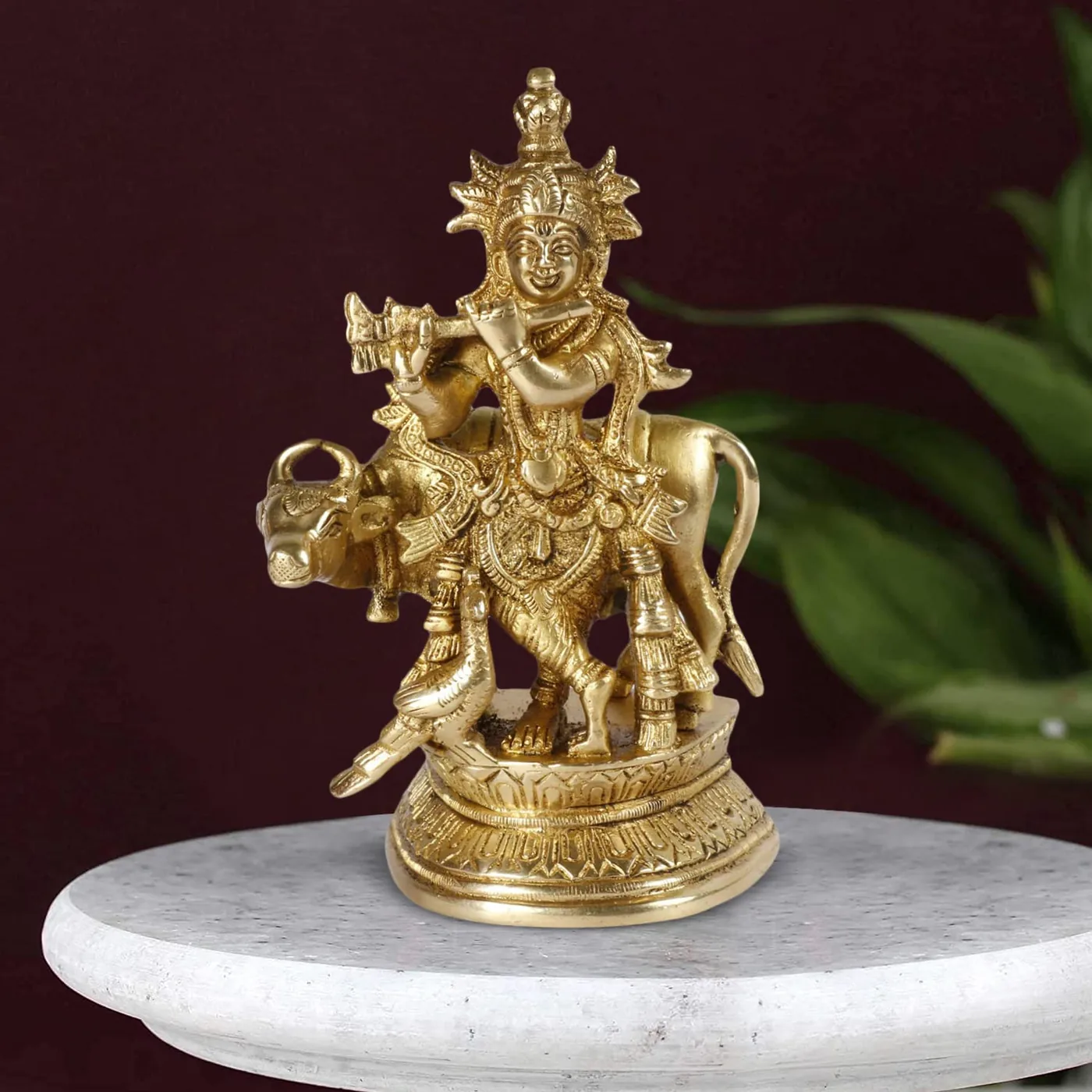
Krishna with cow, brass
गाय के साथ कृष्ण, पीतल
₹2,626
Solid brass, Krishna at the flute with a cow beside him, five and a half inches.