
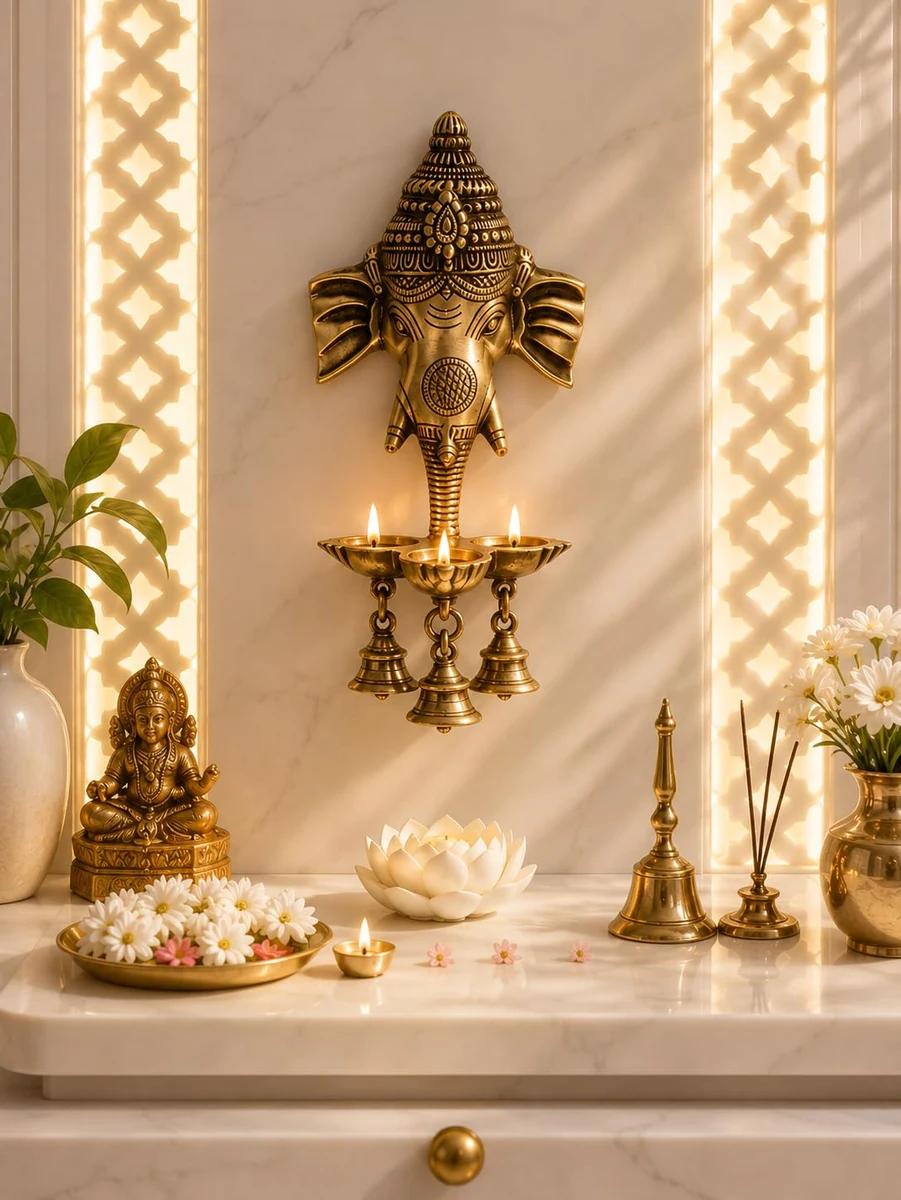
Brass Ganesha wall hanging diya with bells
पीतल गणेश दीवार दीया, घंटियों सहित
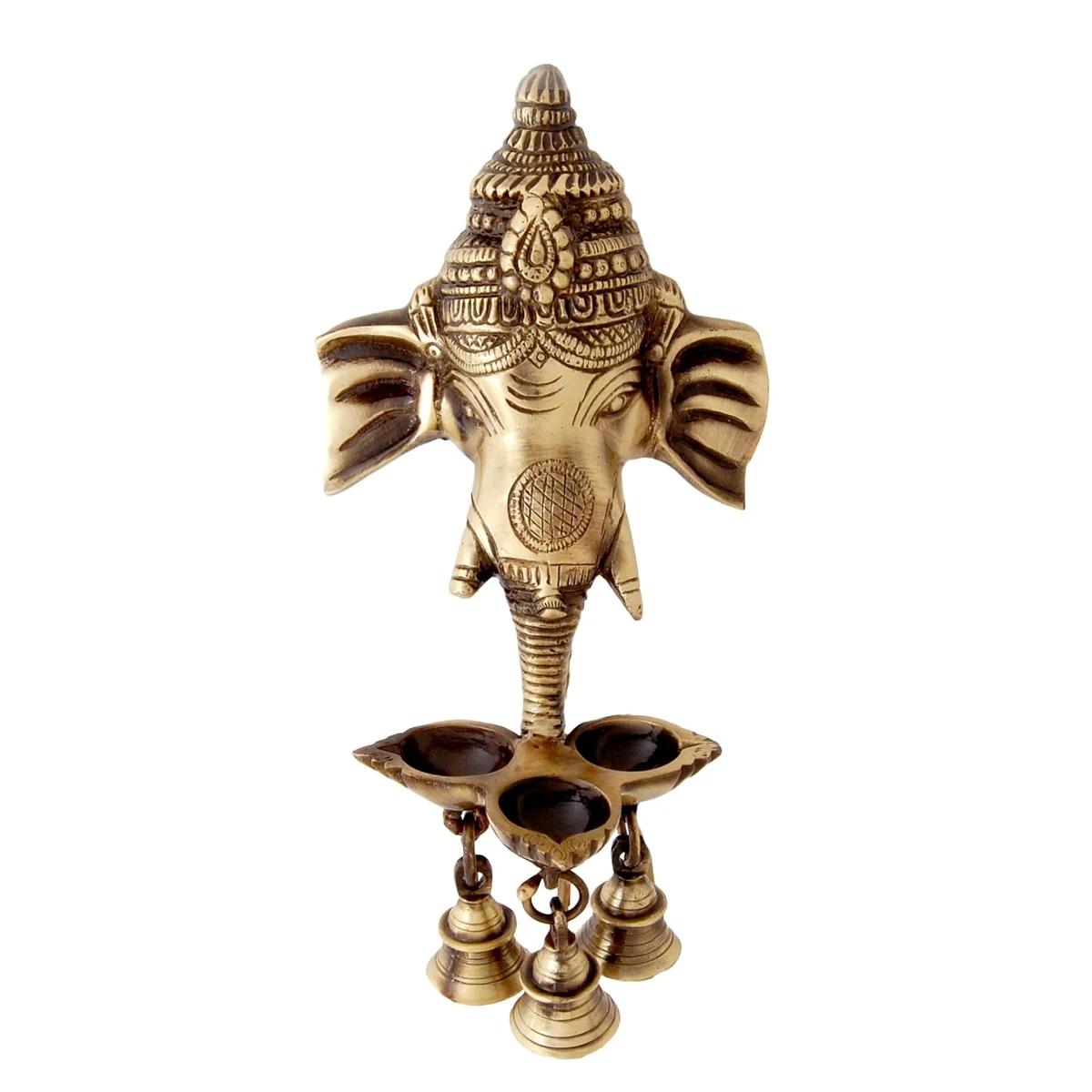
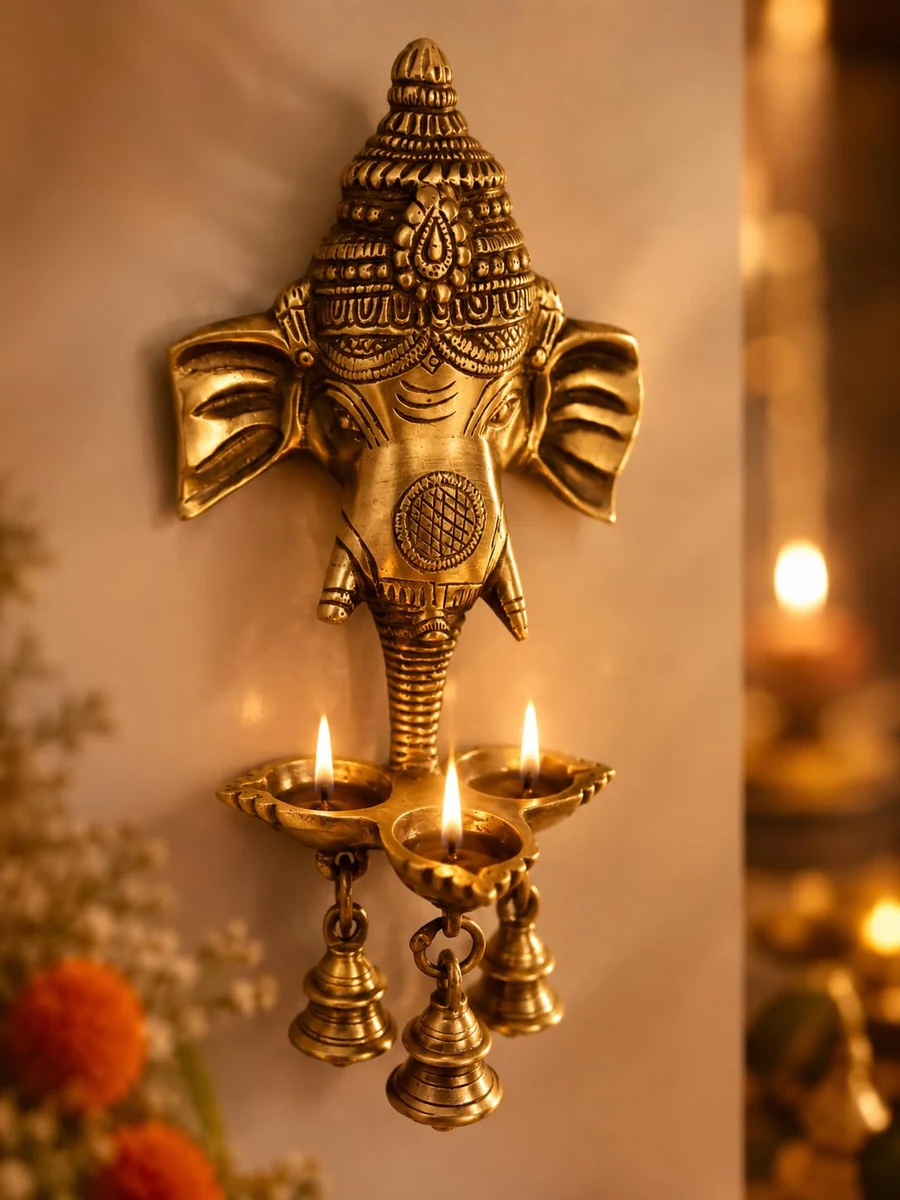
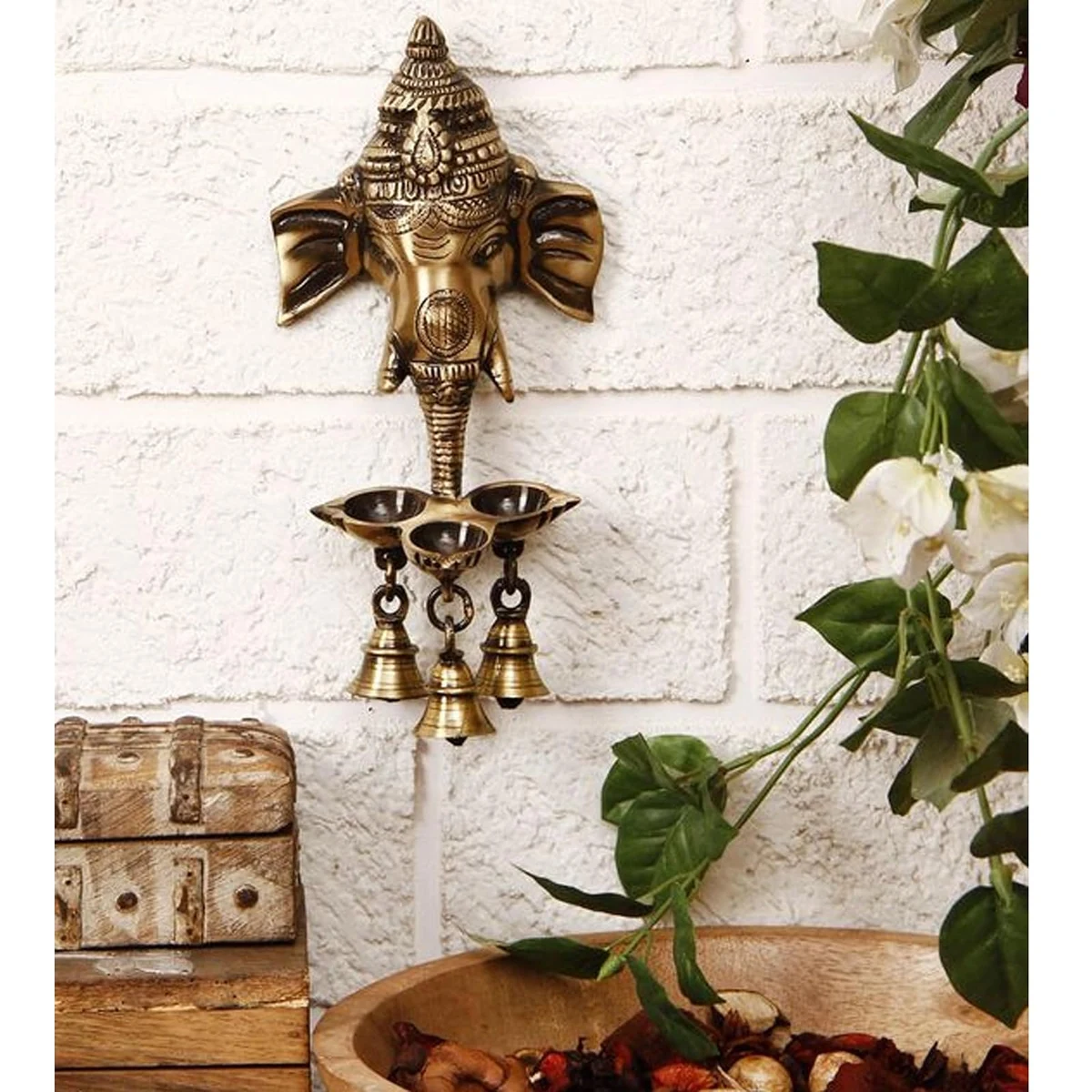
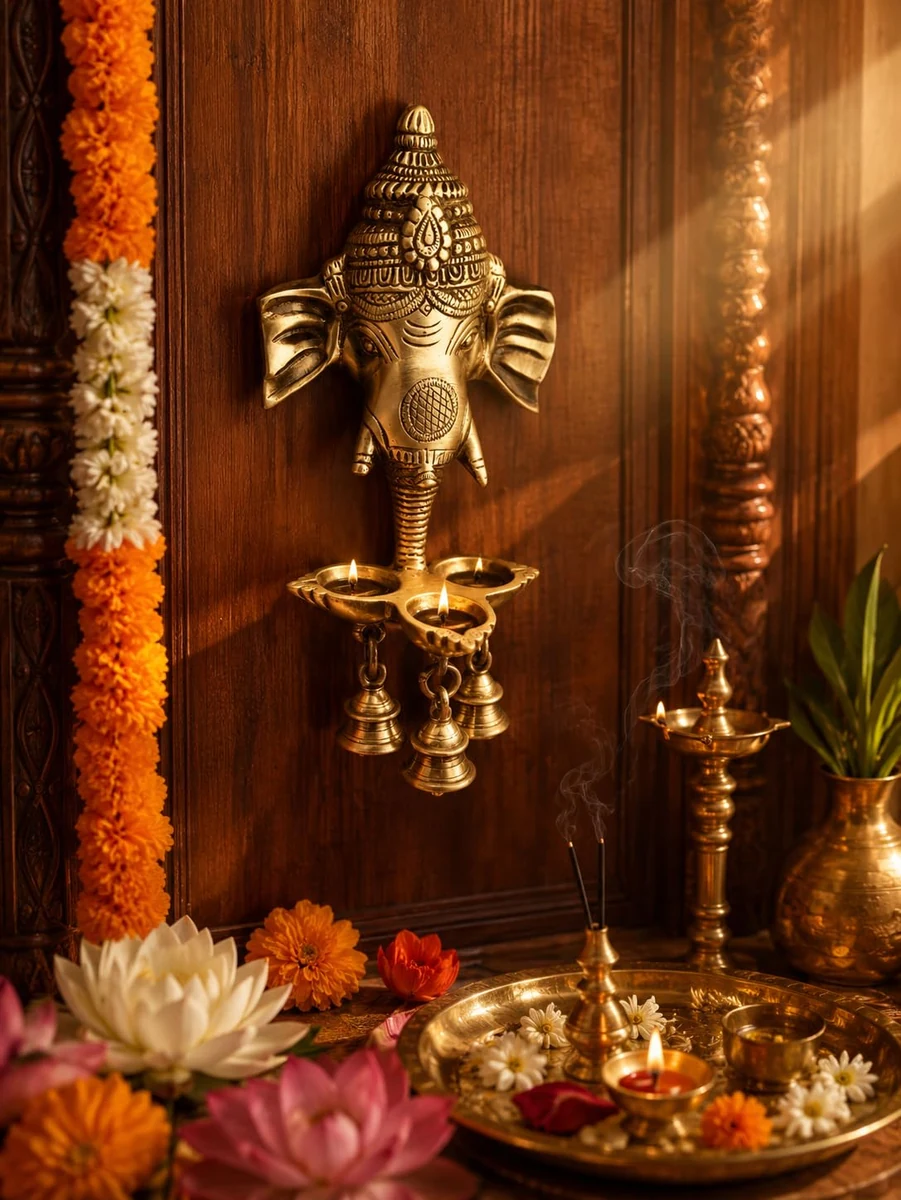
A brass wall piece about nine and a half inches tall: a Ganesha face at the top, a row of small oil lamps below it, and bells hanging from the lower edge. It is a working diya, not only decoration.
- Height
- 9.5 inches
- Width
- 3 inches
- Weight
- 650 g
- Material
- Brass, polished
About this wall hanging
This is one of the few things in this shop that is both ornament and equipment. The lamps along the lower edge are real: they take oil and a wick and they light. That makes it different from a purely decorative wall piece, and it means the decisions about where to hang it are governed by fire rather than by how it looks.
The practical consequence is straightforward. An oil lamp burning against a wall will mark that wall with a dark plume above it, and on a painted surface that mark is permanent. If you intend to light it, hang it on tile, on stone, or with a metal or glass backing plate behind it. If you do not intend to light it, it works perfectly well as an ornament and none of this applies.
The bells at the bottom are the part people underestimate. They move, which means they sound whenever a door closes or a fan runs, and whether that is charming or maddening depends entirely on where the piece hangs. Beside a frequently used door it will ring all day. In a quiet corner of a prayer room it will sound perhaps twice, which is closer to the intention.
Six hundred and fifty grams is not heavy for a wall, but it is heavy enough that the fixing matters. A single nail in plaster will hold it until the day it does not. Use a proper plug and screw, sized for the wall, and check the hanging loop on the back is cast rather than soldered, since a soldered loop is the usual failure point on brass wall pieces.
Ganesha at the top is conventional for an entrance piece: he is the deity invoked at the start of things, and a doorway is a beginning in the most literal sense, which is why so much Indian brass work for entrances carries his image. There is nothing particular to any one sampradaya about it and it is at home in a Vaishnava household as much as anywhere.
One point that applies to every lit object in a home. The decision to burn something is a decision about the wall behind it, the surface below it and whoever walks past it, and those decisions are much easier made before the piece is on its hook. A few minutes of thought buys twenty years of an unmarked wall.
What to look for before buying
Decide whether you will actually light it. A lit oil lamp against a wall leaves a permanent soot plume. If the answer is yes, plan for tile, stone or a backing plate before the piece arrives. If the answer is no, the lamps are fine as they are and the piece can hang anywhere. Most people decide this after they have hung it and marked the paint, which is the wrong order.
Look at the hanging loop on the back. Brass wall pieces fail at the loop. A loop cast as part of the back plate is permanent; one soldered on afterwards will eventually part, usually with no warning. If the listing shows no view of the reverse, request one, and treat a missing rear image on a wall piece as worth querying.
Think about where the bells will be. Hanging bells sound whenever air moves. Next to a door or under a fan they will ring continuously, which most people find wears thin within a week. In a still corner they sound occasionally, which is the intended effect. It costs nothing to think about before choosing the spot and is difficult to fix afterwards.
Keeping it, and where it sits
Clean the lamp cups after every use rather than letting oil sit. Oil left in a brass cup goes sticky and then rancid, it collects dust into a paste, and it eventually varnishes onto the metal in a layer that is genuinely difficult to remove. A wipe with a dry cloth while the cup is still slightly warm takes seconds.
Take the piece down to clean it properly rather than working on it in place. Cleaning brass on a wall means paste and residue run down the paint, and lemon or tamarind left on a painted wall marks it. Once or twice a year off the hook, cleaned over a sink, is the sensible pattern.
Keep the bell clappers dry and free of oil. If they are oiled, or if cleaning paste gets inside them, they collect dust and stop swinging freely, and a bell that does not swing simply hangs there silently. Dry cloth only, and nothing lubricating anywhere near them.
Put felt pads on the back at the lower corners. It stops the piece knocking against the wall when the bells move, keeps the brass off the paint, and removes the faint rattle that otherwise happens every time somebody walks past. It is the cheapest improvement available to any brass wall hanging.
None of this is required. What Maharaj Ji actually asks for is set out on the teachings page, the sayings he repeats most are on the quotes page, and the stotras are free to download as PDFs. If you are planning to visit Vrindavan, read how to meet Maharaj Ji first.
Also worth reading: the photo gallery , and questions people ask.
Questions about buying this
Can the lamps actually be lit?
Yes, they take oil and a wick. If you light them, hang the piece against tile or stone, or fit a backing plate, since an oil lamp will permanently mark a painted wall.
How heavy is it and how should it be fixed?
About 650 grams. Use a proper wall plug and screw rather than a nail, and check that the hanging loop is cast into the back rather than soldered on.
Will the bells ring constantly?
Near a door or under a fan, yes. In a still corner they sound only occasionally. Choose the position with that in mind.
How do I clean the oil cups?
Wipe them out after each use while still slightly warm. Oil left to sit goes sticky, collects dust and eventually varnishes onto the brass.
Why is Ganesha used on entrance pieces?
He is the deity invoked at the beginning of anything, and a doorway is a beginning. It is conventional across traditions rather than particular to one.
Is a lamp needed for the practice?
No. Lamps and bells are ornaments of a household routine rather than requirements of anything, and nothing is asked for that has to be bought.
Is this connected with Maharaj Ji or the ashram?
No. It is not supplied by, authorised by or endorsed by Maharaj Ji or Shri Hit Radha Keli Kunj. It is an ordinary devotional item sold by other people on Amazon, listed here because a devotee might want one.
Do you sell it?
No. The button on this page takes you to Amazon. Amazon takes the payment, ships the order and handles returns and warranty. We hold no stock, never see your payment details, and cannot change or cancel an order.
Is the price on this page current?
It is the price we last saw on Amazon, with the date beside it. Amazon changes prices whenever it likes, so treat the figure here as a guide and the price on the Amazon page as the real one.
Do you make money if I buy it?
Yes. As an Amazon Associate we earn from qualifying purchases. Your price is exactly the same whether you use our link or not; Amazon pays the commission out of its own margin, and that commission is what keeps this site free to read.
Do I need this to follow the teachings?
No. Maharaj Ji asks for the Radha naam and nothing else, with no initiation, no fee and no equipment. Anything on this page is convenience, never a requirement, and he is explicit about that in satsang.
Also for the wall
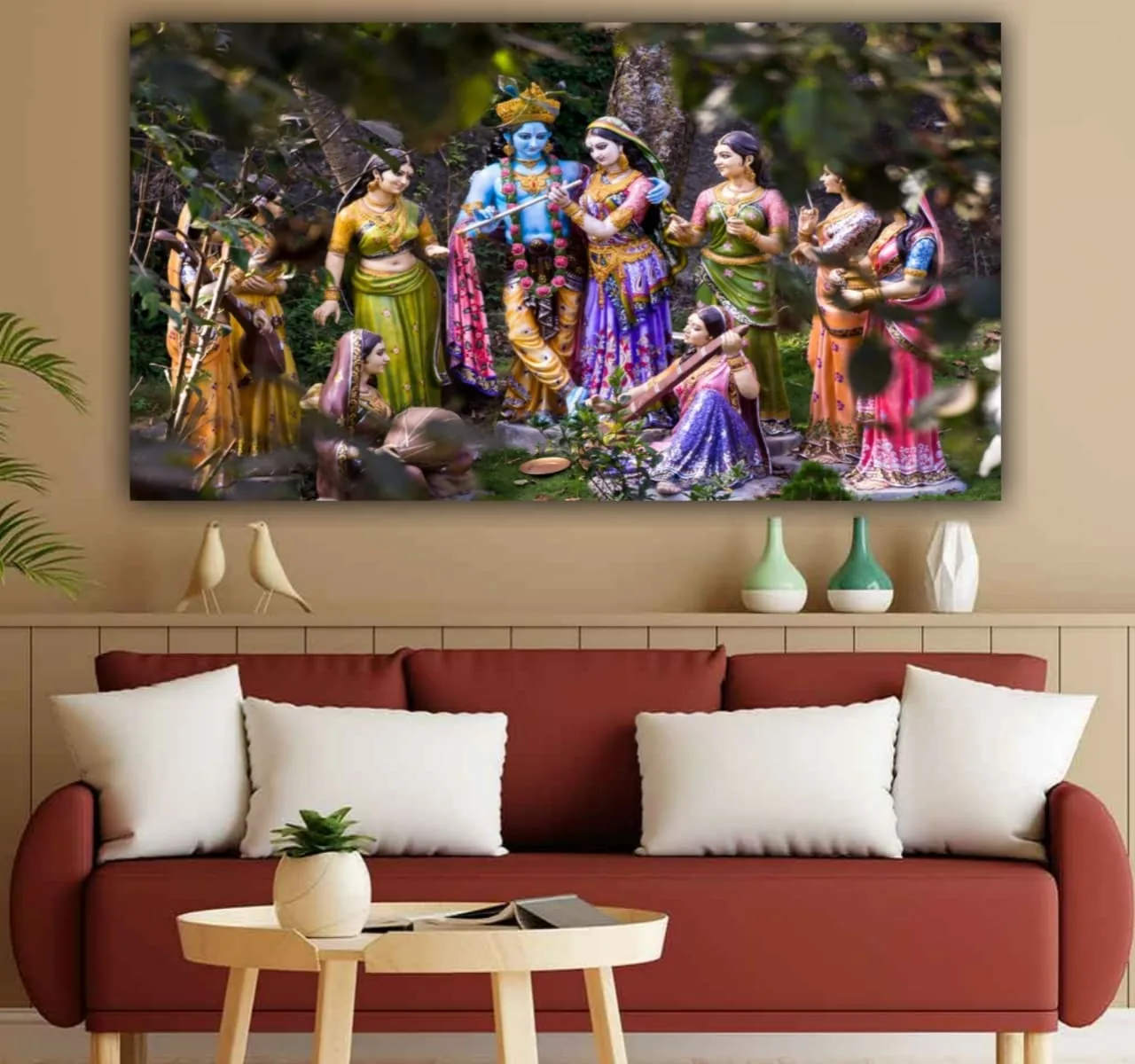
Radha Krishna canvas, 48 × 24 inch
राधा कृष्ण कैनवास, 48 × 24 इंच
₹3,697
A four foot framed canvas of Radha, Krishna and the gopis, ready to hang.

Radha Krishna wall art, five panels
राधा कृष्ण दीवार कला, पाँच पैनल
₹1,888
One image split across five laminated panels, four feet wide in total.
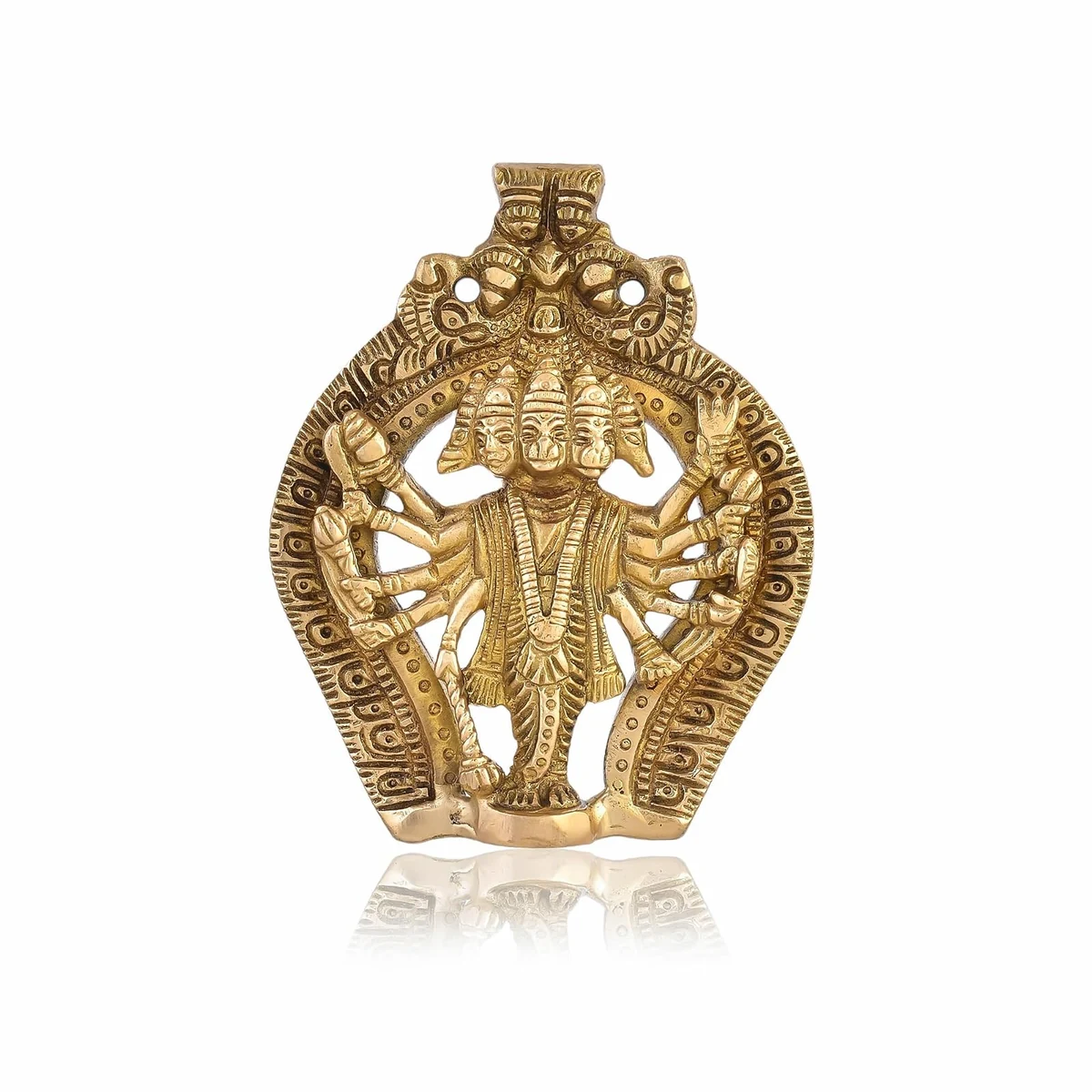
Panchmukhi Hanuman brass wall hanging
पंचमुखी हनुमान पीतल दीवार मूर्ति
₹799
A flat brass panel of the five faced form, 4.7 inches, made to hang.