
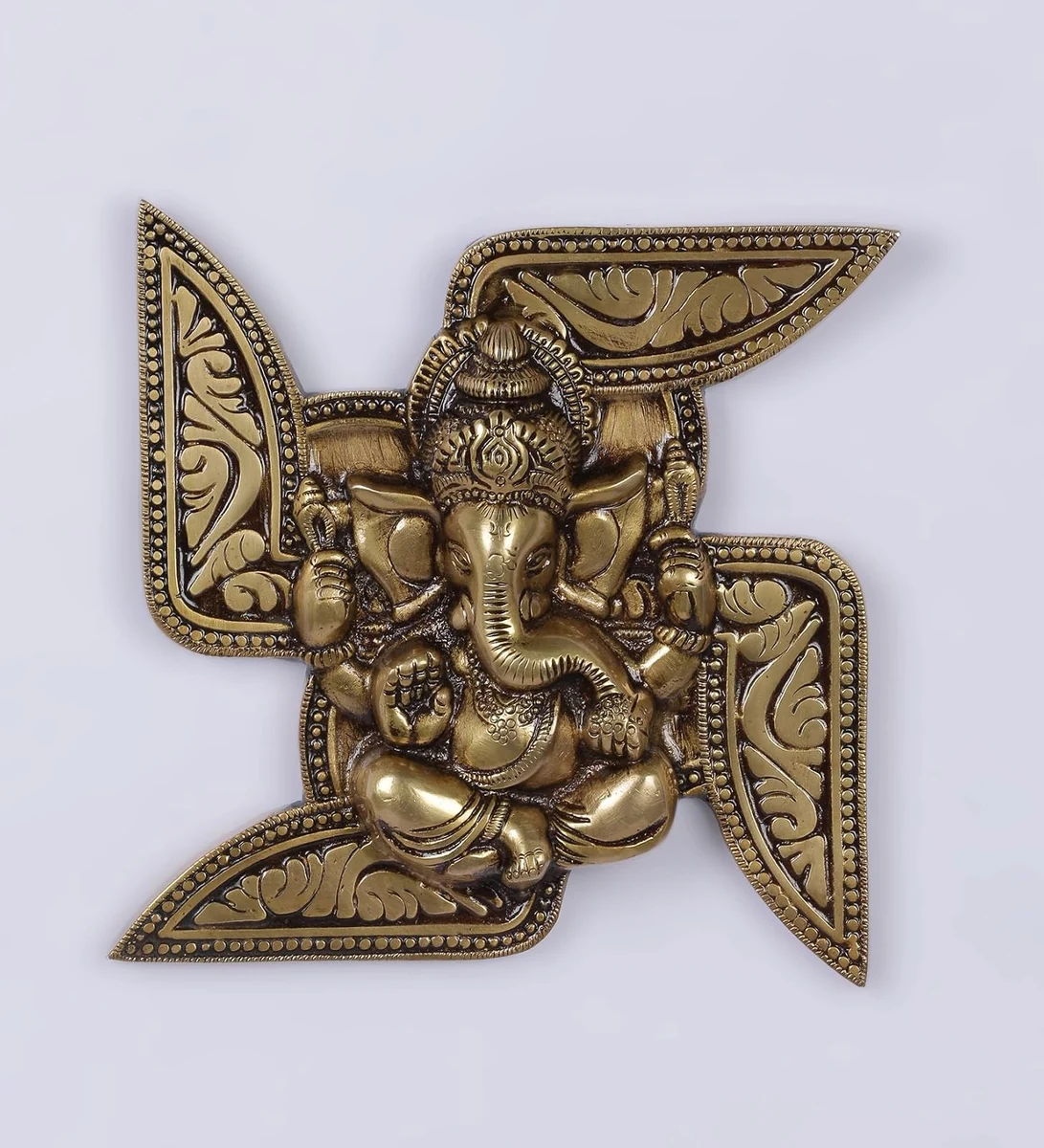
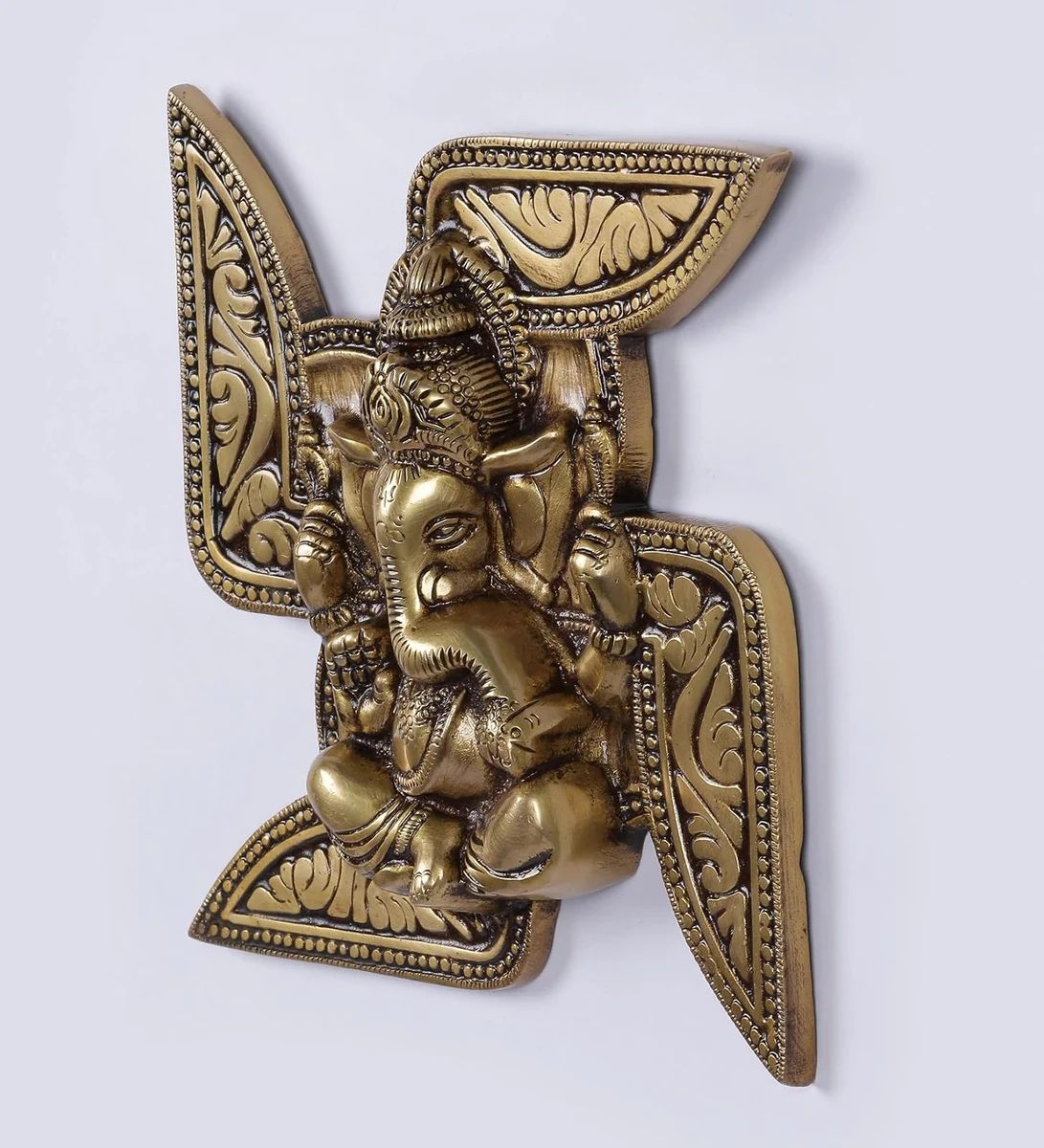
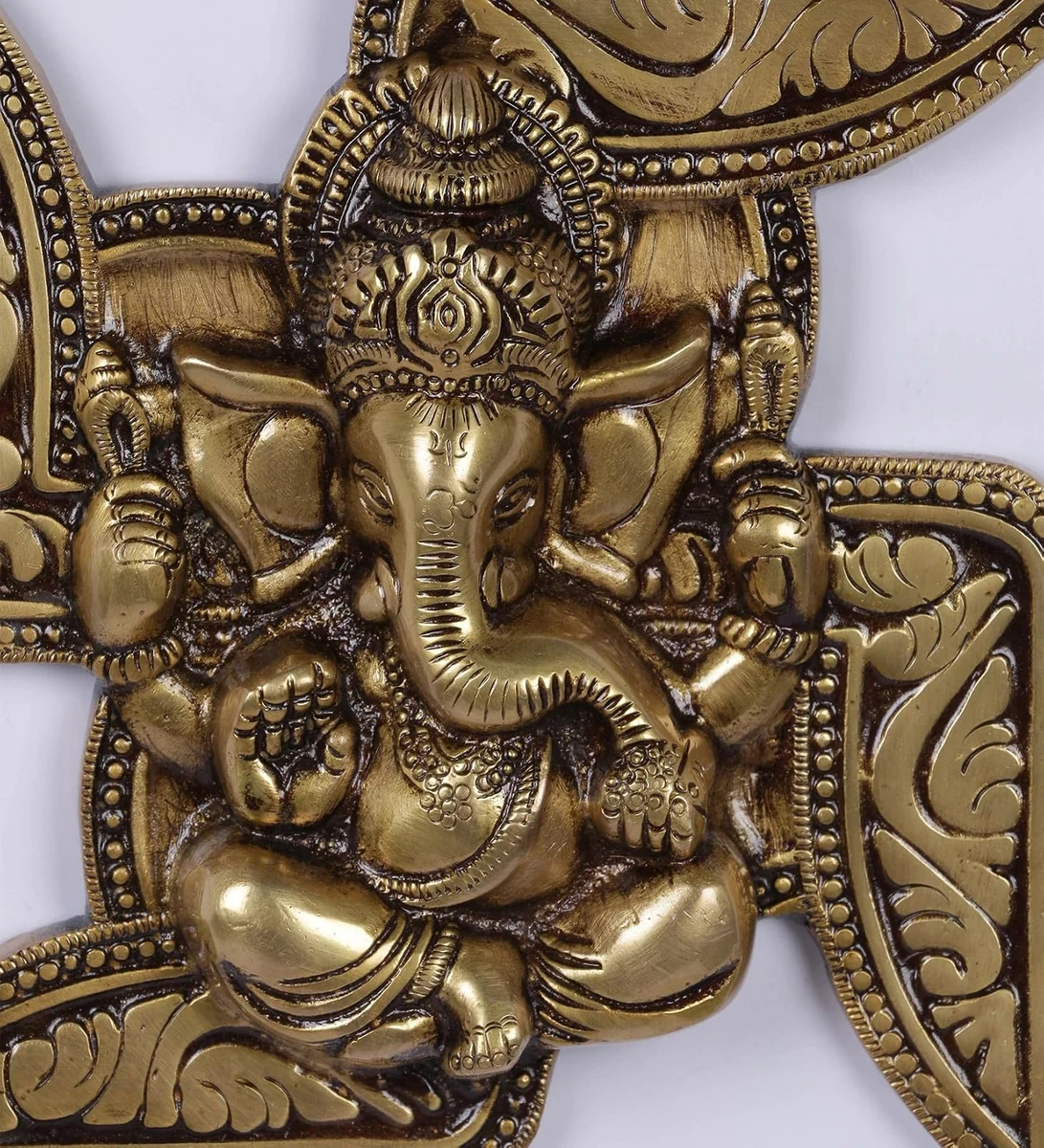
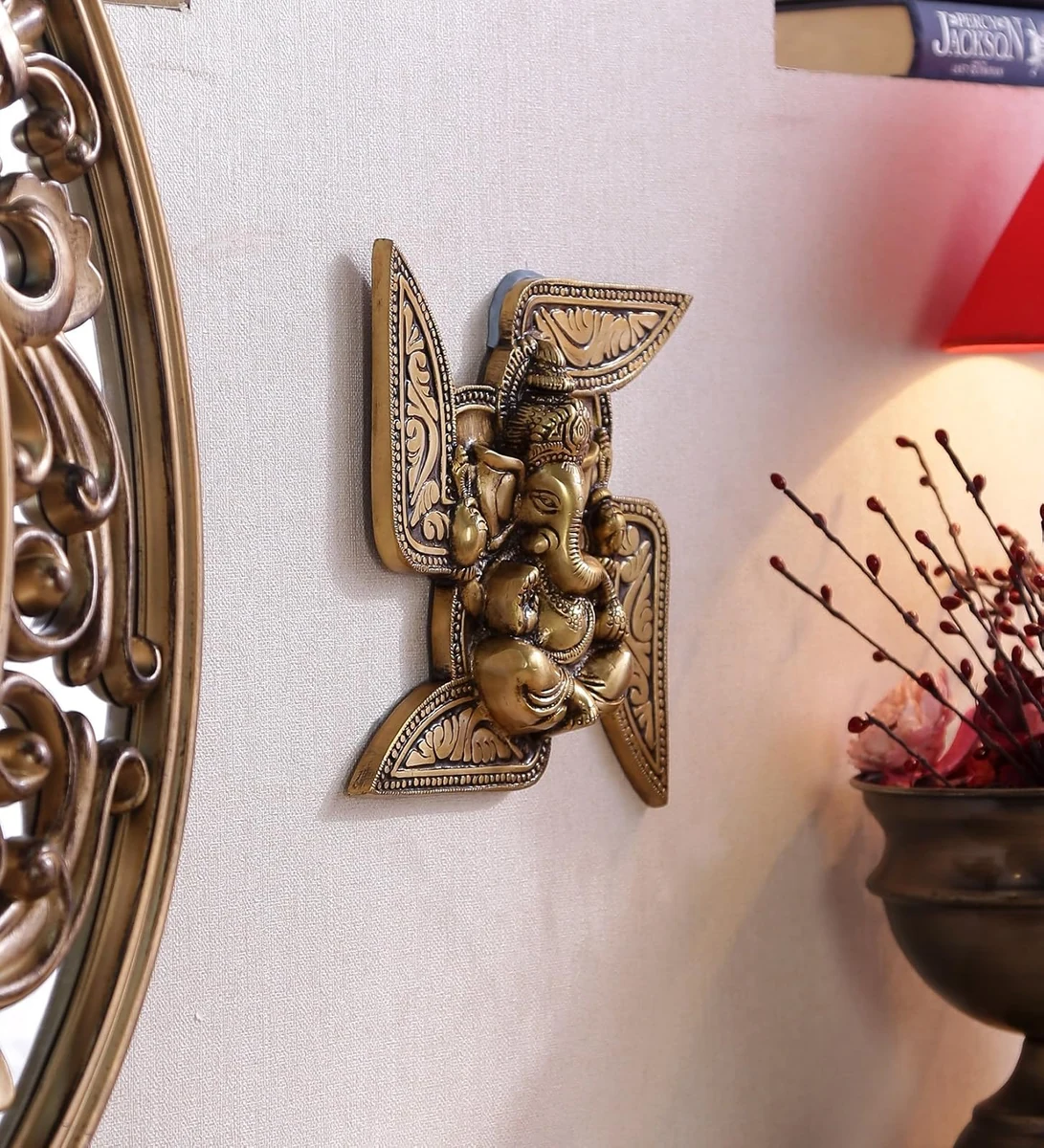
Ganesha swastika brass wall hanging
गणेश स्वस्तिक पीतल दीवार सजावट
A brass panel of Ganesha seated at the centre of a swastika, twenty centimetres square, in a matte brown and gold finish. Made for a doorway or an entrance wall.
- Size
- 20 by 20 cm
- Depth
- 2 cm
- Weight
- About 1 kg
- Finish
- Matte, brown and gold
About this wall hanging
The swastika in Indian use is an old auspicious mark and it long predates the twentieth century European appropriation of it. It is drawn at thresholds, on account books at Diwali, on wedding invitations and above doorways, and the word itself comes from a Sanskrit root meaning wellbeing. The Indian form is usually drawn with dots in the quadrants and is used as a mark of an auspicious beginning rather than as any kind of political symbol.
It is a fact worth knowing plainly if this is going to hang by a front door, because a visitor unfamiliar with the Indian context may read it differently, and that is simply a thing that happens rather than a reason not to own one. Inside a home, in a mandir room or above an internal doorway, the question does not arise at all.
Setting Ganesha at the centre of the swastika combines two marks of beginning into one object, which is why this form is so common on entrance pieces. Both belong at a threshold: Ganesha because he is invoked before anything is started, and the swastika because it is drawn where something is being marked as auspicious. Neither is specific to a single tradition.
A kilogram over twenty centimetres square is a fairly heavy flat panel, and that changes how it should be fixed. This is not a picture hook job. Use a wall plug and screw appropriate to the wall type, and if the panel has a single hanging point, expect it to sit slightly askew from time to time; two points, even improvised, will keep it straight and stop it swinging.
The matte antique finish suits a piece like this better than polished brass would, because the appeal is in the outline and the relief rather than in shine. Matte finishes are also considerably more forgiving on a wall, where fingerprints, dust and the uneven light of a hallway all show up mercilessly on anything polished.
A final note on context, since this piece more than any other in the shop depends on it. In an Indian home, at an Indian doorway, this is an entirely ordinary and long established mark of welcome. Elsewhere it may need a sentence of explanation to a visitor, and knowing that in advance is simply part of choosing where to hang it.
What to look for before buying
Check the fixing points on the back. A kilogram of flat brass wants a proper screw and plug rather than a nail or an adhesive hook. Look at the back for cast hanging points and count them: two is much better than one, since a single point lets the panel rotate and it will need straightening every time somebody closes a door nearby.
Look at the depth of the relief. At two centimetres thick this is a relief panel rather than a flat plate, and the depth is what makes it read on a wall. Request a three quarter view if only a face on image is provided, because a straight photograph makes a shallow casting look exactly like a deep one and the difference is obvious in daylight.
Confirm the finish is matte if that is what you want. Brown and golden, matte and antique are used loosely in listings and sometimes describe a lacquered finish that is shinier than the photographs suggest. On a wall this matters: polished brass in a hallway shows every fingerprint and every patch of dust. If the finish is important, ask before ordering rather than after.
Keeping it, and where it sits
Dust it in place with a soft cloth and leave it at that. A matte antique finish on a wall needs almost nothing, and it is the easiest object in this shop to look after: an occasional wipe is genuinely the whole routine for years at a time.
Do not use brass polish on it. The finish is applied rather than the natural colour of the metal, and polish will lift it from the raised areas and leave the recesses dark, which on a flat panel viewed straight on looks worse than on any sculpted piece. There is no way to correct it afterwards.
Damp outside walls and kitchens are the two places to avoid. Humid or greasy air puts a film on brass, and a large flat panel makes that film very visible. An interior wall in a dry room will keep this piece looking as it arrived essentially indefinitely.
Fit felt pads at the lower corners when you hang it. They keep the brass off the paint, stop the panel knocking when a door closes and prevent the small marks that otherwise appear on a wall behind any hanging metal over a few years.
None of this is required. What Maharaj Ji actually asks for is set out on the teachings page, the sayings he repeats most are on the quotes page, and the stotras are free to download as PDFs. If you are planning to visit Vrindavan, read how to meet Maharaj Ji first.
Also worth reading: about this site , and what is taught.
Questions about buying this
What does the swastika mean in Indian use?
It is an old auspicious mark, drawn at thresholds, on account books at Diwali and on invitations. The word comes from a Sanskrit root meaning wellbeing, and it long predates the twentieth century European use of the symbol.
Why is Ganesha shown inside it?
Both are marks of beginning: Ganesha is invoked before anything starts, and the swastika is drawn where something is being marked auspicious. Together they make a natural entrance piece.
How should a one kilogram brass panel be hung?
With a wall plug and screw suited to the wall, not a nail or adhesive hook. Two fixing points are better than one, since a single point lets it rotate.
Can I polish this to a shine?
No. The matte antique colour is an applied finish and polish will strip it unevenly. Dusting is the only cleaning it needs.
Where is the best place to hang it?
An interior wall in a dry room, traditionally near a doorway. Avoid kitchens and damp outside walls, where brass films over quickly.
Is any of this required by the teaching?
No. It is a piece of brass on a wall. What is taught costs nothing, is open to everybody and has never depended on a mark, an image or an object.
Is this connected with Maharaj Ji or the ashram?
No. It is not supplied by, authorised by or endorsed by Maharaj Ji or Shri Hit Radha Keli Kunj. It is an ordinary devotional item sold by other people on Amazon, listed here because a devotee might want one.
Do you sell it?
No. The button on this page takes you to Amazon. Amazon takes the payment, ships the order and handles returns and warranty. We hold no stock, never see your payment details, and cannot change or cancel an order.
Is the price on this page current?
It is the price we last saw on Amazon, with the date beside it. Amazon changes prices whenever it likes, so treat the figure here as a guide and the price on the Amazon page as the real one.
Do you make money if I buy it?
Yes. As an Amazon Associate we earn from qualifying purchases. Your price is exactly the same whether you use our link or not; Amazon pays the commission out of its own margin, and that commission is what keeps this site free to read.
Do I need this to follow the teachings?
No. Maharaj Ji asks for the Radha naam and nothing else, with no initiation, no fee and no equipment. Anything on this page is convenience, never a requirement, and he is explicit about that in satsang.
Also for the wall
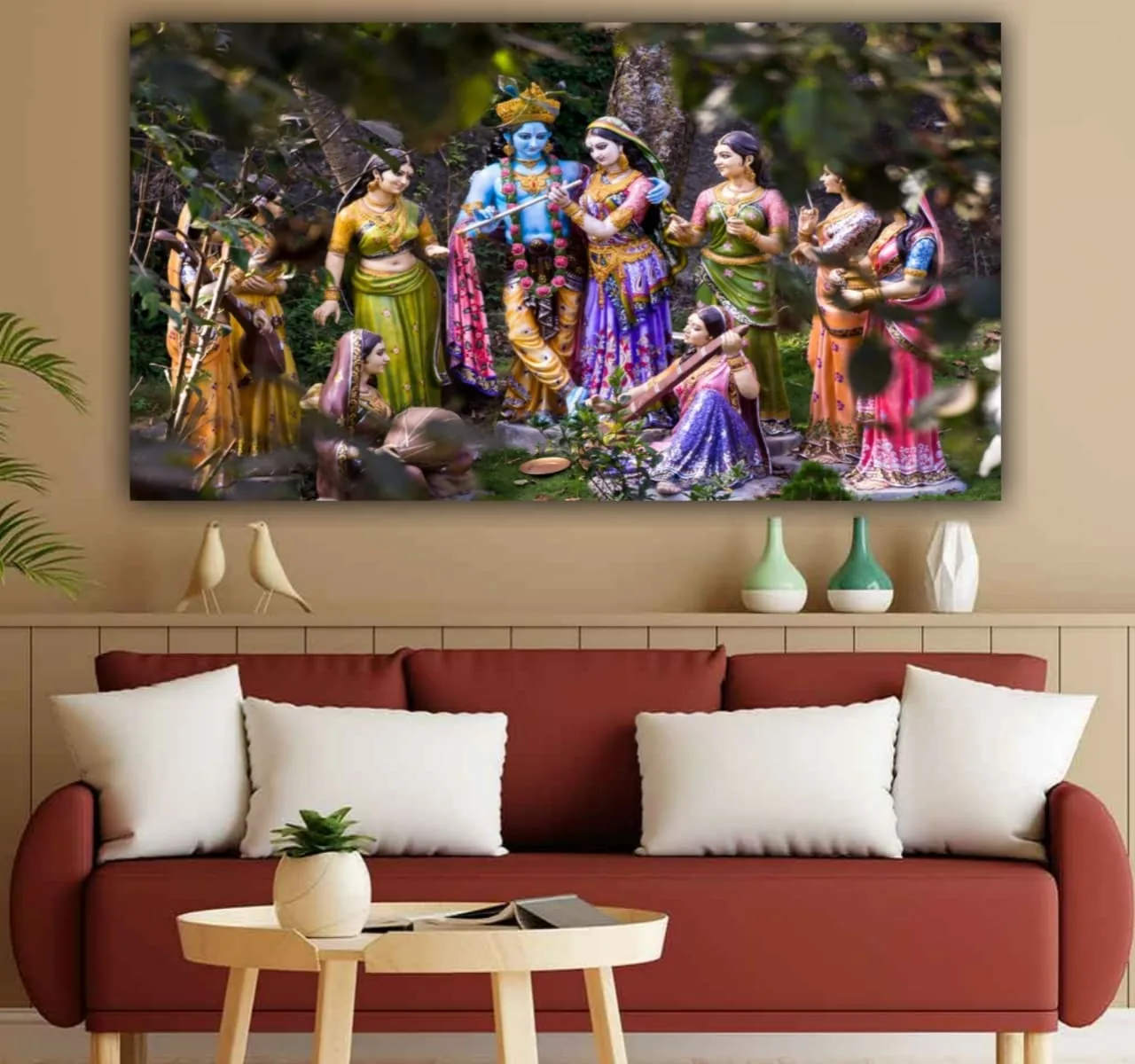
Radha Krishna canvas, 48 × 24 inch
राधा कृष्ण कैनवास, 48 × 24 इंच
₹3,697
A four foot framed canvas of Radha, Krishna and the gopis, ready to hang.

Radha Krishna wall art, five panels
राधा कृष्ण दीवार कला, पाँच पैनल
₹1,888
One image split across five laminated panels, four feet wide in total.
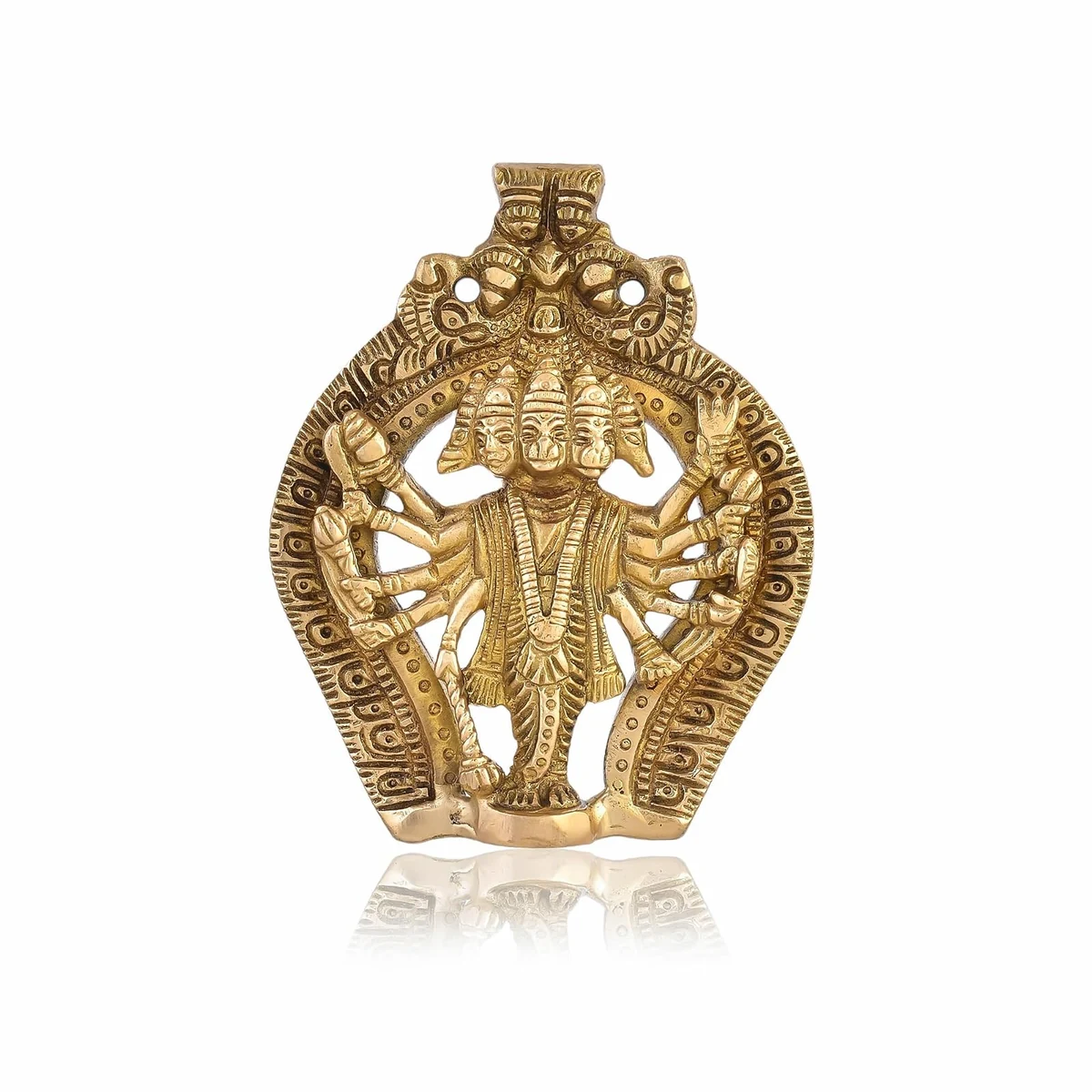
Panchmukhi Hanuman brass wall hanging
पंचमुखी हनुमान पीतल दीवार मूर्ति
₹799
A flat brass panel of the five faced form, 4.7 inches, made to hang.