
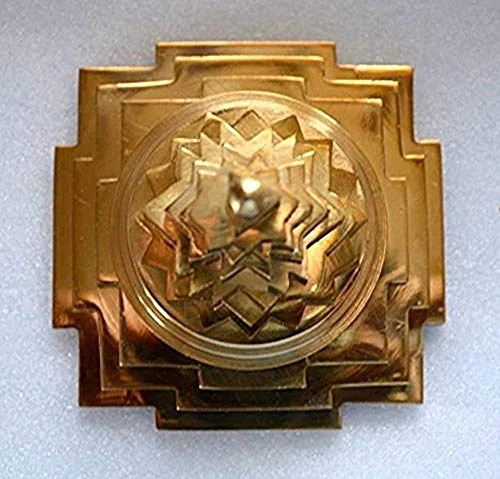
Sri Meru Yantra, brass, 3 inch
श्री मेरु यंत्र, पीतल, 3 इंच
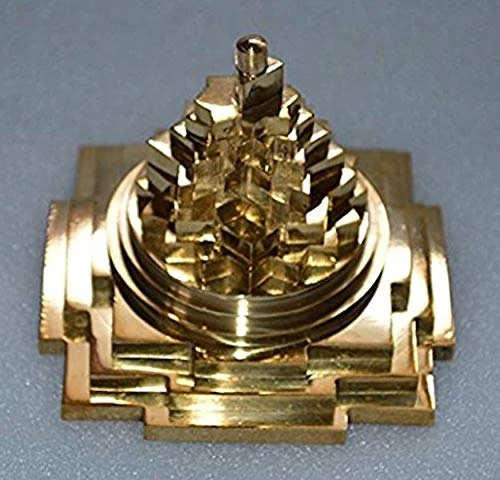
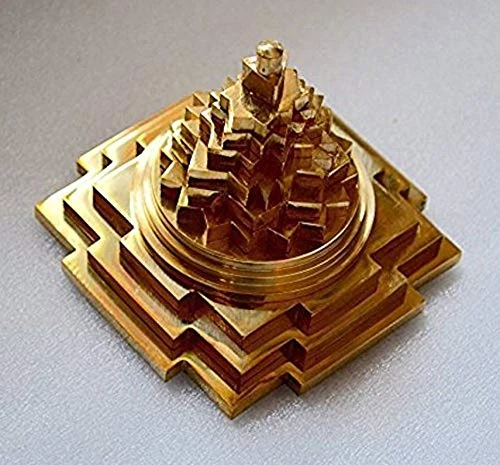
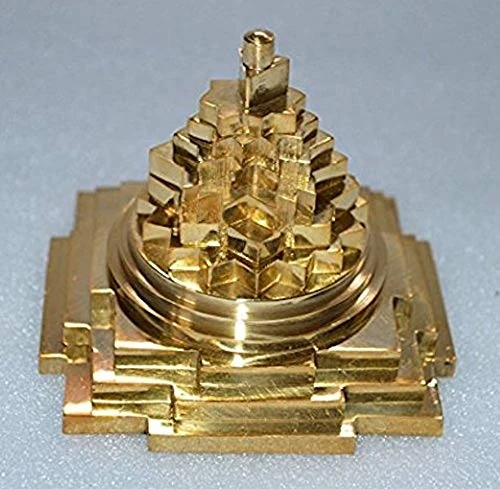
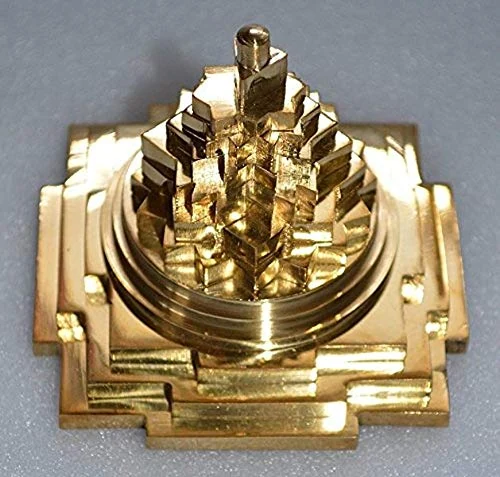
A brass Sri Meru at three inches, polished to a gold tone, from a seller offering the same form in two, three, four and five inch versions. Brass rather than copper, which changes how it ages.
- Size
- 3 inch, about 7.6 cm
- Material
- Brass
- Finish
- Polished gold tone
- Also in
- 2, 4 and 5 inch
About this yantra
The first decision with any meru is size, and unusually this seller offers the same form across four of them. Two inches is a desk object you can close your hand around. Three inches is the common household choice and sits comfortably on a mandir shelf. Four and five inch pieces become the main object on whatever surface they occupy and cost a great deal more, since the metal goes up as the cube of the dimension.
The second decision is metal, and here it is brass rather than the more usual copper. That is a real difference rather than a cosmetic one. Brass is harder, so the cut edges hold their sharpness longer and survive cleaning better. It is more stable in humid air, oxidising much more slowly. It is yellow rather than red, which some people find wrong for a yantra and others prefer. And it is generally cheaper for the same size.
What brass gives up is tradition. Copper is the metal conventionally specified for yantras, and anyone following a particular method will usually be told to use it. If that matters to you, buy copper. If you simply want the form on a shelf and would rather not spend every month cleaning it, brass is the more practical object by a clear margin.
The form itself is the Sri Yantra built upward: nine interlocking triangles, four pointing up and five down, realised as tiers rather than lines, rising to a point. Around them are the two lotus rings of eight and sixteen petals, and the outer square with four gates. On a meru these appear as physical levels, which is why the piece has to be cut accurately or the errors show as steps that will not line up.
This page should say where the object comes from. The Sri Yantra is central to Sri Vidya, a Shakta tradition with its own initiation and its own teachers, and it forms no part of Braj practice. The line Maharaj Ji stands in rests on Shri Radha and on the naam. That is simply a fact about which tradition uses what, and it takes nothing away from anybody who wants one.
The practical summary for anybody choosing between the pieces in this part of the shop. Size determines presence and price; metal determines how much work it will be; accuracy determines whether it is a yantra or an ornament shaped like one. Those three questions are answerable from photographs and a message to the seller, and they are the whole of what can honestly be judged before buying.
What to look for before buying
Pick the size for the surface, not the photograph. Two inches is small enough to be lost on a shelf, five inches dominates a table. Three is the usual household choice for a reason. Measure the space and remember that photographs of yantras are almost always taken close, which makes every size look the same. The price difference between sizes is steep, so it is worth getting right first time.
Understand what brass changes. Brass holds a cut edge better and tarnishes far more slowly than copper, which makes it the easier object to own. It is not the traditional metal for a yantra. If you are following a specific method or a teacher's instruction, check whether copper is specified before buying brass to save effort.
Look down on it from directly above. A meru's accuracy is visible from overhead and almost nowhere else. From that view the figure should be symmetrical about both axes, with the tiers concentric and the points of the triangles aligned. Ask for a top down photograph if the listing shows only three quarter views, which flatter an inaccurate piece considerably.
Keeping it, and where it sits
A dry cloth and a soft brush for the steps is the whole routine while it is bright. Brass is far more forgiving than copper here, and a yantra kept in a dry room will need actual cleaning perhaps twice a year rather than every few weeks.
When it does dull, lemon with salt or tamarind applied by hand is the right method, rinsed off and dried at once. Avoid brushes stiffer than a toothbrush and avoid abrasive pastes altogether: the cut edges of the tiers are the whole quality of the piece, and abrasives round them off permanently.
Dry it inverted on a cloth. Every tier of a meru is a ledge that holds water, and standing it upright to dry leaves it damp for hours in exactly the places where marks show. Upside down it drains in a couple of minutes.
Pick it up by the base, never by the peak. The point at the top is the thinnest section in the object and the natural thing to grip, which is why it is the part most often bent on second hand pieces. If the yantra sits somewhere it has to be moved often, a small tray under it removes the problem entirely.
None of this is required. What Maharaj Ji actually asks for is set out on the teachings page, the sayings he repeats most are on the quotes page, and the stotras are free to download as PDFs. If you are planning to visit Vrindavan, read how to meet Maharaj Ji first.
Also worth reading: what is actually taught , and photographs of Vrindavan.
Questions about buying this
What size Sri Meru should I buy?
Three inches is the usual household size and sits well on a mandir shelf. Two inches is a desk object; four and five inch pieces dominate a surface and cost considerably more.
Is brass or copper better for a yantra?
Copper is traditional. Brass holds its cut edges better and tarnishes far more slowly, so it is the easier object to keep. Choose copper if a method or teacher specifies it.
How do I check the geometry is accurate?
Look at it from directly overhead. The tiers should be concentric and symmetrical about both axes, with triangle points aligned. Three quarter views hide errors.
How often does brass need cleaning?
In a dry room, perhaps twice a year, against every few weeks for copper. Dry dusting in between is enough.
Why should it be dried upside down?
Each tier is a ledge that holds water. Inverted it drains in minutes; upright it stays damp for hours and marks.
Is a yantra needed for naam japa?
No. It belongs to a different tradition entirely, and the one described on this site asks for no object of any kind.
Is this connected with Maharaj Ji or the ashram?
No. It is not supplied by, authorised by or endorsed by Maharaj Ji or Shri Hit Radha Keli Kunj. It is an ordinary devotional item sold by other people on Amazon, listed here because a devotee might want one.
Do you sell it?
No. The button on this page takes you to Amazon. Amazon takes the payment, ships the order and handles returns and warranty. We hold no stock, never see your payment details, and cannot change or cancel an order.
Is the price on this page current?
It is the price we last saw on Amazon, with the date beside it. Amazon changes prices whenever it likes, so treat the figure here as a guide and the price on the Amazon page as the real one.
Do you make money if I buy it?
Yes. As an Amazon Associate we earn from qualifying purchases. Your price is exactly the same whether you use our link or not; Amazon pays the commission out of its own margin, and that commission is what keeps this site free to read.
Do I need this to follow the teachings?
No. Maharaj Ji asks for the Radha naam and nothing else, with no initiation, no fee and no equipment. Anything on this page is convenience, never a requirement, and he is explicit about that in satsang.
Also yantras and symbols
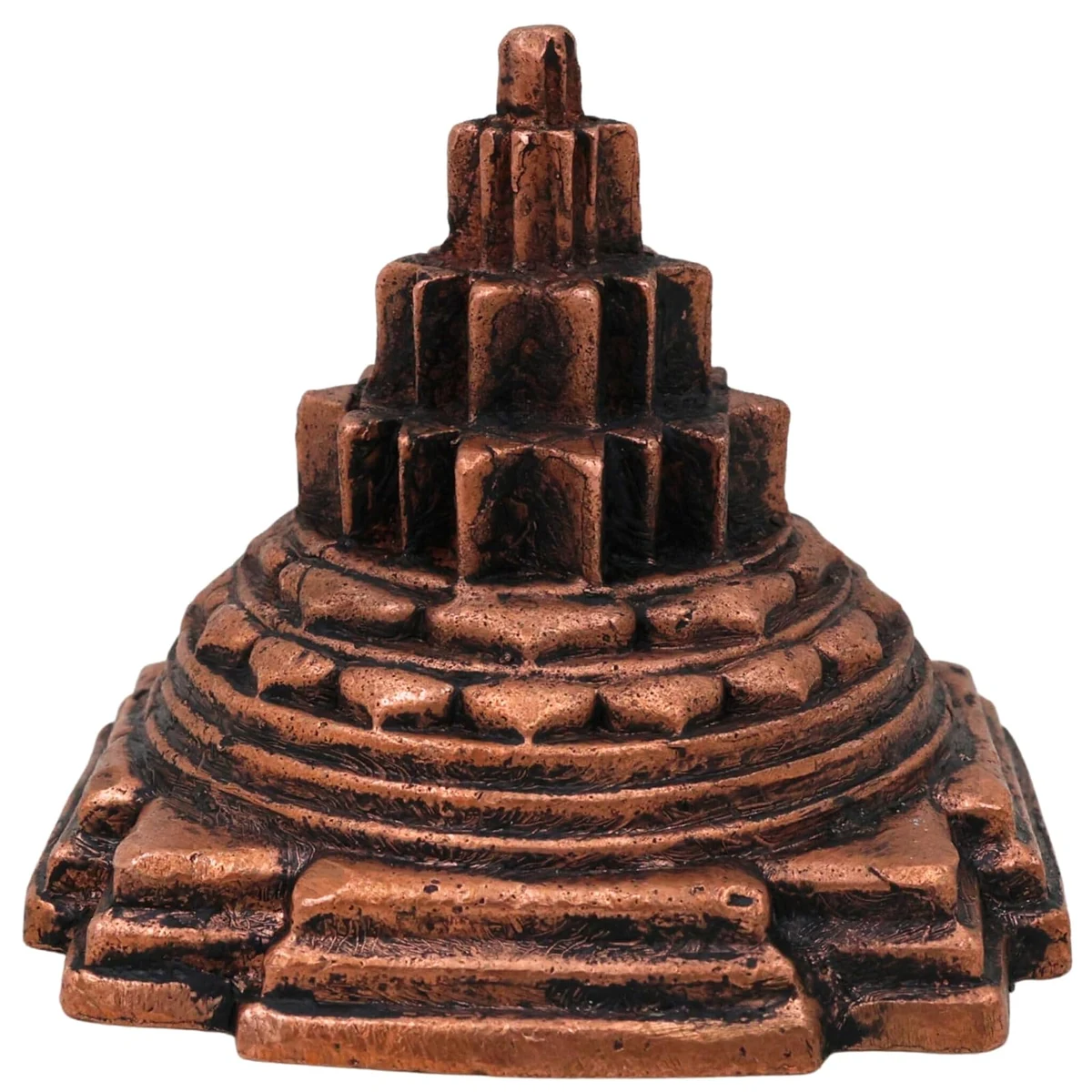
Copper Sri Yantra, 2 inch
तांबे का श्री यंत्र, 2 इंच
₹2,799
A small three dimensional Sri Yantra in solid copper, five centimetres each way.
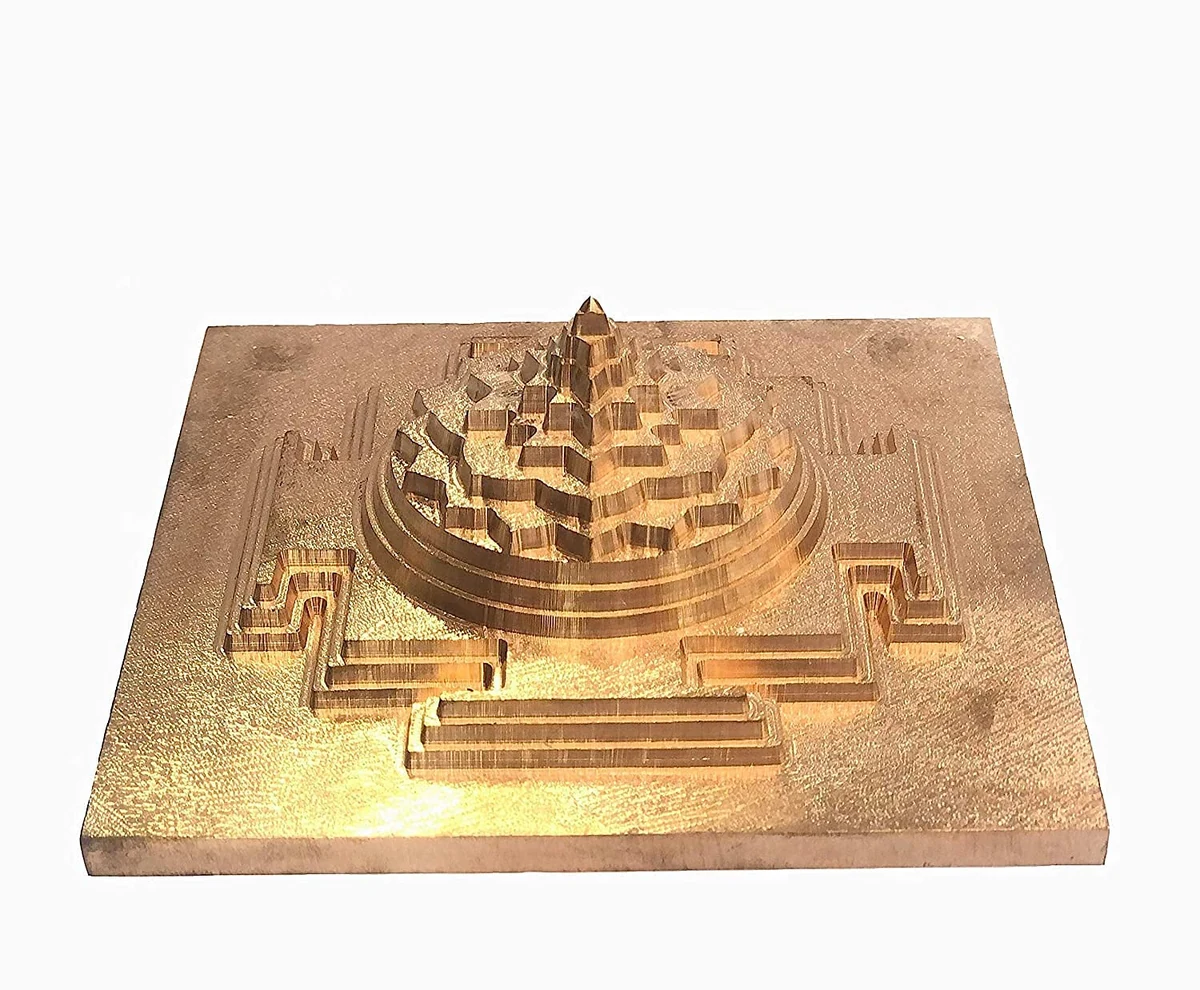
Maha Meru Shree Yantra, copper, 3 inch
महा मेरु श्री यंत्र, तांबा, 3 इंच
₹3,499
A three inch copper meru on a square plate, cut rather than cast, 480 grams.
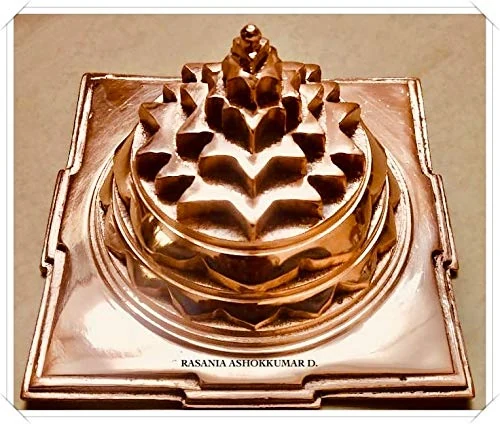
Copper Meru Shree Yantra, 5 inch
तांबे का मेरु श्री यंत्र, 5 इंच
₹4,950
The large size in copper, five inches across and nine hundred grams, hollow built.