
Pointing while speaking
बोलते हुए संकेत करते
One instruction heard two hundred times gets acted on. Two hundred heard once do not.
एक बात दो सौ बार सुनी जाए तो की जाती है, दो सौ बातें एक बार सुनी जाएँ तो नहीं।
Why his satsang repeats and why he shows no interest in varying it to keep anyone entertained. The repetition is the method, not a limit of his range.
Why he says the same thing every morning
Devotees who attend for a week notice it quickly and newcomers sometimes mistake it for a limited repertoire. The instructions barely move from one morning to the next. Take the name, do not feed the thought, do your duty where you already are, expect nothing back. Whatever question comes from the floor, the answer tends to arrive at that same place within a minute or two.
He is entirely aware of the repetition and has no intention of correcting it. His argument is about what he is trying to change. A teacher aiming to alter what somebody knows has to keep introducing new material, because knowledge accumulates. A teacher aiming to alter what somebody does has the opposite problem: behaviour changes through repetition, and novelty actively works against it.
He points out what most spiritual content is built for, without much charity toward it. Anything designed to hold attention must keep supplying something unfamiliar, and a person consuming it steadily can spend years feeling engaged and instructed while doing nothing differently. The sense of progress comes from the arrival of new ideas rather than from any change in conduct, and the two are easily confused.
There is a consequence he draws that devotees find uncomfortable. If you have been listening for a year and nothing about your day has altered, the problem is not that you have yet to hear the right talk. You have heard the instruction, many times, and the missing step is not further listening. He says this plainly and does not soften it when people are hoping for something new.
The repetition also explains why any fragment of a recording works on its own, which is why the clips travel as far as they do. Nothing is being built toward and no conclusion is being withheld until the end. Thirty seconds carries as much of the teaching as the full session does, because there is only one teaching in it, and this is by design rather than by accident.
What it asks of you is to stop looking for the next thing. You already have the instruction, and it is short enough to repeat from memory. Take it, at a size you can hold daily, and keep taking it through the stretch where it feels obvious and the stretch where it feels like nothing. He is not withholding a further teaching for people who prove themselves. This is the whole of it.
The rest of his most repeated sayings are on the quotes page, the teaching they belong to is set out on the teachings page, and the questions devotees bring him about anger, money, family and grief are answered on the questions answered page.
Questions about this photograph
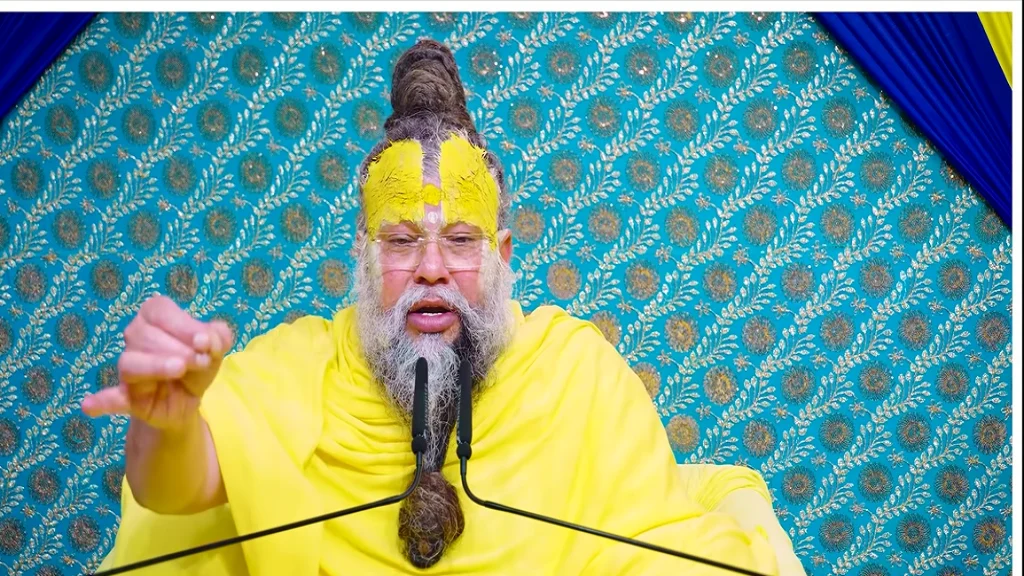
What is Premanand Ji Maharaj doing in this photo?
Premanand Ji Maharaj pointing while speaking, teal backdrop.
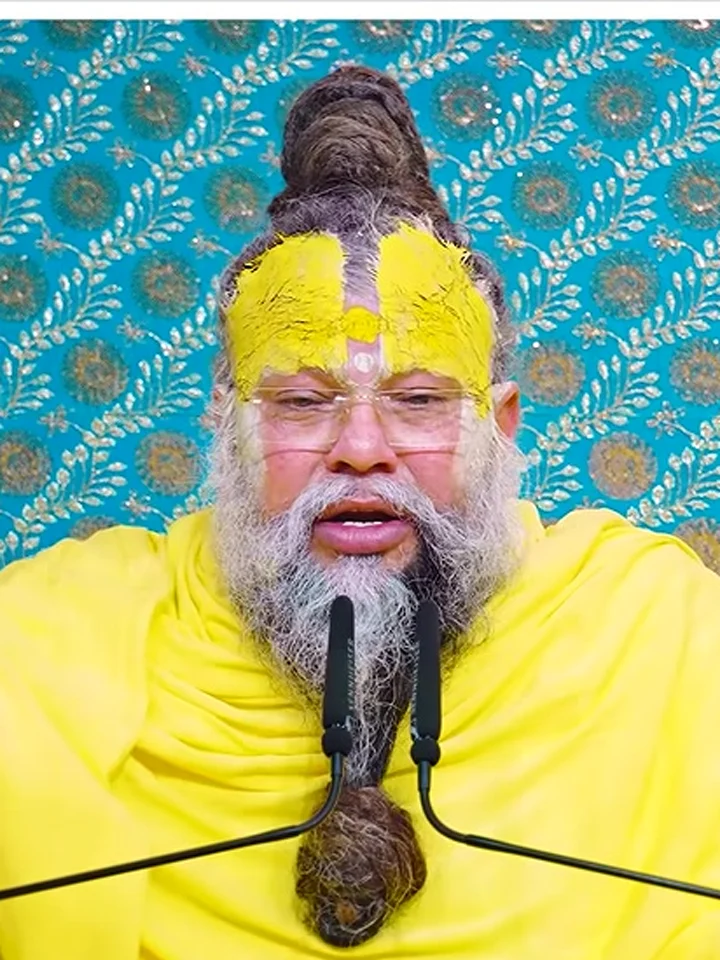
What wallpaper sizes does this photo come in?
Two: 1024 × 576 for a desktop or laptop and 720 × 960 for a phone. Both are WebP, which every current phone and browser opens, and each is cropped from the face outward so nothing important sits under a clock or a status bar.
Where did this photograph come from?
It is a frame lifted from a publicly available satsang recording, chosen out of several thousand for sharpness and cropped so that no channel mark or on-screen text remains. If you hold rights in it, write to us and it comes down the same day.
Is this photo free to download and share?
Yes. There is no fee, no account and no email address to hand over. Share it for personal devotional use as much as you like. Please do not sell it, print it for sale, or attach it to anything asking people for money in his name.
How do I set it as my phone wallpaper?
Tap the phone download button, let the image open, then press and hold it and choose save. Open your gallery, find the picture and set it as wallpaper from there. On an iPhone use the share button and Save Image first.
Can I share it straight to WhatsApp or Instagram?
Yes. On a phone the share button opens your own share sheet with the picture attached, so it goes across as an image rather than as a link. On a desktop the same button offers WhatsApp, Facebook, X, Telegram and a copy-link option.