
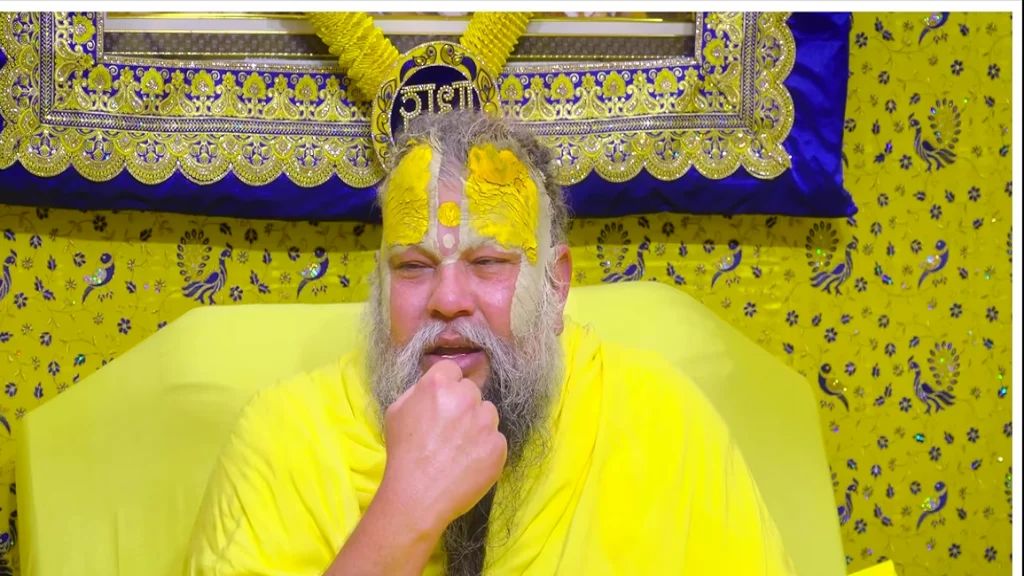
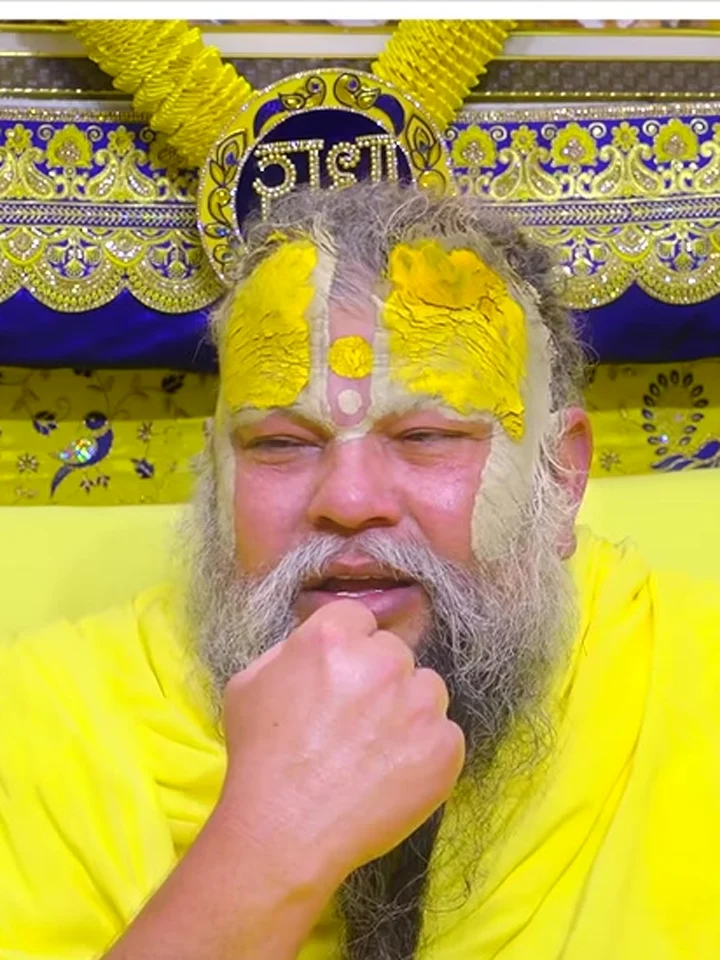
Hand at the beard
दाढ़ी पर हाथ
The Radha naam is itself the greatest mantra.
राधा नाम ही सबसे बड़ा मंत्र है।
The line the whole teaching rests on. He is not recommending the naam among other practices; he is saying it is the practice, available with no initiation, no fee, no fixed hour and no permission from anyone including him.
Why he calls the Radha naam the greatest mantra
Almost everything else he teaches hangs off this one line, so it is worth being precise about what it claims. He is not placing the Radha naam somewhere near the top of a list of useful practices. He is saying that for a householder living an ordinary life this is the practice, and that the things people usually reach for first, ritual, pilgrimage, austerity, elaborate puja, are at best supports for it and at worst substitutes that keep you busy.
The claim comes out of a specific tradition rather than out of nowhere. In the Radhavallabh Sampradaya, founded by Shri Hit Harivansh Mahaprabhu in the sixteenth century, Shri Radha is held as supreme rather than as Krishna's companion, and her love is treated as the highest thing there is. Taking her name in that framework is not calling out to a deity for help. It is deliberately turning the mind toward the one thing the tradition says is worth wanting, and doing it often enough that the turning becomes a habit rather than an effort.
What makes the instruction unusual is everything it does not require. No initiation is needed, and he is explicit that you do not need one from him. There is no fee, no enrolment, no minimum count you must promise, no fixed hour, no direction to face, no posture to hold and no clean room to find. He points out that a practice with entry conditions quietly excludes the people who need it most: the woman with three children and no half hour to herself, the man on a night shift, the person in a hospital corridor. A name that can be taken silently on a crowded train excludes nobody.
The most common objection in satsang is that it seems too small to matter, and he does not dispute the smallness. His answer is that you have already run the experiment the other way. The mind repeats something all day regardless, usually a grievance, a fear or a conversation you are rehearsing for the fourth time, and it does that without any discipline at all. He is not asking you to add an activity to a full day. He is asking you to change what the machinery is already running on.
The second objection is that it feels mechanical, that the words come out while the mind is elsewhere. He treats this as the normal starting condition rather than as failure, and tells people to keep going anyway. Feeling is not the entry fee for the practice; it is what shows up later, unevenly, and usually after the person has stopped auditing themselves for it. Waiting to feel devotional before you begin, in his framing, is waiting for the result before doing the thing that produces it.
The practical instruction that follows is short. Begin now rather than on a chosen date, take the name in the middle of ordinary work rather than setting aside a special hour you will eventually skip, and when the mind goes somewhere else, which it will, bring it back without turning the lapse into an argument with yourself. Do that for long enough and the grip loosens. That is the whole of what he is promising, and he is careful not to promise more.
The rest of his most repeated sayings are on the quotes page, the teaching they belong to is set out on the teachings page, and the questions devotees bring him about anger, money, family and grief are answered on the questions answered page.
Questions about this photograph
What is Premanand Ji Maharaj doing in this photo?
Premanand Ji Maharaj hand at the beard, listening during satsang.
What wallpaper sizes does this photo come in?
Two: 1024 × 576 for a desktop or laptop and 720 × 960 for a phone. Both are WebP, which every current phone and browser opens, and each is cropped from the face outward so nothing important sits under a clock or a status bar.
Where did this photograph come from?
It is a frame lifted from a publicly available satsang recording, chosen out of several thousand for sharpness and cropped so that no channel mark or on-screen text remains. If you hold rights in it, write to us and it comes down the same day.
Is this photo free to download and share?
Yes. There is no fee, no account and no email address to hand over. Share it for personal devotional use as much as you like. Please do not sell it, print it for sale, or attach it to anything asking people for money in his name.
How do I set it as my phone wallpaper?
Tap the phone download button, let the image open, then press and hold it and choose save. Open your gallery, find the picture and set it as wallpaper from there. On an iPhone use the share button and Save Image first.
Can I share it straight to WhatsApp or Instagram?
Yes. On a phone the share button opens your own share sheet with the picture attached, so it goes across as an image rather than as a link. On a desktop the same button offers WhatsApp, Facebook, X, Telegram and a copy-link option.