
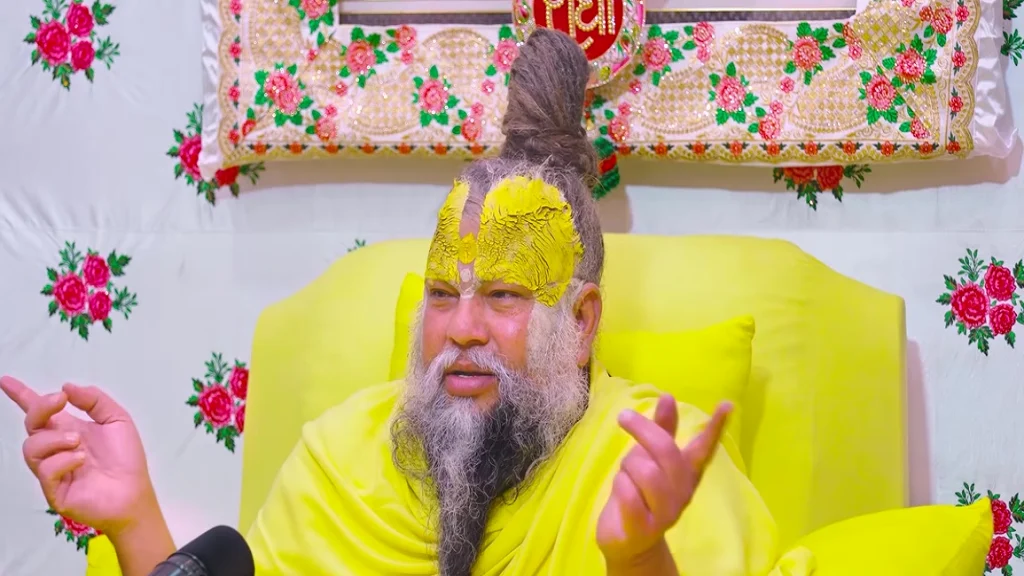
Explaining with both hands
दोनों हाथों से समझाते हुए

Do not weigh your life against one you only see from outside.
दूसरे का जीवन बाहर से देखकर अपना मत तौलो।
On envy. Contentment is not the reward for getting what others have; it is the practice that makes the comparison stop mattering.
Never weigh your life against one you only see from outside
He raises this more now than he used to, and the reason is obvious enough. Devotees arrive at satsang measuring themselves against lives they have only ever seen edited: the family that appears settled, the friend whose career photographs well, the marriage nobody has been inside. The comparison is between your interior, which you know completely, and someone else's exterior, which is the only part on display.
The comparison is not merely unkind, he argues, it is invalid, and the invalidity is what he wants people to see. You are comparing a full account, including every fear and every failure, against a summary that was assembled to be looked at. No conclusion drawn from those two sets of information can be worth anything, whichever way it comes out.
He notes that it also fails in the flattering direction, which people forget. Someone who concludes they are doing better than the person next to them has run the same broken calculation and arrived at pride instead of despair. Both are the product of judging an interior against a surface, and the pride is at least as damaging because it feels like good news.
There is a specific consequence he keeps naming. Comparison converts what you have into what you are missing, without changing anything about it. The same house, the same work and the same family are experienced as adequate or as failure depending entirely on what they were just measured against, and the measuring took a few seconds and cost you the month.
He does not offer this as a reason to stop wanting things, and he blocks that reading when it appears. Wanting to earn more, to do better work or to build something is ordinary and fine. What he objects to is the source of the wanting: an ambition that came out of a comparison is chasing somebody else's edited summary, and arriving there does not settle anything, because a new summary is always available.
What it asks of you is to notice the moment of measurement, which is usually brief and usually happens with a screen in your hand. When you catch yourself running the comparison, do not argue yourself out of it with reasons why your own life is better. Put the name there instead and let the thought go unfinished. An unfinished comparison does no damage; a completed one sets the tone for the rest of the day.
The rest of his most repeated sayings are on the quotes page, the teaching they belong to is set out on the teachings page, and the questions devotees bring him about anger, money, family and grief are answered on the questions answered page.
Questions about this photograph
What is Premanand Ji Maharaj doing in this photo?
Premanand Ji Maharaj explaining a point with both hands.
What wallpaper sizes does this photo come in?
Two: 1024 × 576 for a desktop or laptop and 720 × 960 for a phone. Both are WebP, which every current phone and browser opens, and each is cropped from the face outward so nothing important sits under a clock or a status bar.
Where did this photograph come from?
It is a frame lifted from a publicly available satsang recording, chosen out of several thousand for sharpness and cropped so that no channel mark or on-screen text remains. If you hold rights in it, write to us and it comes down the same day.
Is this photo free to download and share?
Yes. There is no fee, no account and no email address to hand over. Share it for personal devotional use as much as you like. Please do not sell it, print it for sale, or attach it to anything asking people for money in his name.
How do I set it as my phone wallpaper?
Tap the phone download button, let the image open, then press and hold it and choose save. Open your gallery, find the picture and set it as wallpaper from there. On an iPhone use the share button and Save Image first.
Can I share it straight to WhatsApp or Instagram?
Yes. On a phone the share button opens your own share sheet with the picture attached, so it goes across as an image rather than as a link. On a desktop the same button offers WhatsApp, Facebook, X, Telegram and a copy-link option.