
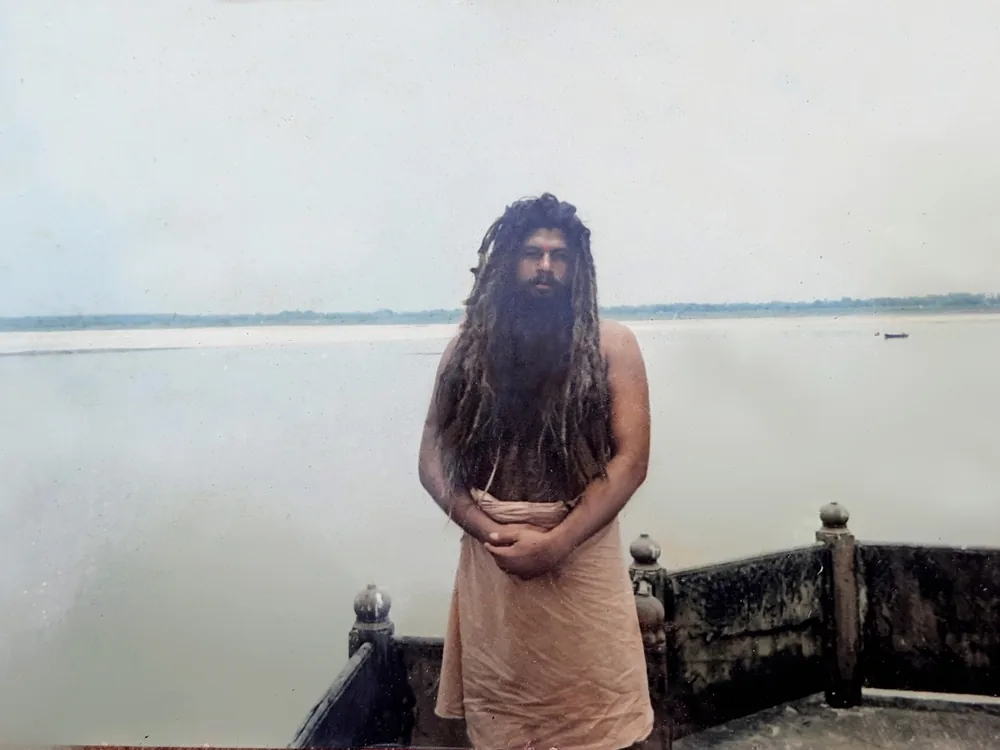
The Ganga years, around 1996
गंगा तट के वर्ष, लगभग 1996
Do not give anger a second thought.
क्रोध को दूसरा विचार मत दो।
His practical instruction on anger. Catch it before the sentence leaves your mouth and put the naam there instead. Anger that is not fed burns out in seconds; anger that is argued with grows.
Anger, and the two seconds you actually have
His instruction on anger is unusually specific, and it is not the one people expect. He does not tell devotees to be calm, to understand the other person, or to look for the fault in themselves. He tells them to catch the thing before the sentence leaves the mouth, and to put the name in that gap instead.
The reasoning rests on an observation anyone can check. Anger that is not fed burns out fast, within seconds, because it has no fuel of its own. What extends it is the second thought: the justification, the recollection of the last time, the reply being drafted while the other person is still talking. Every one of those is a fresh supply, and the fire runs exactly as long as the supply lasts.
This is why he does not ask you to decide whether the anger was justified. That question is itself a second thought, and by the time you have answered it you have been feeding the fire for a minute. Whether you were right is a separate matter that can be examined later, in a cooler hour, with better judgement than you have available while your pulse is up.
He is not teaching suppression, and he says so plainly. Swallowing anger and carrying it around is worse, not better; it comes out later, at somebody unrelated, usually at home. The instruction is to interrupt the loop at the point where it is still cheap to interrupt, which is before speech, not after it. Once the words are out the situation has changed and you are managing damage rather than anger.
The commonest report from devotees who try it is that they miss the window repeatedly at first and only catch it afterwards, sometimes an hour afterwards. He treats that as normal progress rather than failure. Noticing late is the same skill as noticing early, arriving slowly, and the interval shortens on its own with practice. Nobody catches it on the first day.
What it asks of you is one substitution, held for two seconds. When the heat rises, do not compose the reply and do not weigh the injustice. Take the name, let the two seconds pass, and speak afterwards if there is still something worth saying. Most of the time there is considerably less than there was.
The rest of his most repeated sayings are on the quotes page, the teaching they belong to is set out on the teachings page, and the questions devotees bring him about anger, money, family and grief are answered on the questions answered page.
Questions about this photograph
What is Premanand Ji Maharaj doing in this photo?
Premanand Ji Maharaj as a young ascetic with long matted hair on the bank of the Ganga at Varanasi around 1996.
What wallpaper sizes does this photo come in?
One, 1000 × 750, in the shape this picture was taken in. It is a WebP, which every current phone and browser opens, and it is cropped from the face outward so nothing important sits under a clock or a status bar.
Where did this photograph come from?
It comes from Wikimedia Commons under a CC0 public domain dedication, which means anyone may use it for anything. If you hold rights in it, write to us and it comes down the same day.
Is this photo free to download and share?
Yes. There is no fee, no account and no email address to hand over. Share it for personal devotional use as much as you like. Please do not sell it, print it for sale, or attach it to anything asking people for money in his name.
How do I set it as my phone wallpaper?
Tap the phone download button, let the image open, then press and hold it and choose save. Open your gallery, find the picture and set it as wallpaper from there. On an iPhone use the share button and Save Image first.
Can I share it straight to WhatsApp or Instagram?
Yes. On a phone the share button opens your own share sheet with the picture attached, so it goes across as an image rather than as a link. On a desktop the same button offers WhatsApp, Facebook, X, Telegram and a copy-link option.