
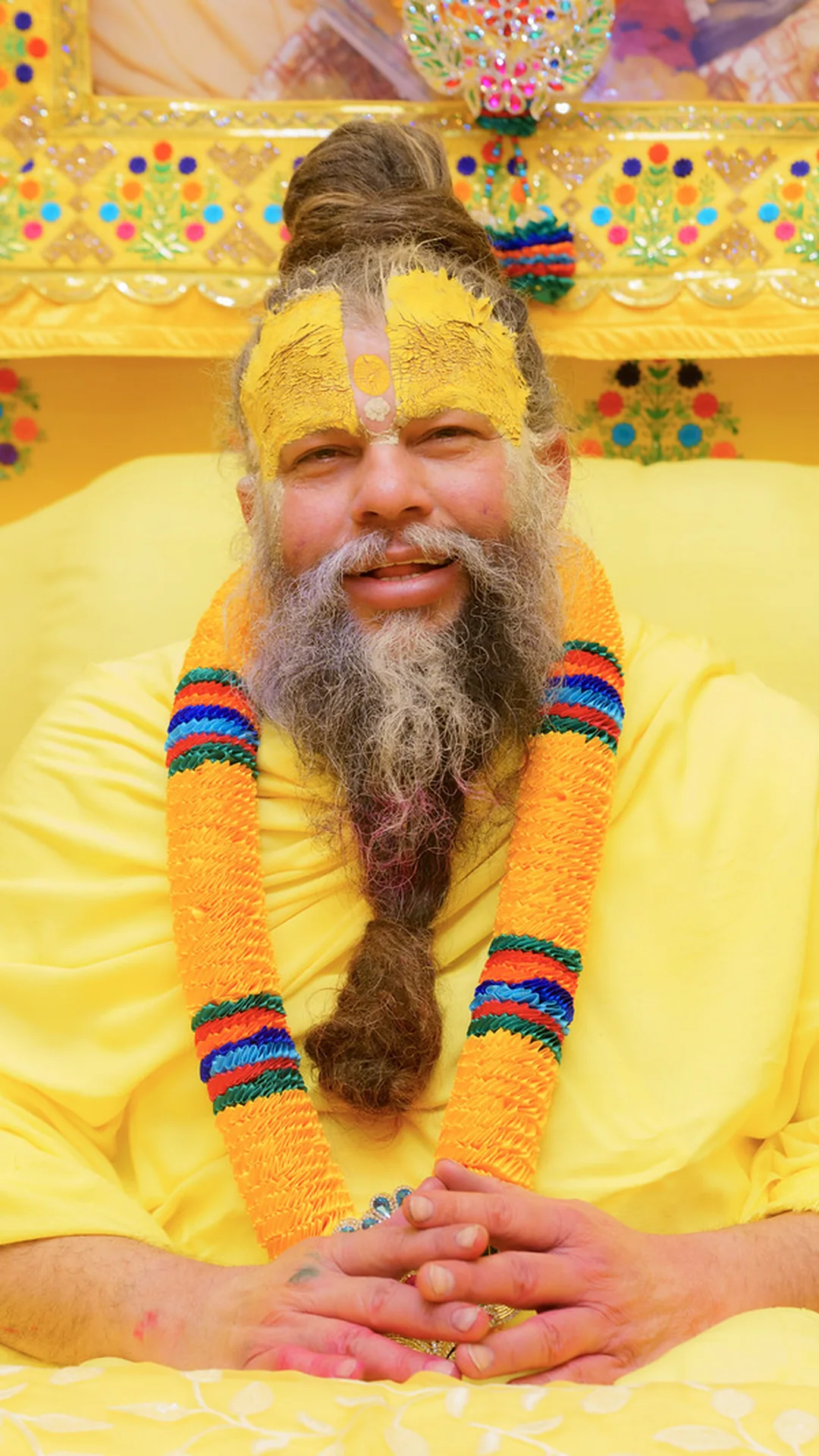
On the asan at Radha Keli Kunj
राधा केलि कुंज में आसन पर

The mind is not your enemy, it is only untrained.
मन शत्रु नहीं है, केवल अनुशासित नहीं है।
He refuses the framing where the mind must be defeated. An untrained mind chews whatever it is handed, and at two in the morning you are the one handing it the problem. The work is substitution, not war.
The mind is not the enemy. It is only untrained
Devotees regularly describe the mind as something to be defeated, and he declines the framing every time. An enemy has intentions. The mind does not. It is a faculty that chews whatever it is given, continuously, with no capacity to decide that a subject is not worth the labour, and it has been doing that since long before you took an interest in it.
He usually makes the point by asking where the material comes from. At two in the morning, when the same conversation is running for the ninth time, nobody else is in the room supplying it. You handed it over, several hours ago, and the mind did precisely what it does with anything handed to it. Calling that an attack misreads a machine as an opponent.
The reason the distinction matters is that the two diagnoses produce opposite treatments. If the mind is an enemy, the response is force: suppress the thought, refuse it, wrestle it down. Everyone who has tried this knows how it ends. Attention placed on not thinking about something is still attention placed on it, so the effort feeds the thing it was meant to starve.
His alternative is substitution rather than suppression. You do not empty the mind, because it will not stay empty and was never built to. You give it different work. The naam is offered here as something the mind can hold indefinitely without exhausting, and the practice is simply the act of putting it back into those hands each time you notice they are empty.
He is also realistic about how often that will be necessary. People come back reporting that the mind wandered a hundred times in ten minutes and treat it as evidence of failure. He treats it as evidence of an untrained faculty behaving normally, and points out that noticing the hundredth wandering is itself the training working. The lapse is not the problem. The self-recrimination that follows the lapse is, because it is one more thing to chew.
What it asks you to do is small and unglamorous. When you catch the mind mid-loop, do not argue with it, do not analyse why it went there, and do not grade yourself. Put the name back and carry on with whatever you were doing. Repeated over months this changes the default, and the default is the only thing that ever really changes.
The rest of his most repeated sayings are on the quotes page, the teaching they belong to is set out on the teachings page, and the questions devotees bring him about anger, money, family and grief are answered on the questions answered page.
Questions about this photograph
What is Premanand Ji Maharaj doing in this photo?
Premanand Ji Maharaj seated on his asan in yellow robes before a decorated backdrop at Shri Hit Radha Keli Kunj, Vrindavan.
What wallpaper sizes does this photo come in?
Two: 1920 × 1080 for a desktop or laptop and 1080 × 1920 for a phone. Both are WebP, which every current phone and browser opens, and each is cropped from the face outward so nothing important sits under a clock or a status bar.
Where did this photograph come from?
It was supplied to this site for devotee use rather than taken from a recording. If you hold rights in it, write to us and it comes down the same day.
Is this photo free to download and share?
Yes. There is no fee, no account and no email address to hand over. Share it for personal devotional use as much as you like. Please do not sell it, print it for sale, or attach it to anything asking people for money in his name.
How do I set it as my phone wallpaper?
Tap the phone download button, let the image open, then press and hold it and choose save. Open your gallery, find the picture and set it as wallpaper from there. On an iPhone use the share button and Save Image first.
Can I share it straight to WhatsApp or Instagram?
Yes. On a phone the share button opens your own share sheet with the picture attached, so it goes across as an image rather than as a link. On a desktop the same button offers WhatsApp, Facebook, X, Telegram and a copy-link option.