
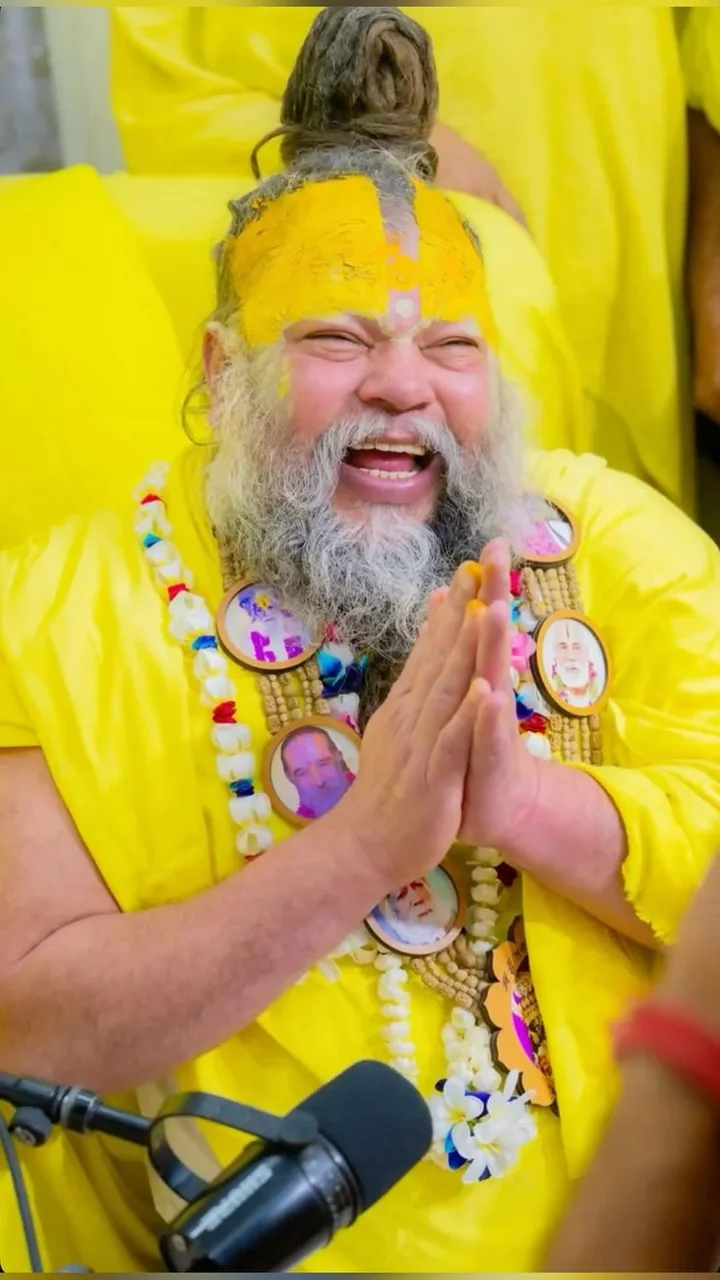
Hands folded beside the microphone
माइक्रोफ़ोन के पास हाथ जोड़े हुए
Keep the practice running through the doubt. Certainty arrives behind it.
संदेह में भी जप चलता रहे, निश्चय बाद में आता है।
On wavering faith, which he treats as ordinary rather than shameful. Certainty comes after the practice, not before it.
Keep going through the doubt
Doubt arrives in every long practice, and he does not treat it as a spiritual emergency. Sooner or later a devotee wonders whether any of this is true, whether the years have been spent on nothing, and whether the people around them at satsang have simply agreed to believe something together. He has heard it many times and he does not react to it as a betrayal.
What he refuses is the demand hidden inside it. Devotees want the doubt resolved before they will continue, and they want the resolution to come from him, in the form of an argument or a proof. He declines to supply that. Certainty produced by somebody else's reasoning lasts until a better argument comes along, which is not a foundation anybody should build a practice on.
His instruction is to let the doubt run and keep the practice running underneath it. The two can coexist; they do coexist, in most people, for long stretches. Nothing about taking the name requires you to have first settled a metaphysical question, and waiting for the question to settle guarantees only that the years pass without practice as well as without an answer.
He points out where the certainty people eventually have actually came from, and it is never an argument. It came from a long stretch of continuing, and from noticing afterwards that they had become someone they were not before: slower to anger, easier to live with, less afraid of the night hours. That is evidence of a kind, gathered from your own life, and it is not available to somebody who stopped in order to think.
There is also a practical observation about when doubt tends to appear. It arrives most reliably during dry periods, exhaustion, and after a loss, which are precisely the times judgement is least reliable. He is not saying the doubt is illegitimate. He is saying that the hour it turns up in is a poor hour for making a permanent decision, and permanent decisions is what people want to make in it.
What it asks of you is to separate two things that feel like one. You are not required to believe anything today. You are only required to do the same small thing you did yesterday, while the question stays open for as long as it stays open. If an answer arrives it will arrive behind the practice rather than in front of it, which is the order he says it always comes in.
The rest of his most repeated sayings are on the quotes page, the teaching they belong to is set out on the teachings page, and the questions devotees bring him about anger, money, family and grief are answered on the questions answered page.
Questions about this photograph
What is Premanand Ji Maharaj doing in this photo?
Premanand Ji Maharaj with hands folded beside the microphone at Shri Hit Radha Keli Kunj, Vrindavan.
What wallpaper sizes does this photo come in?
One, 720 × 1280, in the shape this picture was taken in. It is a WebP, which every current phone and browser opens, and it is cropped from the face outward so nothing important sits under a clock or a status bar.
Where did this photograph come from?
It was supplied to this site for devotee use rather than taken from a recording. If you hold rights in it, write to us and it comes down the same day.
Is this photo free to download and share?
Yes. There is no fee, no account and no email address to hand over. Share it for personal devotional use as much as you like. Please do not sell it, print it for sale, or attach it to anything asking people for money in his name.
How do I set it as my phone wallpaper?
Tap the phone download button, let the image open, then press and hold it and choose save. Open your gallery, find the picture and set it as wallpaper from there. On an iPhone use the share button and Save Image first.
Can I share it straight to WhatsApp or Instagram?
Yes. On a phone the share button opens your own share sheet with the picture attached, so it goes across as an image rather than as a link. On a desktop the same button offers WhatsApp, Facebook, X, Telegram and a copy-link option.